
Whole House Renovation Cost: Room-by-Room Prices and Planning Tips
Whole house renovation cost can often be daunting, as costs can easily run up and exceed the original budget. Unplanned repairs, unexpected changes in material costs, and additional fees can make planning even more stressful. Knowing the full home renovation cost will allow you to prioritize and prevent any unwanted expensive surprises. This guide covers room-by-room costs, remodeling factors, hidden costs, budgeting tips, and realistic ranges.
How much does a complete house renovation cost?
The most reliable government data on renovation spending comes from the 2023 American Housing Survey (AHS), jointly produced by the U.S. Census Bureau and the U.S. Department of Housing and Urban Development (HUD). According to this survey, American homeowners spent a combined $827 billion on home improvements between 2021 and 2023, with a median project cost of $6,500 per homeowner.
Costs vary sharply by project type. The AHS reports these median expenditures per project:
Kitchen remodels: $8,000 (totaling $26.6 billion nationally across 7.9 million projects)
Roofing: $10,000 (totaling $20.9 billion across 4.6 million projects)
Bathroom remodels: $5,000 (totaling $68.9 billion across 7.5 million projects)
HVAC replacement: $5,500 (totaling $32.8 billion across 3.9 million projects)
Doors/windows: $2,800 (totaling $51.0 billion across 10.9 million projects)
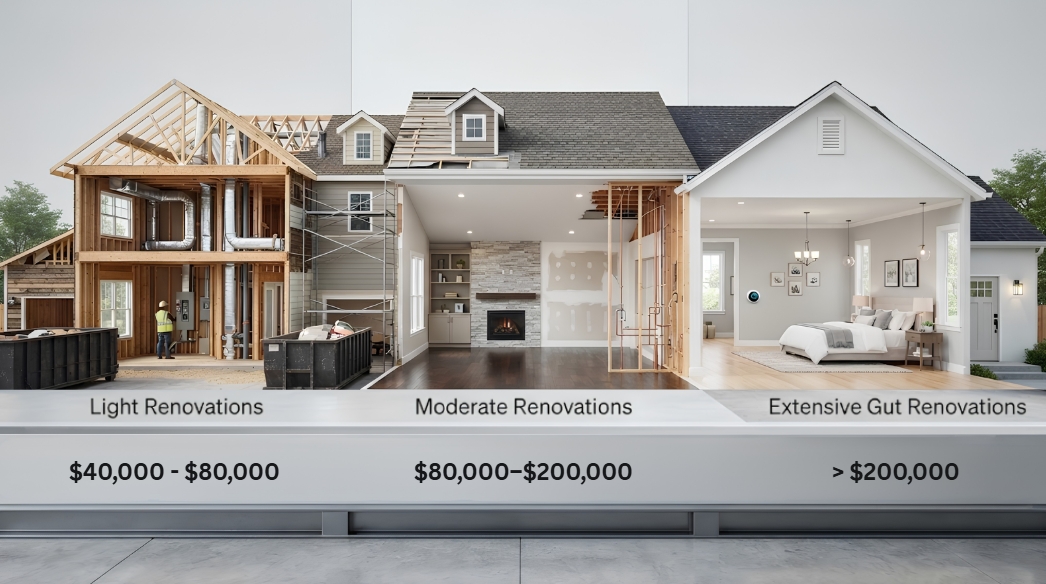
Breaking down costs by room (Where your budget actually goes)
Kitchen renovation cost
When you're looking at home remodeling, kitchen remodeling can take up a significant amount of the budget, as cabinetry is where the majority of the money goes. Budget updates can run from $10,000 to $25,000, and mid-range updates can cost between $25,000 and $65,000, including new cabinets and appliances. Premium kitchens can go over $150,000, and custom cabinetry alone ranges anywhere from $30,000 to $80,000 based on materials used.
Bathroom renovation cost
Bathroom remodeling expenses can really fluctuate as fixtures, tile, plumbing alterations, and waterproofing can add up. The average price of powder rooms is $5,000 to $15,000, and the average cost for a full bathroom remodel is $15,000 to $35,000. Master bathrooms can cost $80,000 or more, and tile work and walk-in showers add $3,000 to $12,000.
Bedroom updates
When the changes are just to surfaces, lighting, and simple fixtures, bedroom renovations typically cost less. Basic projects range from $2000 to $ 6,000, and the mid-range u$ 6,000,s start at $6000 and up, often including windows or closet improvements.
Living room and common areas
Whether you're looking to update finishes or rearrange the living room layout will make a significant difference in the cost. Cosmetic changes can cost from $3,000 to $8,000, nd hardwood floors and built-ins mid-range projects can cost as much as $20,000. Removing load-bearing walls and obtaining engineering, permits, and reinforcement can cost more than $50,000 for open-concept conversions.
Basement/Attic finishing
Building up is costly, and basement and attic finishing can provide valuable living space without it. Basic finishes range from $10,000 to $25,000, and in the mid-range, finishes can jump up to $50,000 with better flooring, walls, and lighting. Finishing often costs $30 to $80 per square foot, and a finished suite with a bathroom can cost more than $100,000.
Exterior upgrades
Exterior improvements affect the renovation budget, weather protection, windows and doors, roofing, and landscaping needs. Cosmetic improvements can range from $5,000 to $15,000, and siding, windows, and garage doors can add up to $40,000. The average cost for an exterior remodel is $100,000 or higher; roofing costs $4-$11 per square foot, and siding costs $5,000-$17,000.
What factors affect the cost of home renovation?
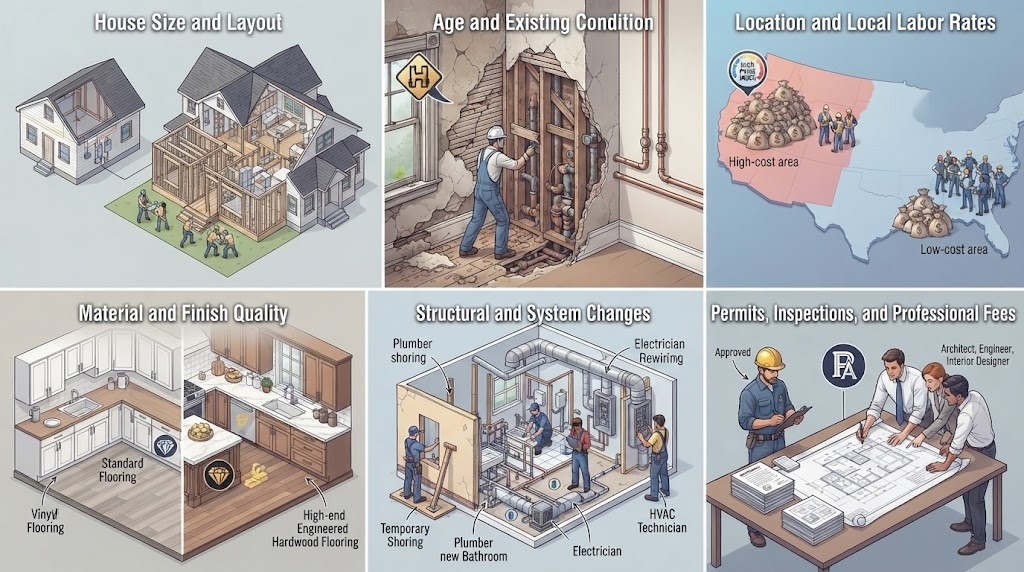
There are many factors that affect the cost to renovate an entire house. Some of the key factors are discussed below:
House size and layout: The larger the house, the more materials, labor, and installation time it will take. Complicated designs can also make renovations very costly.
Age and existing condition: It is possible that older homes will require repairs prior to upgrading. Costs may be higher than the initial renovation estimates because of hidden damage.
Location and local labor rates: Renovation prices vary considerably by region and market conditions. Higher labor rates can raise overall project costs quickly.
Material and finish quality: Standard materials are generally cheaper than higher quality materials. You can add custom finishes, fixtures, and cabinetry to your overall budget.
Structural and system changes: Moving walls or changing plumbing requires specialized work. Electrical, HVAC, insulation, and structural upgrades can add substantial expenses.
Permits, inspections, and professional fees: Most major renovations require permits and inspections. Architects, engineers, designers, and other specialists can further increase project costs.
Hidden costs to include in your full house renovation cost
A house remodel can be a lot more expensive than the contractor estimates due to hidden costs. There are additional fees that may occur, such as permit and inspection fees, design services, demolition, debris removal, and material delivery. Costs that may be incurred with large projects include temporary utilities, site requirements, and accommodation, which can also be significant. Planning contingencies are usually 10%-20% but can be higher or lower depending on the complexity. Older homes and unknown conditions might necessitate a bigger reserve in case of unexpected problems.
How to calculate a realistic whole house renovation cost?
Step 1: Define the renovation scope
Begin by compiling a list of all of the renovation work – cosmetic or major structure changes. Distinguish between necessary repairs and desirable improvements to make the project's needs more apparent. Cover kitchens, bathrooms, electrical, plumbing, HVAC, roofing, flooring, and exterior. This provides a real basis for cost planning.
Step 2: Establish a budget range
After determining the scope, determine a realistic budget range based on the complexity of the project. Take into account the size, location, condition, labor costs, and materials you will use on your home. After that, set aside extra money for unforeseen repair needs, permits, design services, and more that the contractors might not have thought about.
Step 3: Prioritize must-haves
Not all renovation upgrades require immediate attention, particularly if there is a set budget. Prioritize improvements that impact safety, function, energy efficiency, and/or structure. Then prioritize aesthetic improvements based on value, need, and usefulness to enhance your home's day-to-day function.
Step 4: Get multiple detailed quotes
Get quotes from multiple reputable contractors before you make a decision on your renovation. Labor, materials, permits, demolition, disposal, and other project costs should be clearly delineated in each estimate. When comparing itemized proposals, you can see exactly how different the prices are and steer clear of surprises down the road.
Plan electrical and energy upgrades during a whole-home renovation
When renovating, planning for electricity and energy upgrades can help to increase efficiency, resilience, and long-term value. The EcoFlow OCEAN Pro Solar Battery System offers grid-tied whole-home backup for electrical upgrades. Shifting electricity use around time-of-use rates can be achieved by battery storage and energy management. The EF-PCS-24 inverter can output up to 24 kW, and storage can be expanded up to 160 kWh. These improvements can help you simplify the process and save money on your project over time. Energy management can also optimize energy resilience and help reduce electricity costs over time. For tips on how to build a solar-ready new home, you can visit here!

Conclusion
Effective full house renovation cost planning begins with realistic budgeting, prioritizing, and a contingency plan for unexpected issues. Knowing the cost of each room will enable you to allocate your budget appropriately without any unwanted surprises. When thinking about upgrading, think about incorporating energy solutions, like a home backup battery, for whole-home backup, energy resilience, and smarter energy management. These upgrades, when integrated with renovation projects, can enhance your home's comfort, efficiency, and overall value.
Get Your Free Home Energy Consultation!
Which energy solution are you interested in?

FAQs
What is the 30% rule for renovations?
The 30% renovation rule suggests limiting remodeling expenses to roughly 30% of your home's current market value. This guideline helps prevent over-improving while keeping renovation spending aligned with local property values and resale returns. Calculate this limit by multiplying market value by 0.30, including labor, materials, permits, and unexpected expenses.
Is $100,000 enough to renovate a house?
Yes, $100,000 can fund a substantial mid-range renovation when the home's structure and major systems remain sound. It can cover kitchens, bathrooms, flooring, painting, and fixtures, with an EcoFlow Ocean Pro Solar Power Battery System planned. However, gut renovations, additions, structural changes, or major system replacements can quickly exceed this budget significantly.
What is the most expensive part of a whole house renovation?
The kitchen is the most expensive area because cabinetry, appliances, countertops, plumbing, and electrical work add costs. Bathrooms often follow because waterproofing, tile, fixtures, and plumbing require specialized labor and materials for many projects. Planning electrical upgrades alongside renovation work can also accommodate an EcoFlow OCEAN Pro Solar Battery System efficiently.

