
How is Electricity Made? From Energy Sources to Your Home
Every time you flip a light switch, you tap into a century-old energy system. Most households remain at the mercy of this linear grid, with little say over how their power is produced, priced, or delivered. This guide breaks down the core science of how electricity is made, contrasts fossil fuels, nuclear power, and renewables, and charts the journey from power plant to outlet. Finally, discover how rooftop solar and modern home battery storage put energy independence directly into your hands.
How Is Electricity Generated?
Electricity is the flow of electric charge. At the atomic level, every atom has a nucleus containing protons (positive charge) and neutrons (no charge), with electrons (negative charge) orbiting around it. When outer electrons gain enough energy to leave their atoms and move freely from one atom to another, an electric current is created.
Most electricity generation works through electromagnetic induction. When a conductor moves through a magnetic field, or a magnetic field moves past a conductor, a voltage is induced, and electrons begin to flow. In practical terms, this almost always means spinning a turbine connected to a generator. The turbine turns a rotor inside a set of wire coils surrounded by a magnetic field. That motion forces electrons to move through the coils, producing electric current.
How is electricity generated from different energy sources?
While electromagnetic induction remains the primary mechanism for generating electricity, the mechanical input used to turn the turbine varies widely across generation technologies.
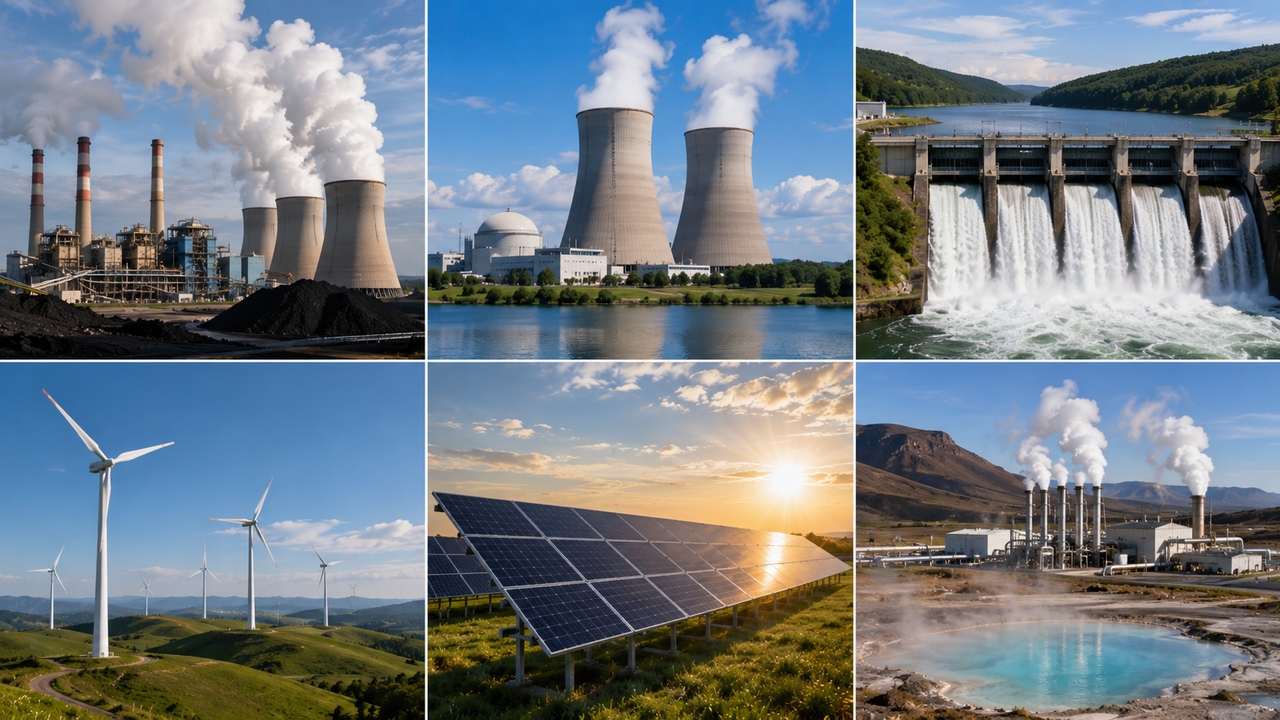
Energy Source | How It Generates Electricity |
|---|---|
Fossil Fuels (Coal, Natural Gas, Oil) | Fuel combustion boils water inside a pressurized boiler to produce high-pressure steam. This steam expands through turbine blades, forcing the shaft to rotate the generator. |
Nuclear Power | Heavy atomic nuclei (typically Uranium-235) undergo controlled nuclear fission inside a reactor core. The reaction releases intense thermal energy that heats water into high-pressure steam, spinning a turbine generator. |
Wind & Hydroelectric | Moving fluids turn turbine blades directly. Wind pushes aerodynamic turbine rotors; water stored behind a dam or running in a river rushes down a penstock to spin hydraulic water turbines. |
Solar Photovoltaic | Solar cells absorb sunlight photons, dislodging electrons within a semiconductor layer (silicon) to create direct current. No turbine or generator required. |
How electricity travels from the grid to your home
Generating electricity at a power station is only half the journey. Getting that energy into your wall outlets requires a multi-stage distribution highway:
Power plant: Power plants generate electricity by converting energy from fuels, nuclear reactions, moving water, wind, or sunlight into electrical energy that can enter the power grid.
Step-up transformer: A step-up transformer increases electricity's voltage, allowing it to travel long distances through transmission lines with lower energy losses during transportation.
Transmission lines: High-voltage transmission lines carry electricity across long distances from power plants to regional substations, connecting major generation facilities with cities, communities, and local distribution networks.
Substation: At a substation, transformers reduce electricity's voltage, and equipment directs power into local distribution networks, preparing it for delivery to nearby homes and businesses.
Distribution lines: Distribution lines carry lower-voltage electricity from substations through neighborhoods, bringing power closer to individual homes, businesses, and other buildings connected to the local grid.
Final transformer and your home: A pole-mounted or pad-mounted transformer reduces voltage to a level suitable for residential use, allowing electricity to safely enter your home's electrical panel and power appliances.
The green shift: how solar energy becomes electricity
Solar power takes a different approach to electricity generation. Instead of burning fuel or using moving water or wind to spin a turbine, solar panels convert sunlight directly into electrical energy.
The photovoltaic effect
Solar panels contain photovoltaic cells made from semiconductor materials such as silicon. When sunlight hits these cells, photons transfer energy to electrons, causing them to move and creating an electrical current. This process is called the photovoltaic effect.
Direct Current (DC) to Alternating Current (AC)
Solar panels produce direct current (DC) electricity, while most household appliances use alternating current (AC). A solar inverter converts the panels' DC electricity into AC electricity that can be used throughout your home.
The basic process is: Sunlight → Solar panels → DC electricity → Inverter → AC electricity → Home
Maximizing solar energy with battery storage
Generating solar electricity is only part of the equation because your panels don't produce the same amount of power all day. Production typically drops in the evening and stops overnight.
A home battery can capture excess solar electricity when production is high and store it for later. You can then use that stored energy when solar output is low, helping increase solar self-consumption and reduce reliance on grid electricity.
What Happens to Solar Electricity Generated at Home?
When electricity flows through a home system, it follows one of several paths depending on equipment configuration:
Use it immediately: In a standard grid-tied setup with no storage, electricity is consumed in real time by whatever loads are running in the home.
Export excess solar electricity: Under a traditional grid-tied solar system, any unused power is automatically sent back to utility, often for credit through net metering. The homeowner has little control over this process. It is simply the default when no battery is present.
This is where most homes get stuck. Without storage, solar power you generate at noon and don't use immediately is gone, sent back to the grid instead of saved for when you actually need it. Two more paths open up once a home battery enters the picture:
Store electricity in a home battery: Instead of sending cheap surplus power to the utility, excess midday solar production is routed into a dedicated residential battery storage system.
Use stored energy later: When the sun sets, when utility time-of-use (TOU) rates spike, or when severe weather causes a blackout, the home draws on its stored battery reserves rather than expensive or unavailable grid power.
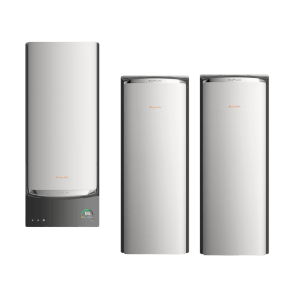
This is the gap that a system like the EcoFlow OCEAN Pro Solar Battery System is built to close. Rather than leaving homeowners with immediate use or automatic export as the only two options, OCEAN Pro adds real control over how and when generated electricity gets used.
OCEAN Pro is an all-in-one home energy ecosystem that combines solar, battery storage, and multi-source backup in a single system. It accepts up to 40 kW of solar input and scales from 10 kWh to 80 kWh of storage, so the battery capacity can grow alongside a household's needs. On the output side, it delivers 24 kW of continuous power, enough to run demanding loads like multiple HVAC units, a pool pump, or an EV charger at the same time.

Get Your Free Home Energy Consultation!
Which energy solution are you interested in?

Conclusion
Electricity is made primarily through generators driven by spinning turbines or through direct solar photovoltaic conversion. However, the traditional centralized grid leaves homeowners with virtually no agency over where their power originates, what it costs, or how reliably it arrives. Modern home systems like the EcoFlow OCEAN Pro rewrite that dynamic, empowering you to generate clean energy on-site, store surplus power, and control household usage. Ready to build true energy independence? Schedule a free consultation with an energy expert to learn more and receive your personalized quote.
FAQs
What supplies 80% of all energy in the world?
Fossil fuels, including oil, coal, and natural gas, supply roughly 80% of the world's primary energy. These fuels remain dominant globally, although renewable energy sources continue expanding their share of total energy consumption.
What is the main source of electricity in the US?
Natural gas is the largest source of electricity generation in the United States. It powers turbines directly or produces steam, which drives generators. Nuclear, coal, wind, solar, and hydropower provide the remaining generation.
How to produce electricity step by step?
Most power plants burn fuel or use nuclear fission to heat water into steam, spinning a turbine and generator. That motion induces an electric current, which travels through transformers and power lines to homes safely.

