
How to Choose the Best Level 2 EV Charger For Your Home Charging
Transitioning to an electric vehicle is an exciting milestone. It offers incredible benefits for your daily commute and your wallet. However, relying on public charging stations can quickly become a massive headache. You bought your car to save time and money. Eliminating range anxiety means bringing the fuel station directly into your own garage. You need a dedicated, high-speed home solution. But not all home charging setups are created equal. Some will barely give you enough juice to get to work. Others will completely transform how you manage your vehicle and your home electricity bills. If you want to optimize your daily drive and cut down on downtime, finding the best level 2 EV charger is the most impactful upgrade you can make. This guide will help you find the perfect system.
Understanding the Different Charging Levels (The Buyer's Perspective)
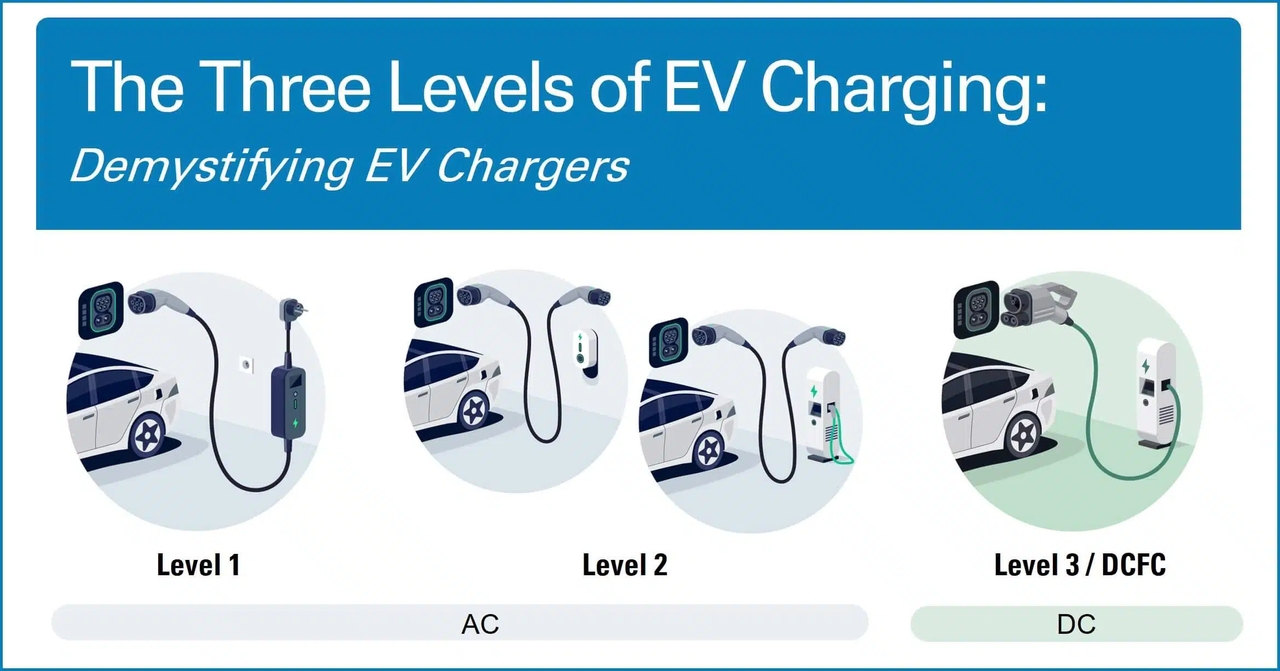
When you start setting up your home garage, you must first cross off the wrong options. Many new car owners feel totally lost looking at the different hardware tiers. You might be asking yourself, "What is a level 2 EV charger exactly?" If you want a deep dive into the specifics, our level 2 EV charger guide is an excellent resource. For now, let us look at how these different chargers actually perform in the real world.
Level 1 (120V): The Slow Drip
Every electric vehicle usually comes with a basic charging cord. This cord plugs right into a standard 120-volt household wall outlet. This is known as Level 1. While it is highly accessible, it is totally inadequate for daily commuters. Its extremely slow power output adds only 3 to 5 miles (4.8 to 8.0 km) of range per hour. If you arrive home with an empty battery at 6:00 PM, a Level 1 plug will not give you a full charge by the time you leave for work the next morning. It simply cannot keep up with a busy lifestyle. If you want to learn more about how standard household circuits handle power, you can read our home battery backup guide.
Level 2 (240V): The Residential Gold Standard
This is the only viable baseline for a premium home setup. A Level 2 unit uses a dedicated 240-volt electrical circuit. This is the exact same type of heavy-duty circuit that powers your electric clothes dryer or your oven. Because it has access to much more electricity, it delivers high-speed charging. This is the system that ensures you wake up to a 100% full battery every single morning.
Level 3 (DC Fast Charging): The Commercial Powerhouse
You have likely seen these massive stations along major highways. They use direct current (DC) to charge a car battery up to 80% in less than an hour. However, these ultra-fast units are strictly commercial solutions. Their massive power demands and extreme installation costs rule them out completely for residential garages. Your home electrical grid cannot support them.
Estimating Your Level 2 Charging Time: Average vs. Premium Output
Charging speed is one of the most critical factors when you are buying new equipment. You do not want to guess if your car will be ready for a morning road trip. You want absolute certainty. You want to know exactly when your vehicle will have the range you need.
This is where the difference between an average charger and a premium charger becomes very clear. Let us look at the details to see the real-world impact.
The Charging Formula: Your actual charging time depends on two main numbers. First, you must know your vehicle's total battery capacity. This is measured in kilowatt-hours (kWh). Second, you must know the charger's power output. This is measured in kilowatts (kW). When you divide your battery capacity by the charger output, you get a rough estimate of your total charging time.
Average Output Speeds: An average entry-level unit might only output 7kW of power. Let us say you drive a large electric truck or an SUV with a massive battery. That 7kW unit might take well over 10 to 12 hours to fill the vehicle from empty. That is simply too slow for many active families.
Premium Output Speeds: A premium model delivers a much more robust 11.5kW (48A) output. At this high output level, you can typically fully recharge a standard EV battery overnight in just 6 to 8 hours. You can expect to regain up to 46 miles (74.0 km) of range per hour of charging. This rapid speed keeps you confidently on the road. It ensures you are ready to go, no matter how much driving you did the day before.
Smart Power Management: Integrating this kind of high-capacity hardware into a broader Home Energy Ecosystem ensures your power is managed safely. It keeps everything running efficiently without overloading your home.
Key Benefits and Ideal Use Cases for Smart Home EV Charging
The true value of a premium charging station extends far beyond just raw power. It fundamentally changes how you manage your household expenses and your daily routine. The best level 2 EV charger for home use will actively help you save money.
The Lifestyle and Financial Benefits
Convenience is the biggest perk here. You wake up every single morning with a full battery. You never have to visit a gas station again. The money you save is a huge deal, too. Most power companies use Time-of-Use (TOU) rates. They charge you less for electricity at night because fewer people are using it. During the day, the price goes up. You can set your system to charge only during those cheap nighttime hours. This simple step cuts down your monthly power bill.
Ideal Scenarios and Use Cases
This home upgrade is highly valuable for several specific types of drivers:
Heavy Daily Commuters: If you exhaust more than 40 miles (64.3 km) of range per day, you absolutely need high-speed recovery. A standard wall plug will leave you with a constant range deficit by the end of the week.
Multi-EV Households: If you have two electric vehicles sharing a single garage, charging speed is everything. You need a powerful unit that can quickly top off one car in the evening and handle the second car overnight.
Extreme Climate Residents: Cold weather drains electric batteries much faster than warm weather. If you live in an area with harsh winters, you need the reliability of a powerful home-based station. Sitting at an outdoor public station in freezing temperatures is a miserable experience.
Are you ready to resolve your uncertainty about home EV charging? We can help you find the perfect energy solution for your property. Request a consultation today to speak with our experts.
Get Your Free Home Energy Consultation!
Which energy solution are you interested in?

Industry Average vs. The Best Level 2 EV Chargers
To truly understand what makes a charging station worth your money, it helps to put them side-by-side. We need to compare standard market offerings against top-tier models. Here is how an average unit stacks up against a premium option like the EcoFlow OCEAN EV Charger.
Power and Charging Time
The industry average for standard residential units hovers around 7kW to 9kW. While this is better than a wall plug, it is still middle-of-the-pack performance. In contrast, the best models deliver a much more robust 11.5kW (48A) output. This higher capacity translates to regaining up to 46 miles (74.0 km) of range per hour. It easily handles modern, large-capacity EV batteries without breaking a sweat.
Smart Connectivity and Automation
Average chargers offer very basic smartphone apps. They usually just let you start or stop the flow of electricity. The best chargers are much smarter. They utilize Intelligent Mode to automatically shift your charging sessions to off-peak nighttime hours. They come equipped with comprehensive connectivity options like Wi-Fi, Bluetooth, RS485, and CAN. They also feature clear, on-unit LCD displays. This advanced automation maximizes your financial savings without forcing you to manually schedule the plug-in routine every single day.
Whole-Home Ecosystem Integration
Standard chargers operate as isolated appliances. They pull power exclusively from the utility grid, meaning you are always paying the power company to fuel your car. Top-tier models are designed differently. They communicate directly with a broader smart home energy ecosystem. When paired with a system like the EcoFlow OCEAN Pro Solar Battery System, the charger can automatically prioritize using stored rooftop solar energy over expensive grid power. This accelerates your path to true energy independence.
Cable Reach and Maneuverability
The industry average often features rigid, shorter cables. These are usually around 16 to 18 feet (4.8 to 5.4 m) long. This strict limit dictates exactly how you must park your vehicle in the garage. Premium options solve this problem. The EcoFlow OCEAN EV Charger provides a premium 25-foot (7.5 m) pre-wired cable equipped with a universal SAE J1772 connector. This gives you maximum flexibility to reach the charging port whether you pull in forward, back in, or park outside in the driveway.
Physical Specifications and Durability
Durable hardware is absolutely essential, especially for outdoor driveway installations. Standard units are often bulky and wrapped in basic, cheap plastic casing that cracks in the sun. Premium units feature high weatherproofing and strict durability ratings. For example, the EcoFlow OCEAN EV Charger boasts a tough NEMA Type 4 enclosure and IK 10 impact protection. It is capable of operating flawlessly in extreme temperatures ranging from -22°F to 122°F (-30ºC to 50ºC).
Navigating Installation Costs and High-Voltage Requirements
Buying the hardware is only the first step. Because a 240-volt circuit draws a continuous, heavy electrical load, proper setup is critical to your safety. Your total installation cost will be split into two parts. You will pay for the hardware itself, and you will pay for professional labor.
Labor costs will fluctuate wildly based on your home's current electrical setup. Every house is different. If your home operates on an older 100-amp electrical service, you cannot just add a massive new charger to it. You will likely need a heavy-up electrical panel upgrade. This upgrade prevents tripped breakers and eliminates serious fire hazards.
It is vital to understand that high-voltage home wiring is absolutely not a simple project. It is not "plug and play." You cannot just buy the unit and screw it into the wall yourself. It requires a licensed professional electrician. Your electrician will handle the necessary load calculations to ensure your home can support the power draw. They will pull the required local permits from your city. Most importantly, they will ensure that the entire system complies with the National Electrical Code. Taking shortcuts with high voltage is never worth the risk. Always hire a professional to ensure your garage is completely safe.
Final Thoughts
Switching to an electric car is a great choice. But you need the right home charger to truly enjoy the switch. Picking a premium unit quickly pays off. You get much faster charging speeds. The tough hardware easily survives bad weather. Smart scheduling also saves you money automatically. Connecting the charger to your whole home energy ecosystem gets your garage ready for the future. You get a completely stress-free drive every single day.
FAQs
1. What is a level 2 EV charger?
It is a residential charging station utilizing a dedicated 240-volt circuit to deliver high-speed power to your electric vehicle. It offers significantly faster replenishment than a standard wall outlet, adding 15-46 miles of range per hour.
2. Can I install a Level 2 charger myself?
No. Installing a 240-volt circuit requires handling dangerous high-voltage wiring. It is never a DIY project. Always hire a licensed professional electrician to ensure full code compliance, prevent fire hazards, and guarantee your safety.
3. How much does a Level 2 EV charger increase my electric bill?
It depends on your driving habits and local rates. However, using a unit with Intelligent Mode, like the EcoFlow OCEAN EV Charger, automatically shifts your energy usage to cheaper, off-peak nighttime hours, significantly lowering your utility costs.
4. Do I need to upgrade my electrical panel for a Level 2 charger?
If your home has an older 100-amp service, you will likely need a heavy-up panel upgrade. This is required to safely support the continuous heavy load without tripping your breakers. A professional electrician can verify your capacity.
5. How fast does a Level 2 charger charge a car?
A standard unit usually gives you 15 to 30 miles of range per hour. A premium 11.5kW model is much faster. It adds up to 46 miles of range per hour. This speed lets you fully recharge most modern electric vehicles overnight in just 6 to 8 hours.

