
Understanding Power Ratings: How to Calculate Your Home's Backup Energy Needs
Every time you plug in a toaster, run the central air conditioner, or flip over a microwave to check the safety stickers on the back, you are interacting with electrical limits. But do you actually know what those numbers mean?
For most homeowners, electrical numbers are invisible details, until something goes wrong. Understanding power ratings is not just a lesson in physics; it is the ultimate practical tool for keeping your home safe.
In this guide, we will break down what power ratings are in plain, easy-to-understand terms. You will learn the golden formula you need to calculate power draw, how to decode the tiny spec labels on your household appliances, and how to transition from calculating individual appliance loads to choosing a robust, long-term whole-home battery backup system.
What is a power rating? (the core basics)
A power rating is the maximum amount of electrical power an appliance can safely consume or output under normal, continuous operating conditions. It tells you how much energy a device needs to do its job properly without overheating or failing.
To make sense of these ratings, you only need to understand two basic units of measurement:
Watts (W): This is the standard unit of measurement for electrical power. It represents the rate at which energy is consumed. For example, a standard LED light bulb might use 9 Watts, while a hair dryer might use 1,500 Watts.
Kilowatts (kW): For larger loads, we use kilowatts to keep the numbers manageable. One kilowatt is equal to 1,000 Watts (1 kW = 1,000 W). If a central AC unit pulls 5,000 Watts, it has a power rating of 5 kW.
The crucial distinction: rated vs. surge power
When looking at power ratings, especially for motor-driven appliances, you must understand the difference between these two types of power:
Rated (Continuous) Watts: This is the constant, steady-state power an appliance requires to run continuously after its initial startup. For instance, once a refrigerator is running and cooling, it draws its continuous rated wattage.
Surge (Starting) Watts: This is the temporary, high-power burst required for a split second to start up a motorized appliance or compressor. The motor needs extra "push" to get moving. For example, while a refrigerator might only need 400 Watts to run continuously, it may require a quick surge of 1,200 Watts just to start its compressor.
.
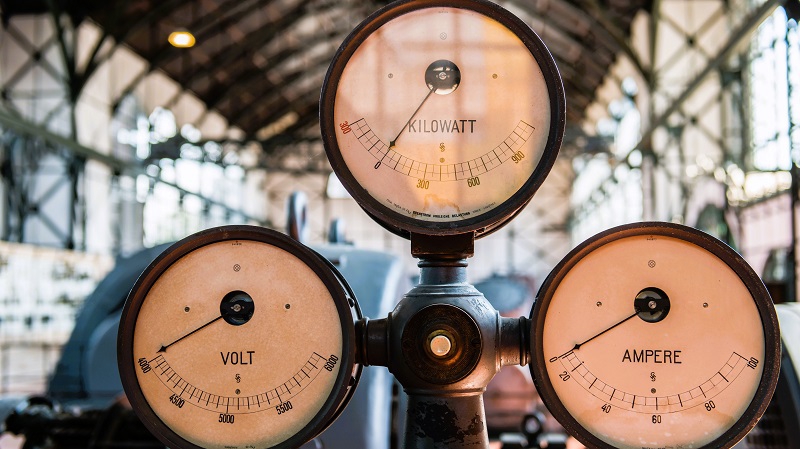
The golden power rating formula: how to calculate power rating
To calculate how much power an appliance is drawing, you only need one simple formula:
Watts = Volts x Amps
In a real-world setting:
Volts (Voltage): Think of voltage as the "electrical pressure" pushing electricity through the wires. In standard North American homes, standard wall outlets provide 120 Volts (120V), while heavy-duty outlets for clothes dryers or electric ovens provide 240 Volts (240V).
Amps (Amperage): Think of amperage as the actual "volume" of electrical current flowing through the wire at any given second.
A practical example
Imagine you have a portable space heater plugged into a standard 120-Volt wall outlet. The label on the heater states that it draws 12.5 Amps. How many Watts does it use?
Using our golden formula:
120 Volts x 12.5 Amps = 1,500 Watts
Your space heater has a power rating of 1,500 Watts (or 1.5 kW). Knowing this number helps you understand exactly how much capacity it is taking up on your home's electrical circuit.
Step-by-step guide: how to read the spec label on your appliances
Every electrical product sold is legally required to have a specification label. These are typically small silver stickers, engraved metal plates, or molded plastic text located on the back, bottom, inside the door frame, or on the power cord of the device.
To read and decode your appliance spec label, follow these steps:
Step 1: Locate the label
Find the physical plate on your appliance. On a microwave, check inside the door or on the back panel. On a refrigerator, look on the inner wall of the fresh food compartment.
Step 2: Scan for electrical symbols
Look for the basic electrical units: V (Volts), A or Amps (Amperes), and W (Watts).
Step 3: Perform mathematical calculation
Some appliance manufacturers only print the Voltage and Amperage on their labels to save space. If you do not see a "W" rating, simply multiply the listed Volts by the listed Amps to get your total wattage.
Example: A desktop computer monitor label reads: Input: 120V ~ 50/60Hz 1.5A.
Calculation: 120V x 1.5A = 180 Watts.
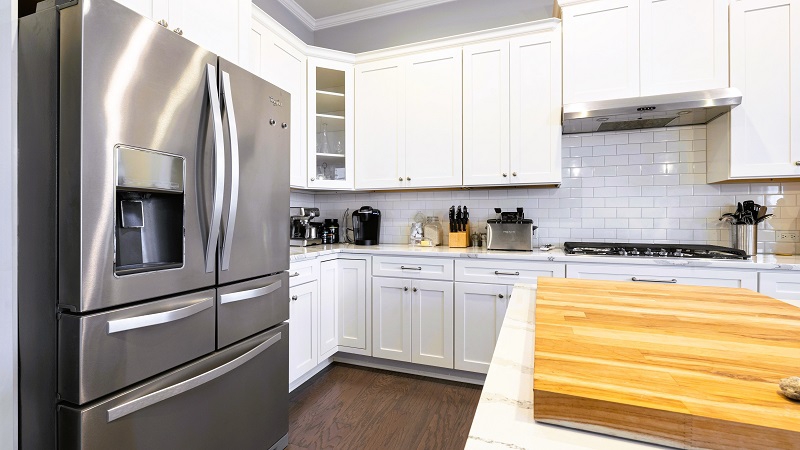
Quick reference: power ratings of popular home appliances
Because different appliances serve different functions, their power needs vary wildly. Heating elements and large electric motors pull the most power, while digital electronics and LED lighting pull the least.
Use this quick-reference table to estimate the continuous (rated) and starting (surge) wattages of common household appliances:
Appliance / Device | Typical Running (Rated) Watts | Typical Starting (Surge) Watts |
Central Air Conditioner (5-Ton) | 5,000 - 6,000 W | 10,000 - 12,000 W |
Electric Clothes Dryer | 4,000 - 5,400 W | 0 W (Minimal surge) |
Water Heater (Standard) | 4,500 W | 0 W |
Sump Pump (1/2 HP) | 1,050 W | 2,200 W |
Refrigerator / Freezer | 400 - 800 W | 1,200 - 1,600 W |
Microwave Oven | 1,000 - 1,500 W | 0 W |
Coffee Maker | 800 - 1,400 W | 0 W |
Toaster | 800 - 1,500 W | 0 W |
Flat Screen TV (60-Inch) | 60 - 150 W | 0 W |
Laptop Computer | 50 - 100 W | 0 W |
LED Light Bulb | 9 - 15 W | 0 W |
Powering and protecting your home with the EcoFlow Ocean Pro
Once you know the power ratings of your individual appliances, you can calculate the total load required to run your home during a power outage.
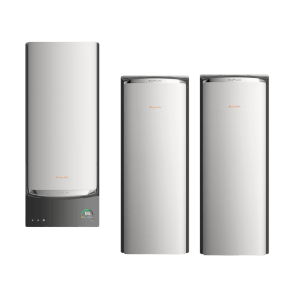
When your calculated electrical needs go beyond basic electronics, you need a heavy-duty backup power solution. This is where a high-capacity, highly durable home battery system like the EcoFlow Ocean Pro whole-home battery system comes in.

The Ocean Pro is engineered specifically to handle demanding whole-house electrical loads safely, without flickering, overloading, or shutting down.
24,000 Watts (24 kW) of continuous output: With 24 kW of robust, split-phase power delivery, the Ocean Pro can effortlessly power 100% of your home's heavy-duty appliances simultaneously. It can easily run HVAC units, pumps, electric cloth dryers, and other critical kitchen appliances, all at the same time.
205A LRA surge power: When heavy compressors, like those in large central air conditioners, kick on, they draw massive starting currents. The Ocean Pro features an exceptional 205A LRA (Locked Rotor Amps) starting capability, ensuring those heavy motors start up smoothly without tripping the battery's safety limit.
Scalable battery capacity: The system is modular, starting at a baseline of 10 kWh of energy storage and expanding all the way up to 80 kWh. This ensures you can scale your system to match your home's specific power consumption for days of continuous backup.
Get Your Free Home Energy Consultation!
Which energy solution are you interested in?
Conclusion
Understanding power ratings is the ultimate foundation for managing your home's energy. It takes guesswork out of household electricity, helping you avoid overloaded circuits and allowing you to make smart, informed decisions when sizing backup power systems.
When you are ready to secure your home against unpredictable power grids, rising electricity rates, and extreme weather, don't settle for low-capacity backups. Take charge of your backup power security with a smart, incredibly durable, and high-performance ecosystem like the EcoFlow Ocean Pro.
FAQs
What does a power rating of 1.5 kW mean?
It means the appliance consumes 1,500 Watts of electrical power. Common examples include space heaters, microwaves, and hair dryers, which use over 80 percent of a standard 15-Amp household circuit's safe capacity.
Is 2.5 kW a lot of electricity?
For a single appliance, yes; standard wall outlets cannot support 2.5 kW (2,500 Watts). However, for a whole home's total baseline load, 2.5 kW is a highly moderate, easily manageable amount of power.
Why does my appliance use less power than its stated power rating?
The labeled power rating represents maximum power draw for safety reasons. In everyday use, appliances like washing machines or refrigerators cycle their energy consumption, drawing significantly less power during normal operating cycles.
What happens if I plug an appliance with a higher power rating into a backup system or generator with a lower rating?
Doing this triggers the backup system's built-in overload protection, causing it to shut down immediately. To prevent damage, ensure your system's continuous output rating is higher than the combined wattage of active appliances.
Can I run standard 120V appliances and heavy-duty 240V appliances on the same backup battery system?
Yes, but only if your backup system supports split-phase output. Advanced systems like the EcoFlow Ocean Pro natively power both standard 120V and heavy-duty 240V appliances simultaneously without needing any external transformers.

