
How to Manage the Solar Energy for Home Cost Wisely
UK electricity bills have climbed sharply in recent years, and the national grid shows no sign of stabilising. For homeowners seriously considering solar, that ongoing pressure makes the switch feel urgent—but the upfront solar energy for home cost often stops people before they even request a quote.
Many figures are being thrown around with some sources citing £5,000 while others £15,000 or more without context. However, these numbers mean nothing if they don’t provide answers to these questions:
What exactly are you paying for?
Which parts of the system drive costs the highest?
Does the investment genuinely pay off?
Are you committing to a system that struggles through British winters?
This guide looks at:
The initial investment of home solar solutions
Assessing the long-term savings and payback timelines
Hidden solar energy for home obstacles and performance limitations
How to maximise your solar investment with future-proof energy technology
Modern home solutions you can implement to get the most out of your home solar investment
Unpacking the Initial Investment of Home Solar Solutions
Breaking Down the Key Cost Components of a Home Solar System
Solar energy cost for home installations cuts across three core areas:
Photovoltaic solar panels
The supporting structure such as home storage batteries
The electrical setup
Out of this solar energy cost for home, solar panels cost usually take the largest share of the hardware spend which is about 40-50% of the budget. The rest of the hardware costs is consumed by mounting systems, including roof brackets and railing. Their cost is determined by roof pitch and tile material.
The next driving factors in the solar energy cost for home are wiring, consumer unit modifications, and the inverters that convert DC output from the solar panels to usable AC electricity. Each component comes in quality tiers. So, any decisions you make at this point determine if you get an ROI on your solar investment or not.
Component Type | Average Percentage of Total Budget | Primary Performance Metrics |
Monocrystalline PV Panels | 35% – 45% | Output Rating (Wp), Efficiency (%) |
Solar Power Inverters | 15% – 20% | MPPT Efficiency, Lifespan (Years) |
Mounting & Structural Racking | 10% – 15% | Wind Resistance, Roof Load Capacity |
Electrical Balances & Cables | 5% – 10% | Voltage Drop, Weatherproofing Rating |
Why Quality Equipment Choices Impact the Initial Capital Outlay
Tier-3 panels and budget inverters are less costly, but perform less well and offer less warranty coverage. A panel which loses efficiency early exacerbates the situation with a limited irradiance in wintertime in UK climate.
Tier-1 components from proven manufacturers are more expensive at the start, but maintain output ratings longer, withstand temperature cycling more effectively and have 25-year product guarantees versus the 10-year equivalent of the less costly components. The price difference between mid-range and premium panels can be several hundred pounds per unit and is not that much compared to the long-term performance you're sacrificing by opting for the lower cost option.
Navigating Setup Fees and the Total Cost of Solar Energy for Home
Hardware costs are only a part of the total solar energy for home cost, other charges include:
MCS-certified installer labour
Scaffolding hire for roof access
Structural surveys if the property is older
Grid connection applications under G98 or G99 depending on system size
These are regulatory requirements and are not optional. Without MCS certification, you won’t access export incentives like the Smart Export Guarantee (SEG). On most projects scaffolding alone adds between £500 to £1,200. It’s crucial when preparing your cost of solar energy for home budget you include all these to avoid last minute surprises when you start your project.
Assessing Long-Term Savings and Payback Timelines
If you want to get the real value of your home solar project, measure it against the system’s savings over time. When calculating the ROI, consider your consumption habits, tariff, and how much of your generated electricity you actually use versus export.
Calculating Return on Investment Against Volatile National Grid Tariffs
Every unity of solar electricity you use in your household directly replaces one you would pay for from the grid. The current Ofgem electricity price cap is 24.67 p/kWh, and this is the amount you are saving if you are using solar. The current SEG export rates range from 5p/kWh to 25p/kWh depending on the supplier, and these figures are lower than the electricity import rates.
Note: To check the current electricity price cap and the current SEG export rates, always visit Ofgem’s official website
From these two figures one thing is clear, it’s cost-effective to consume your own solar electricity rather than selling it to the grid. Therefore, building your household appliances to consume electricity during daytime generation instead of pushing the surplus energy to the grid at a low-rate export tariff ensures you get most value from your solar installations.
How the Average Cost of Solar Energy for Home Varies by Property Type
Another crucial factor that impacts the average cost of solar energy for home installations is the property size. For example,
If you have a terraced house with limited south-facing space, a 3–4 kWp system is sufficient. This is usually installed for around £5,000–£7,000.
For a semi-detached property with better roof, a 4–6 kWp array that costs around £7,000–£10,000 to install is sufficient.
For detached homes with larger roofs and higher consumption, a 6–10 kWp system that costs around £12,000–£16,000 is sufficient.
Although these figures change with installer margin, equipment grade, and property-specific requirements, they provide a realistic starting range rather than a vague estimate.
Minimising the Breakeven Period with Strategic Energy Tracking
Monitoring your consumption closely is the best way to get your solar payback faster. Knowing which appliances consume most power in your household and shifting their use to solar peak hours (10am to 3pm), helps reduce grid imports noticeably. For example, using dishwashers, washing machines, and charging EV’s around midday reduces the amount of energy you import, keeping your electricity costs lower.
With real-time monitoring tools, you can know your total generated electricity and also your households consumption. These tools help identify waste patterns and therefore put you in a better position to fix this. This visibility also allows you to prevent excess solar generation from getting quietly exported to the grid at low rates and also prevents evening grid imports that cost higher.
What Solar Energy Costs Look Like for Different Types of Homes
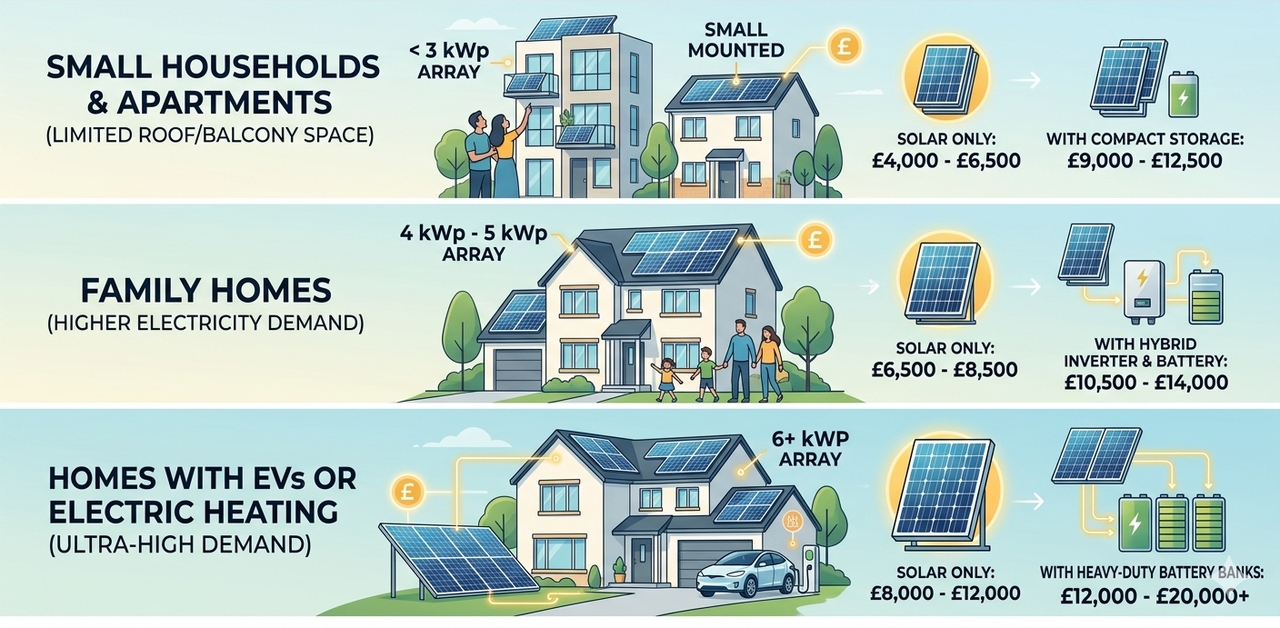
Small households and apartments
Smaller properties require proper optimisation of the limited roof or balcony spaces. Smaller arrays of under 3 kWp are sufficient for such properties and cost lower upfront costs ranging from £4,000 to £6,500 for a standalone panel installation. Adding a compact storage setup, the cost increases to the range of £9,000 to £12,500.
Family homes with higher electricity demand
Medium to large family properties have a higher solar energy for home cost because they require extensive solar arrays. A 4 kWp to 5 kWp system is sufficient for a three-to-four bedroom house with installation cost ranging between £6,500 and £8,500. If you add a hybrid inverter and a reliable storage battery to cover peak evening usage to the setup, the initial cost rises to anywhere between £10,500 and £14,000.
Homes with EVs or electric heating
Homes with EVs and electric heating consume more electricity. And this directly impacts the upfront solar energy for home cost. To cover this high energy demand, such households require solar arrays that are 6 kWP or higher with prices ranging between £8,000 to £12,000. If you incorporate high-capacity, heavy-duty solar battery storage banks that can handle overnight EV charging in this setup, the prices rise to ranges of between £12,000 to £20,000+.
Note: These prices are market estimates and are subject to change based on economic conditions, supply chain shifts, and regional installation factors. Because these external market forces fluctuate, we cannot guarantee these exact figures and recommend obtaining a personalized quote for current pricing.
Navigating Hidden Obstacles and Performance Limitations
A solar quote describes the system on a good day. What most salespeople skip past are the conditions that reduce performance over time—or remove it entirely.
Factoring Component Lifespans Into Your Long-Term Solar Energy for Your Home Cost
When calculating the solar energy for your home cost, also account for component replacement cycles. String inverters are common in residential installations and last for 10 to 15 years. This means that if you have a standard warranty of 25 years, replacement of this component is likely and can cost between £800–£1,500 depending on system size.
If you added battery storage to your setup it has its own degradation cycle depending on its chemistry. Lithium iron phosphate (LFP) chemistry lasts longer than the old lithium-ion formulation. However, in both expect capacity reduction across 3,000–6,000 charge cycles. Factor these costs into your total model upfront to avoid discovering them mid-ownership.
The Hidden Reality of Weather Dependencies and Winter Efficiency Losses
In the UK, the average peak sun hours range between 1.5 to 3.5 per day, depending on location and season. In some northern regions in the months of November and December this average falls below 1 hour. During these months, solar energy produced is a fraction of what you would normally get in summer months. This energy is not sufficient to run your household and therefore you are forced to rely on grid electricity. However, this is not a reason to avoid solar. All you need to do is plan around it. If you implement your solar solutions without proper storage or demand management, you are likely to get exposed to the grid between 4pm and 8pm each winter evening, which is where a significant portion of household energy spend sits.
Why Smart Infrastructure Influences the Final Solar Energy for Homes Cost
During outage, a standard grid-tied solar setup without storage cuts off completely when there is power outage. This is a regulatory requirement for protecting line workers from backfed electricity. When you include a hybrid inverter and battery storage in your setup, the solar energy for homes cost calculation changes. This configuration enables islanding (operating independently from the grid during outages). Also, this hybrid system allows time-of-use arbitrage, which means charging the battery storage using cheap overnight rates and discharging during peak pricing windows. This additional capability changes the long-term financial picture in ways a basic solar-only setup cannot match.
Maximising Your Solar Investment with Future-Proof Energy Technology
Identifying a system's weak points is half the work. The other half is selecting architecture that actively counters them—capturing more generation, cutting more import spend, and building in resilience that standard setups cannot offer.
Mitigating High Peak-Rate Charges by Storing Daytime Surplus Generation
One of the most frustrating challenges of grid-tied solar is generating surplus power at midday and then buying expensive electricity at 6pm. Physical battery storage helps prevent this problem. The batteries store excess daytime generation, allowing you to run high-draw appliances, such as ovens, heat pumps, dishwashers, using the power stored by the batteries.
Shifting from Simple Renewable Generation to Total Household Autonomy
Connecting storage to an EV charger, heat pump, and heating controls builds what functions as a private microgrid within the home. Instead of managing each system independently, implement a unified energy architecture for creating an integrated controllable source for solar generation, stored power, and grid imports. This move helps create a home energy ecosystem that’s optimised to consume less grid energy, limiting your exposure to tariff volatility.
Overcoming the Technical Inefficiencies of Rigid Traditional Solar Architecture
Older fixed solar installations operate on a simple rule: generate when there is sun, export what goes unused. They have no mechanism to respond to tomorrow's weather forecast, no ability to pre-charge ahead of an overcast spell, and no awareness of whether grid electricity is cheap or expensive at a given moment. That rigidity costs money continuously. Modern hybrid systems integrated with predictive software actively adapt—charging when power is cheapest, discharging when it is most expensive, and adjusting strategy based on forecast irradiance the following day.
Modern Home Solutions for Getting the Most Out of Your Solar Investment
Why the EcoFlow OCEAN 2 Single-Phase Battery System Maximises Your Solar Investment
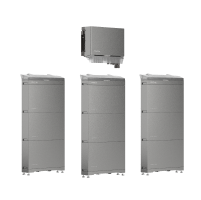
The main limitation of a solar only setup is that you lose your generation value because no one is at home to really use it. This is the pain point the EcoFlow OCEAN 2 Single-Phase Home Battery is built to address. The battery’s LFP chemistry ensures it handles the high-frequency charge-discharge cycling that comes with daily solar storage without degradation risk that affects older lithium-ion designs.
This home battery also comes with a 15-year warranty, giving you peace of mind of how long you can expect to get from the system. A 0ms switchover time means appliances keep running through grid outages, closing the resilience gap that standard grid-tied solar leaves wide open. The modular architecture allows you to expand capacity up to 30kWh as your household’s needs grow.

Achieving Greater Energy Independence and Lower Bills Using the EcoFlow Intelligent HEMS Platform
Solar hardware stores energy. Adding to this setup the EcoFlow Intelligent HEMS Platform further optimises your setup adding in another option of when the energy is consumed and ensures you get maximum ROI from your solar energy for homes cost investment. This platform connects directly with dynamic tariff providers, such as Octopus and Tibber, and has built-in AI-driven weather forecasting accurate to 90%. Therefore, it automates some decisions that you won’t have time to make, such as
Charging the battery when grid rates drop
Discharging the battery during peak pricing windows
Adjusting charge strategy when cloud cover is forecast the following day
Households that have already implemented this system report bill reductions of up to 77.6%, a figure that directly shortens the payback timeline and addresses the breakeven uncertainty that puts many homeowners off making the investment at all.

Schedule Your Free Consultation Today!
What kind of product or solution are you interested in?

Conclusion
The upfront solar energy for home cost is hefty. However, there is no need to try and minimise it by going for the cheapest product options available on the market. Consider the complete picture by accounting for the long-term savings, component replacement cycles, and the compounding effect of pairing quality storage with intelligent energy management. Once you account for all this in your solar investment, you’ll notice that the ROI is really achievable and worth every cent. Creating a home ecosystem that combines solar panels, physical storage, and predictive management software creates an integrated system that reduces grid dependency, defends against peak tariffs, and keeps power on during outages.
Optimising your cost of solar energy for home starts with having the right technology. Integrating your solar infrastructure with EcoFlow’s Intelligent HEMS Platform and the robust OCEAN 2 Single-Phase Home Battery, you are protecting your initial investment from the very first day. Don’t let unpredictable grid tariffs control your household expenses. Explore our full range of EcoFlow products and find solutions that can actually address your solar pain points today.
Solar Energy for Home Cost Frequently Asked Questions
What is the main factor that increases the average solar energy for home cost?
Two main factors drive costs: hardware sizing and storage capacity. A larger panel array and higher-capacity battery add to the upfront spend. However, they also reduce grid dependence more aggressively.
Do home solar systems still generate power during cloudy or rainy days?
Yes. Modern solar panels generate electricity from both diffuse light and direct sunlight. However, during cloudy and rainy days, the output is reduced. On overcast days, generation can drop to 10–25% of peak capacity. Therefore, its recommended having an automated home energy management platform that can supplement shortfalls with cheap off-peak grid power.
Is it possible to expand my home solar storage capacity at a later date?
Yes, provided the system uses modular battery architecture. Modular storage units stack together, letting you start with a smaller capacity to keep initial costs manageable and add more as your household's energy needs grow—without replacing the entire storage system to do so.
Is solar energy still worth the cost if electricity prices stabilise?
Yes. Generating your own electricity is far cheaper than purchasing from a utility provider, even when grid prices stabilize. Maximising your self-consumption ensures your initial solar energy for home cost continues to deliver excellent long-term financial returns and strong energy independence.

