Electricity Bill Calculator: Estimate and Understand Your Energy Costs
Electricity bill calculator tools help Australians understand and estimate their energy costs. They show how much you are likely to pay based on your usage. In Australia, electricity prices usually range from 24 to 43 cents per kWh. The exact rate depends on your state, tariff, and provider. South Australia has some of the highest prices. Victoria and Tasmania often have lower rates. Even with rising costs, many people pay their bills without checking the details. This guide shows how electricity bill calculators work and how they can help you track and reduce your energy use.
What is an electricity bill calculator?
The purpose of an electricity bill calculator is to figure out approximately how much you may be charged for electricity every month. It does so by taking into account your energy consumption in kilowatt-hours (kWh) along with your rate of electricity per kWh.
Calculators like these are very helpful for managing your finances. Besides that, they can be an important part of deciding the right size of solar panels.
Two common types of electricity bill calculators are:
Device-level calculators: These calculate the cost of using specific appliances. It includes air conditioners, refrigerators, televisions, and washing machines.
Whole-house calculators: These rely on your electricity meter readings or total household consumption.
Explaining your electricity bill
Electricity bills are a source of confusion for many people. Mainly, users only check the grand total and disregard the other details. Knowing bills via an electric bill calculator can help you control energy consumption.
Bill types: Quarterly vs. monthly billing
Quarterly billing
Quarterly electricity billing is the most typical for electric service in Australia. Most households get a bill every three months. It is based on their actual electricity consumption as recorded by the meter.
Monthly billing
A few electricity retailers are also offering monthly billing instead of quarterly billing. Breaking down the payments into small monthly installments can make budgeting easier. It also helps households monitor their energy expenditures more closely throughout the year.
Budget billing or smoothed payments
Budget billing, or smoothed payments, as it is sometimes called, is a feature some providers offer their customers. The program calculates your annual electricity consumption. It divides the cost into equal payments over the year by direct debit. This can be a helpful way to minimize the shock of a big bill during seasons of high use, like summer or winter.
The core components of every Australian electricity bill
Australian electricity bills comprise several components. Knowing these different aspects can give you a better idea of how your money is spent each time you receive a bill.
Usage charge (kWh cost): This refers to the charge for the electricity your household consumes. It is calculated in cents per kilowatt-hour (kWh). Naturally, the more you consume, the greater this component of your bill.
Daily supply charge: This is a regular charge you pay each day to maintain your property's connection to the electricity network. You are required to pay this even if your electricity consumption is extremely low.
Network charges: Network charges are the fees that go towards the cost of constructing and running the poles. These fees are paid by your electricity retailer to the distributor.
Environmental levies & GST: Electricity bills must include the cost of government renewable energy programs, such as the Large-scale Renewable Energy Target (LRET). Furthermore, a standard 10% GST applies to energy charges in Australia.
Feed-in tariff credit (solar users): If your residence is equipped with solar panels, you may be awarded a feed-in tariff for surplus electricity exported to the grid. Such a tariff is, in most cases, shown on the bill as a negative sum or a separate credit line that reduces your total amount due.
Advanced rate structures
Electricity plans do not always charge the same way. Some have different pricing structures depending on the time and the manner of electricity use. Familiarizing yourself with these rate types will help you find the cheapest plan for your household.
Single/flat rate: A single-rate plan requires you to pay the same price per kWh throughout the whole day. Yet, a single-rate plan might not be the best deal for homes that can shift major electricity use to off-peak hours.
Time-of-Use (TOU) rates: Time-of-Use rates vary throughout the day. During peak times, electricity will cost more, whereas during off-peak periods (usually at night) it will be cheaper. Such tariff plans are standard in Victoria.
Controlled load tariff: Controlled load tariff refers to a separate, lower rate of electricity supply. It is specifically for appliances that consume a lot of electricity. For example, electric hot water systems. Such appliances run during off-peak times, usually at night. Controlled load tariffs are mainly found in Queensland, New South Wales, and South Australia.
Demand tariffs: Demand tariffs measure the highest level of electricity consumption during a very short period. Such as a 15-min or 30-min time window within the billing cycle. It determines the customer charges accordingly.
The units that matter: kW vs. kWh
Many people confuse kW and kWh, but they measure different things. Understanding these terms makes it easier to read your electricity bill and use an electricity bill calculator correctly.
kW (kilowatt): Instantaneous power demand — how much electricity a device draws at any given moment
kWh (kilowatt-hour): Energy consumed over time — what your bill is actually calculated on
Formula: kWh = (Wattage × Hours) ÷ 1,000
Your bill's usage charge = total kWh used × your rate in c/kWh ÷ 100
How to calculate your electricity bill
There are different methods to calculate your electricity bill. Explore them as follows:
Method 1: Reading your electric meter
Analog (dial) meters
These meters have dials that rotate to measure electricity consumption. To read them, start from the left and move to the right. If the pointer points between two numbers, write down the smaller number. To determine your usage, you simply take the current meter reading and subtract the previous one.
Digital meters
Digital meters display the total electricity consumption on a screen. You just have to write down the indicated kWh figure and compare it with your previous reading to find out the amount of electricity consumed.
Tracking usage between bills
To track your electricity usage between bills, take your current meter reading and subtract your previous one. The difference shows how much energy you consumed during that period.
Method 2: Manual calculation formula
Manual calculation is a simple way to estimate your electricity bill using basic formulas. It helps you understand exactly how usage, rates, and fixed charges combine to form your total bill.
Basic formula: Total Bill = kWh Used × Rate per kWh + Fixed Charges. This means you multiply your electricity usage by the unit rate, then add any fixed daily or monthly fees.
For TOU plans: Calculate each period separately: (Peak kWh × Peak Rate) + (Off‑Peak kWh × Off‑Peak Rate) + Fixed Charges
Method 3: Appliance-by-appliance calculation
Step 1: Find the appliance wattage on its label or user manual. This shows how much power the device uses when running (for example, 2000W for an AC).
Step 2: Convert watts to kilowatts (kW) by dividing by 1,000. This makes it easier to calculate electricity usage (2000W ÷ 1000 = 2 kW).
Step 3: Calculate daily energy use (kWh) by multiplying the appliance's power (kW) by the number of hours it runs each day (2 kW × 5 hours = 10 kWh/day).
Step 4: Calculate monthly energy use by multiplying daily kWh by 30 days (10 × 30 = 300 kWh/month).
Step 5: Calculate monthly cost by multiplying total kWh by your electricity rate per kWh (300 × 0.15 = $45/month).
Online electricity bill calculators are worth using
Don't want to spend a lot of time manually calculating the electricity bill? You can try using online electricity bill calculators.
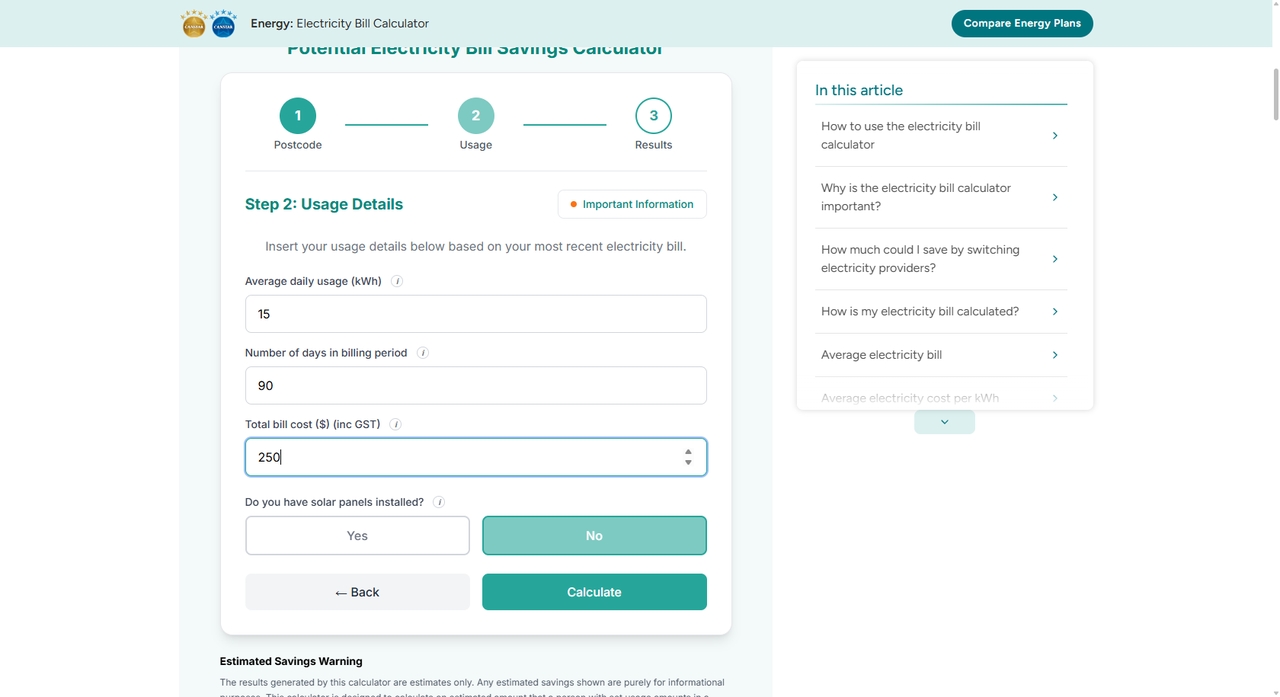
Canstar Electricity Bill Calculator
The Canstar Electricity Bill Calculator is an easy online utility for figuring out approximately monthly electricity expenses. By entering kWh consumption, you can instantly get the predicted bill amount without having to do the math by hand. This calculator comes in handy if one wants to check which electric plan would be best for their needs or see how changes in their rates will affect their bill amount.
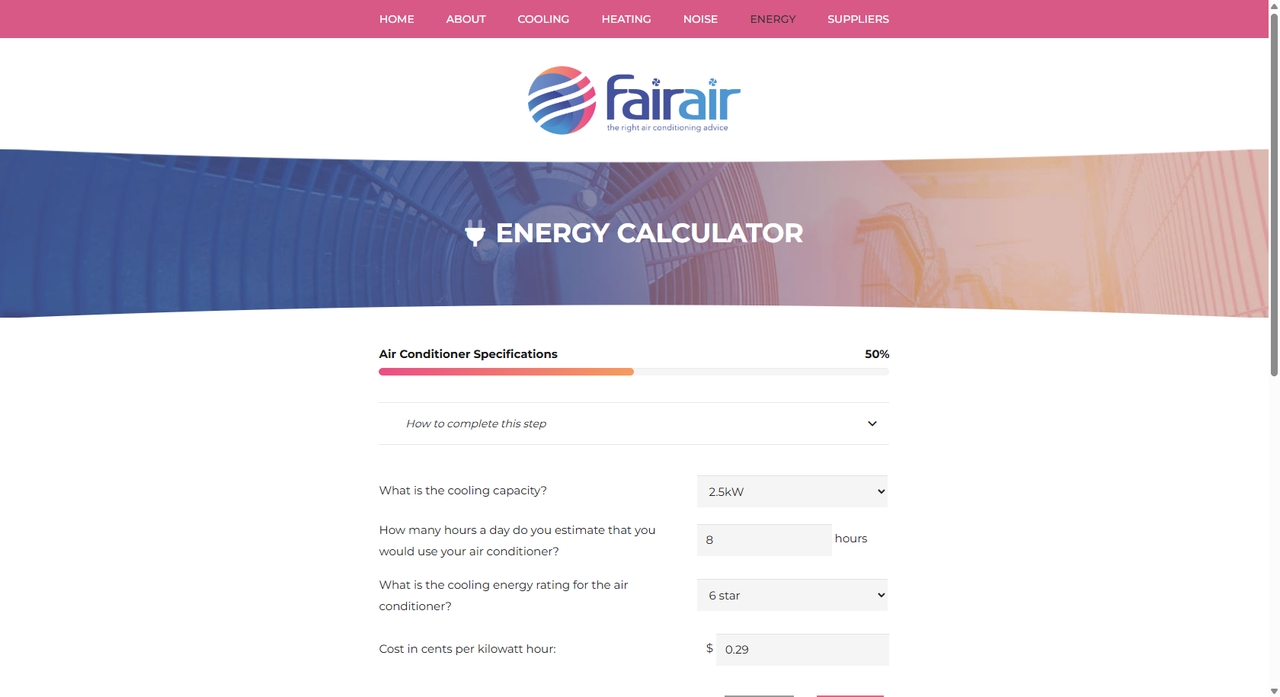
fairair.com.au
The fairair.com.au electric bill calculator can give you a rough idea of your appliance running costs. You can provide your state, your electricity rate, and add the wattage of your appliances. It will give a detailed cost breakdown per hour, day, month, and year. Besides, it displays energy consumption in kWh so that you can easily connect the extent of your usage with your electricity bill. The tool even comprises a daily supply charge option and uses the latest Australian rates to be more precise.
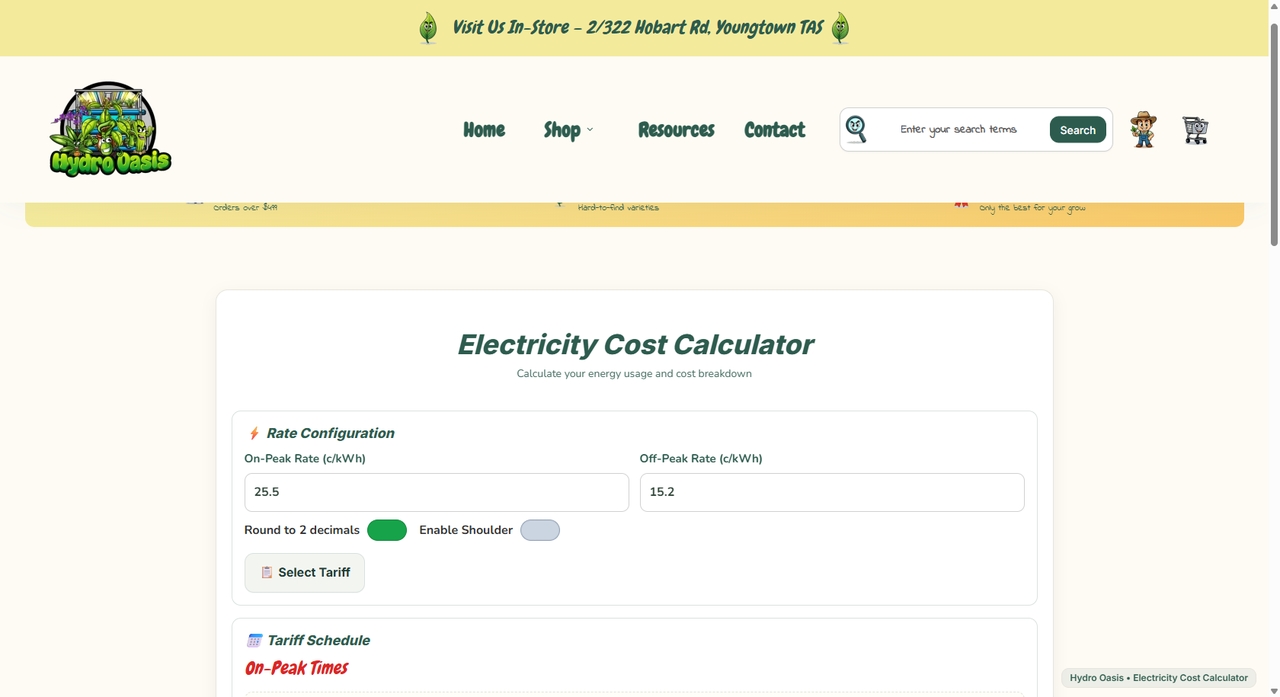
Hydro Oasis
Hydro Oasis is an online electricity bill calculator designed for Australian users. It is mainly used to help estimate household appliance energy consumption, electricity costs, and usage expenses under different tariff (time-of-use pricing) structures. This calculator is not just for estimating a simple total electricity bill. Instead, it provides more detailed analysis, including the running cost of individual appliances, tariff plans across different states, and electricity retailers.
How to lower your electric bill — and stop guessing
Electricity expenses might seem untameable, particularly when seasonal variations in consumption occur. Fortunately, slight modifications to everyday behaviors can have a significant impact. As soon as you figure out your power consumption patterns, it will be very straightforward to manage expenses, avoid guessing, and perhaps even reduce them a little bit.
Shift usage to off-peak hours
One of the easiest measures to cut your electricity bill is to use power during off-peak hours when rates are lower. Time-of-Use (TOU) electricity tariffs tend to have higher prices at peak times and lower prices at night.
Use dishwashers, washing machines, and dryers at night after midnight when the demand is at its lowest
Charge electric vehicles at night rather than during the day
Keep heavy appliance usage away from peak hours, usually from 4 PM to 9 PM on weekdays
Changing high-energy consumption periods to off-peak times of day only helps build a habit of reducing bills, but overall consumption remains the same.
Identify energy hogs with real-time monitoring
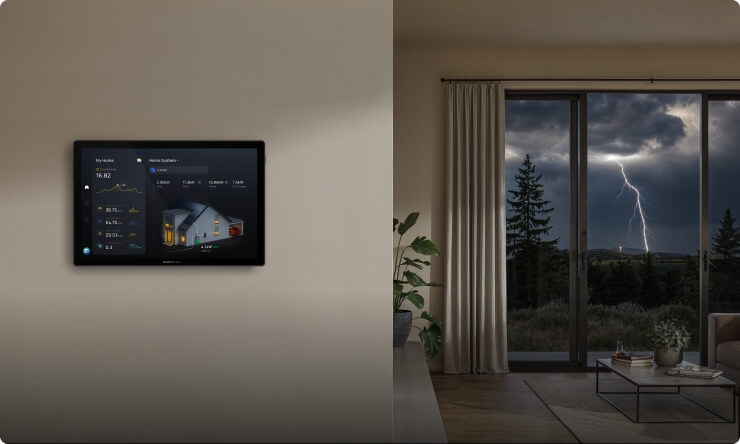
Many households have no clue which of their appliances contribute the most to the electricity bill until the damage is already done. In fact, instead of guessing, real-time monitoring tools let you know exactly where your energy is going and when it is being consumed. The EcoFlow PowerInsight 2 Monitor simply demonstrates live energy flow in the home. It keeps a record of solar generation, battery charge, and discharge. That means you no longer need multiple apps to control your devices.
Store solar energy and reduce grid dependence
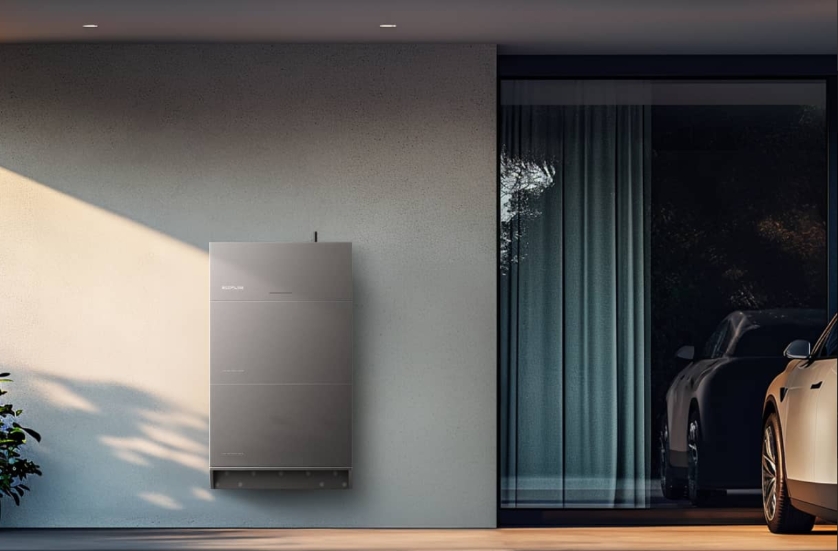
Using solar cells is an effective way to save on electricity costs. The EcoFlow PowerOcean Single-phase system uses batteries to store solar energy collected during the day. Then it dispatches the stored energy in the evening, when power prices are higher. It encourages you to be less dependent on the power utility and more on your own power generation. The system storage can be expanded to 45 kWh, allowing you to upgrade your capacity as your power requirements rise.
Quick wins (no equipment required)
Set your air conditioner or heater to 2 to 3 degrees below the outdoor temperature. Small changes can significantly cut down your energy consumption while you hardly notice any difference in comfort.
Unplug devices that continue to draw power in standby mode, such as TVs and chargers. Using smart power strips can simplify this process by turning off the power supply automatically.
Change to LED bulbs if your lighting is still outdated. LEDs not only consume much less energy but also have a significantly longer lifespan.
Wash your clothes with cold water and make sure to fill your washing machine to the maximum capacity.
Conclusion
You have now figured out how to calculate your electric bill and compute your energy expenses confidently. If your bill feels higher than expected, the first step is to check your usage. An electricity bill calculator can help you see where your power is going. The EcoFlow PowerInsight 2 Monitor helps you see exactly how and where electricity is used in real time. This makes it easier to spot waste. Once you understand your usage habits, you can make better choices to reduce energy waste. Starting today, use the right methods to save electricity and pay less on the electricity bill.
FAQs
What is the average electricity bill in Australia?
The average electricity bill in Australia varies by household size, location, and usage, but most homes pay around $300–$600 per quarter. Higher usage during heating or cooling seasons can significantly increase this.
Why is my electric bill so high?
High electricity bills are usually caused by increased appliance use, inefficient heating or cooling, standby power waste, or being on a higher tariff plan like peak Time-of-Use rates. You can try using a solar home energy storage system to reduce your electricity bill.
Can solar panels lower my electricity bill?
Yes, solar panels can significantly lower your electricity bill, but the amount depends on how much electricity you use, your system size, and how much sunlight your home gets.
What is the Default Market Offer (DMO) and how does it affect my bill?
The Default Market Offer (DMO) is a government-set reference price that caps electricity plans in some Australian states. It is designed to be a safety net, not the cheapest available rate.
What's the difference between a flat-rate and a time-of-use electricity plan in Australia?
A flat-rate plan charges the same price per kWh at all times of the day, making it simple but less flexible. A Time-of-Use (TOU) plan charges different rates for peak and off-peak hours, so you can save by shifting usage to off-peak times.