
Salt Water Battery Options: Costs, Pros, Cons, and Top Alternatives
Energy storage is a crowded space right now. Lithium-iron-phosphate systems dominate most residential installations, lead-acid still shows up in off-grid setups, and flow batteries are slowly creeping toward commercial viability. Somewhere in that mix sits a technology that gets mentioned often but installed rarely: The salt water battery.
The concept is genuinely interesting. A battery built from abundant, non-toxic materials with no fire risk and no heavy metals sounds almost too good to be true for home energy storage. In many ways, it is. But understanding why, and knowing exactly where saltwater chemistry does and does not work, is useful for anyone making a serious decision about a home battery backup.
Here is an honest breakdown of how a battery with salt water actually works, what it gets right, where it falls short, and what most homeowners end up choosing instead.
How Does a Salt Water Battery Work?
Most batteries people are familiar with use lithium, lead, or other reactive metals to move electrical charge through a chemical reaction. Saltwater batteries take a different approach entirely.
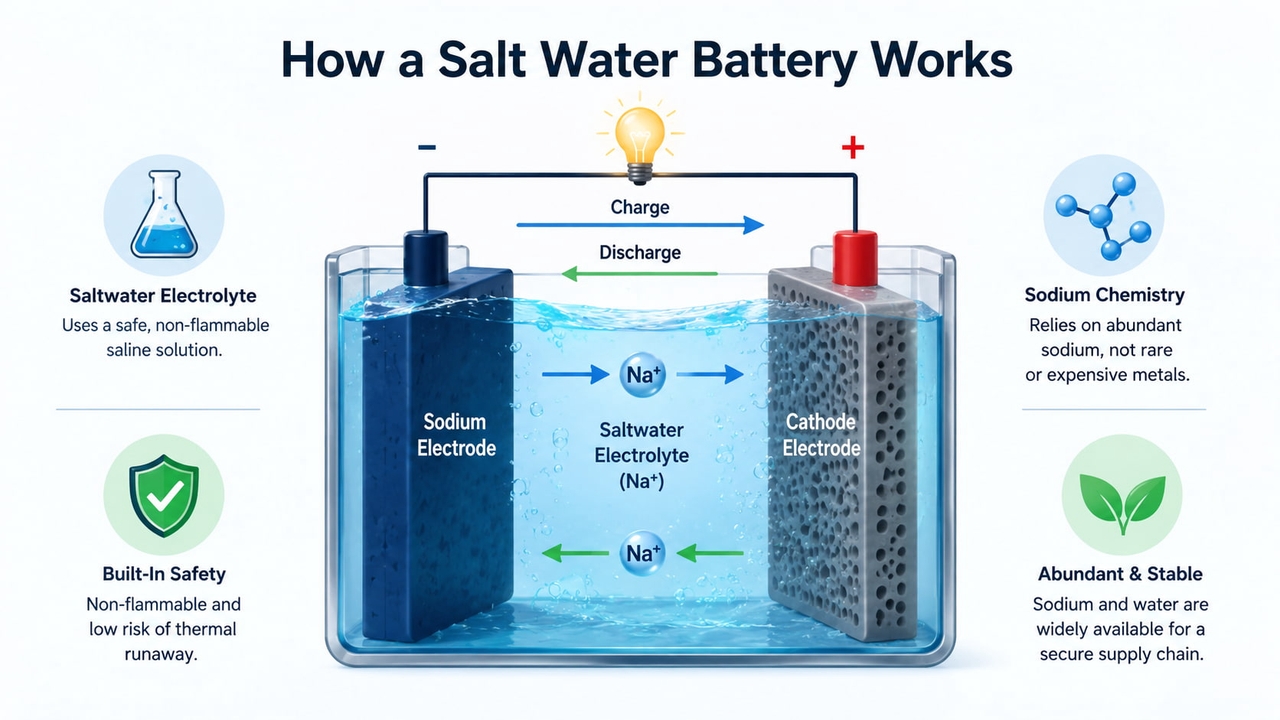
Instead of lithium, the chemistry here relies on sodium, the same element found in table salt, dissolved in water to create a saline electrolyte solution. Here is what that means in practice:
Rather than a solid or gel electrolyte, these systems use a liquid saline solution to capture, store, and release energy through electrochemical reactions.
Sodium-based materials replace lithium at the electrode level, which removes the need for rare or difficult-to-source minerals.
The water-based electrolyte is non-flammable by nature, which eliminates the thermal runaway risk that lithium-ion batteries have historically carried.
Because the core materials are sodium and water, both abundant and widely available, the supply chain for saltwater batteries is inherently more stable than lithium-dependent alternatives.
The science is sound. The chemistry works. The question is whether it works well enough to make sense in a real residential setting, and that is a different conversation.
Key Advantages of Saltwater Batteries
The appeal of saltwater technology is real, particularly from a safety and sustainability standpoint. For homeowners and grid operators alike, a few qualities stand out.
Safety first: The non-flammable saline electrolyte means thermal runaway is not physically possible with this chemistry. No fire risk, no explosion risk, no toxic fumes during a malfunction. For installations near living spaces, that is a meaningful safety advantage over some conventional alternatives.
Genuinely eco-friendly: Saltwater batteries contain no heavy metals, no rare earth elements, and no corrosive acids. At the end of life, they are far easier and safer to recycle than most energy storage technologies on the market. Aquion's original Aspen battery was actually the first battery to achieve Cradle to Cradle certification, an acknowledgment of its sustainable material profile.
Deep discharge tolerance: Internal chemistry lets saltwater batteries drain close to zero without damaging the cells or shortening the overall lifespan. Many older NMC and NCA lithium-ion batteries prefer to stay above 20 percent charge to preserve longevity. Modern LFP batteries have largely addressed this, tolerating deep discharge without significant degradation, though saltwater systems still offer an edge in this regard for the most demanding off-grid cycling applications.
Temperature resilience: Operating across a wide temperature range without needing active cooling or climate-controlled enclosures is a genuine advantage in remote or outdoor settings. The water-based electrolyte moderates internal temperature naturally, and thermal runaway is chemically impossible.
Long shelf life during idle periods: These batteries tolerate sitting unused for extended periods better than some conventional options. For seasonal or backup-only applications, that matters.
Major Drawbacks: Size, Weight, and Cost
The advantages above are real. Unfortunately, so are the drawbacks, and for most homeowners looking at residential energy storage in 2026, the practical limitations are significant.
Lower energy density: This is the core problem. Saltwater batteries store less energy per unit of physical space than lithium-based alternatives. That means achieving the same storage capacity requires a much larger and heavier physical system.
Massive footprint: A single basic saltwater module typically weighs between 150 and 200 lbs (68–91 kg), with larger commercial units exceeding that range. and requires considerable dedicated floor space. A standard garage barely accommodates one module, let alone the multiple units needed for meaningful whole-home backup. In most residential settings, finding that space simply is not realistic.
High upfront cost: Without large-scale manufacturing infrastructure, saltwater batteries remain expensive relative to lithium alternatives whose prices have fallen by over 80% since 2013. As of 2025–2026, installed residential LFP battery costs have fallen to approximately $700–$1,000 per usable kWh, with some systems coming in lower due to continued price declines.
Limited scalability: Scaling up capacity means adding more heavy, bulky modules. For an average home needing meaningful backup, the physical space requirements become unworkable fast.
Sourcing challenges: Very few manufacturers produce residential saltwater systems in 2026. The most prominent early player, Aquion Energy, went bankrupt in 2017 despite backing from Bill Gates and other notable investors. While a newer generation of sodium-ion products is beginning to emerge, finding local installers, replacement parts, and qualified service technicians for saltwater systems remains genuinely difficult in most US markets.
Comparing Energy Storage: Saltwater vs. LFP Alternatives
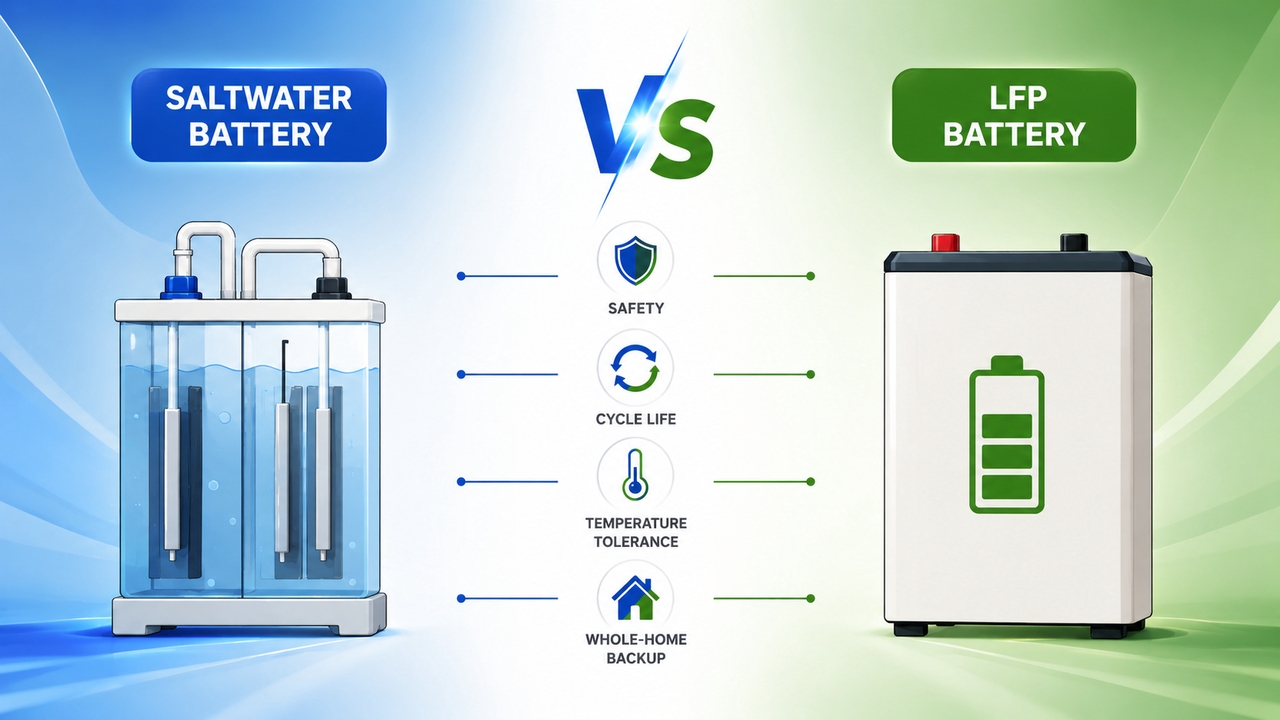
The honest comparison between saltwater and lithium iron phosphate comes down to one overriding reality: they are optimized for different situations.
Why LFP Is the Standard for Residential Use
LFP batteries have become the dominant chemistry for home energy storage in the US for straightforward reasons. They are compact, energy-dense, chemically stable, and increasingly affordable. A modern LFP system holds significantly more usable energy in a fraction of the floor space a saltwater system requires. In a typical suburban home where the battery often lives in a garage, a utility closet, or against an exterior wall, physical size is not a minor consideration. It is often the deciding factor.
Space constraints that are barely noticeable with an LFP installation become a serious problem with saline tank systems. Most homeowners simply do not have the square footage to make saltwater storage work at a meaningful capacity.
Cycle Life and Degradation Over Time
Both chemistries handle long-term wear reasonably well, but in different ways. Saltwater systems are particularly tolerant of regular deep discharges without significant degradation over time. That is a real strength.
Modern LFP technology, however, comfortably delivers 6,000 whole life cycles under standard household conditions. For the average home, cycling once per day through daily solar charging and evening discharge, translates into well over a decade of dependable service before any meaningful capacity loss. The cycle life advantage of saltwater is real, but LFP has closed that gap considerably in recent years.
Temperature Tolerance and Climate Readiness
Saltwater systems handle ambient temperature swings naturally, without active cooling infrastructure. In an outdoor installation or an unconditioned outbuilding in a moderate climate, that passive resilience is useful.
LFP batteries are inherently more sensitive to sub-zero temperatures and require active thermal management to operate effectively in cold environments. The better residential LFP systems address this with built-in thermal management that allows safe operation from -4°F to 140°F (-20°C to 60°C). In practice, for most US homeowners installing inside a conditioned or semi-conditioned space, this is a solved problem rather than an active limitation.
Real-World Scenarios for Whole-Home Backup
When the goal is keeping an entire home running through a multi-day grid outage, the math strongly favors high-density LFP. Running dual HVAC units, a refrigerator, a water pump, and normal household loads simultaneously demands serious continuous output. A saltwater system scaled to that load would require so many modules that installation becomes impractical for most residential properties.
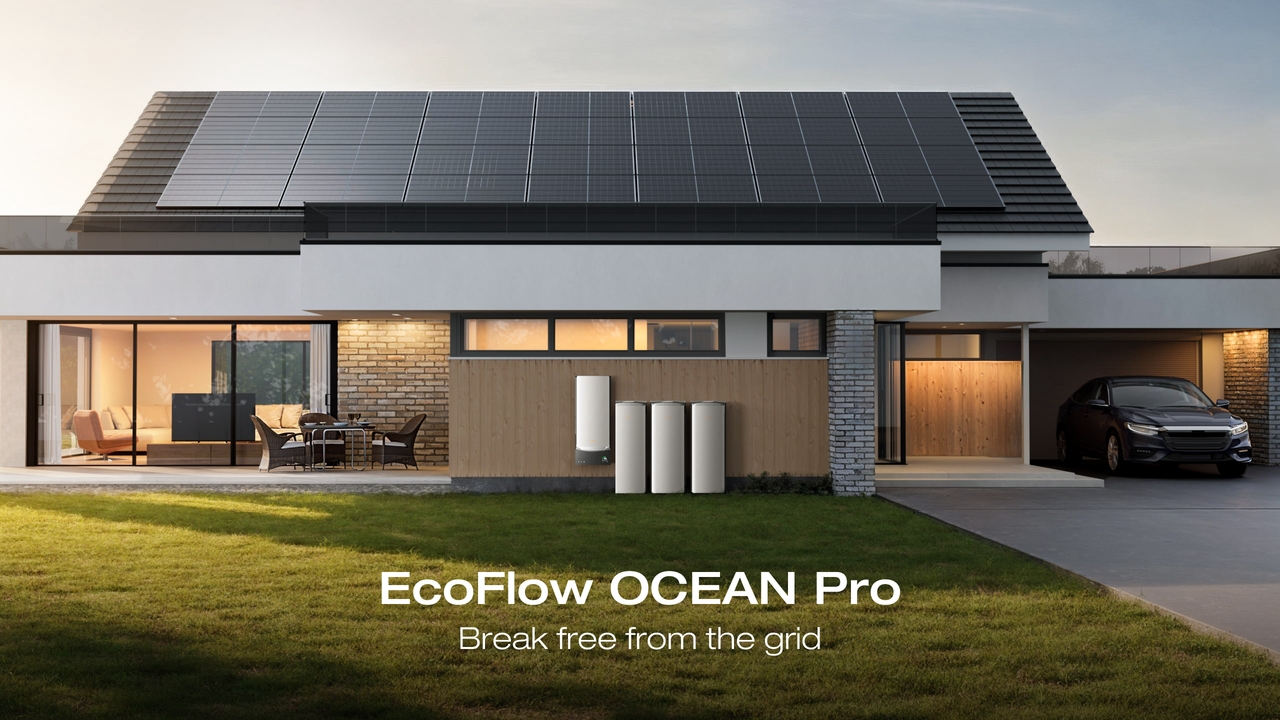
The EcoFlow OCEAN Pro Solar Battery System is a good example of what a properly scaled LFP solution looks like in practice. Starting at 10kWh and expandable to 80kWh, it supports 24kW of continuous power output with 205A LRA surge capability, enough to run heavy appliances like dual HVAC units simultaneously without sacrificing other circuits. Its built-in Intelligent Mode automatically shifts energy usage to off-peak hours to reduce utility costs, and the whole system fits in the space a saltwater equivalent could never match.
For homeowners weighing real-world backup capability against physical footprint, that gap is difficult to bridge with saltwater chemistry at current technology levels.
Every home has a different load profile, different space available, and different goals for backup and bill savings. Request a consultation with an EcoFlow energy advisor to work through exactly what configuration makes sense for a specific property and situation.
Get Your Free Home Energy Consultation!
Which energy solution are you interested in?

Is a Salt Water Battery for Solar Worth It?
The most straightforward answer: it depends almost entirely on the property.
For off-grid rural properties with plenty of outdoor space, no weight restrictions, and limited access to LFP service networks, a saltwater battery for solar is worth serious consideration. The zero fire risk, deep discharge tolerance, and passive temperature management make them genuinely well-suited to remote, unattended installations where maintenance access is infrequent and safety is the primary concern.
For standard residential solar owners in suburban or urban settings, the technology is not practical yet. The energy density gap means too many modules, too much space, and too little installer support to make it competitive with LFP alternatives that are cheaper, smaller, and backed by mature supply chains. In fact, research from Stanford University designates LFP batteries as the "cornerstone technology" for energy storage precisely because of their unmatched safety, longevity, affordability, and supply-chain stability.
The table below captures where each chemistry fits most naturally:
Battery Type | Space Required | Fire Risk | Ideal Use Case |
|---|---|---|---|
Saltwater | Very High | Zero | Off-grid rural properties with unlimited space |
Lead-Acid | Medium | Low | Budget-conscious, low-demand backup setups |
LFP (Lithium) | Low | Extremely Low | Modern homes requiring reliable whole-home backup |
The saltwater battery market is projected to grow at a 23.3% CAGR through 2035, driven by industrial and grid-scale applications where space is less of a limiting factor. Residential viability is improving, but at the pace the technology is developing, most homeowners installing storage today will complete their first battery's useful life before saltwater becomes a genuinely competitive residential option.
Conclusion: The Verdict on Sodium-Based Storage
Saltwater battery technology isn't a failed concept; its safety and environmental benefits are undeniable. However, in 2026, it remains impractical for most residential solar setups. Due to low energy density, physical bulk, and higher costs, saltwater batteries are currently best suited for industrial or niche off-grid applications.
For residential solar storage, the evidence points clearly toward compact, proven LFP systems that fit in existing spaces, handle real home loads, and come backed by installer networks and service infrastructure that saltwater simply cannot match right now. The home battery backup landscape has more options than it ever has, and for most households, LFP remains the straightforward choice.
FAQs
How long can a salt water battery last?
Saltwater batteries generally offer strong long-term cycle tolerance. Most systems are rated for several thousand cycles, and their deep-discharge chemistry means they degrade less from full drain than many lithium alternatives. Actual lifespan depends heavily on installation conditions and usage patterns.
What is the disadvantage of saltwater batteries?
The biggest practical limitation is low energy density. Saltwater batteries store significantly less power per unit of space than LFP systems, resulting in large, heavy installations that are difficult to fit into standard residential properties. Commercial availability in the US is also limited in 2026.
Are there any reliable a salt and battery reviews available?
Detailed real-world reviews are scarce because very few residential saltwater systems have been installed in the US. Aquion's Aspen series generated some documented feedback before the company's 2017 bankruptcy, and newer sodium-ion products from manufacturers like CATL (with its Freevoy sodium-ion cells) and HiNa Battery are beginning to appear in commercial applications, but long-term user data for residential installations remains limited.
Can I use a battery with salt water for my home?
Technically, yes, but practically, it is challenging. The physical size and weight of saltwater modules make them difficult to install in typical residential spaces. Finding a qualified installer and sourcing replacement components in most US markets adds further complexity. For most homes, LFP systems are a more workable choice.
Is it possible to make a battery using salt water?
Yes, and it is actually a well-established electrochemical principle. A basic saltwater battery can be assembled as a demonstration using salt water, electrodes, and a simple circuit. However, DIY saltwater batteries produce very little power and are not suitable for home energy storage. Commercial systems use engineered sodium-ion chemistry that is far more sophisticated than a homemade salt solution.

