
What Is a HERS Rating and Why Does It Matter for Your Home?
If you're struggling with rising utility bills, a HERS rating can help you understand how energy-efficient your home really is. A lower HERS score means lower energy use, greater comfort, and higher long-term savings. Whether you're buying, selling, or upgrading a home, knowing your HERS rating helps you make smarter energy decisions and increase your property's value. Here's what it means, how it's scored, and what you can do to bring your number down.
What is the HERS rating?
HERS stands for Home Energy Rating System. Developed and overseen by the Residential Energy Services Network (RESNET), it is the nationally recognized standard for measuring and verifying a home’s energy performance.
A certified RESNET HERS Rater inspects and tests the home before entering the results into approved energy modeling software. The software compares the home against a reference home, which is a modeled house of the same size, shape, and orientation built to the 2006 International Energy Conservation Code (IECC) standards. Based on this comparison, the software generates a single HERS index score. The lower the score, the more energy-efficient the home.
How is the HERS index calculated?
Getting to that final number takes a few distinct steps:
Energy modeling: The rater feeds your home's design details and building materials into specialized software, which builds a model of how the house is expected to perform.
Comparison to the reference home: That model is measured against the RESNET reference home, a version of your house built to 2006 IECC standards. The gap between the two determines your score.
On-site inspection and testing: The rater physically verifies the home's construction and systems, including a blower door test to measure air leakage and a duct blaster test to check for leaks in the ductwork.
Final report: You get a HERS Index score along with a breakdown of where your home is losing energy and which upgrades would help most.
Understanding the HERS index scale
The HERS Index operates like a golf score: the lower the number, the more energy-efficient the home. The scale provides an easy visual baseline for comparing different properties regardless of size or geographic location.
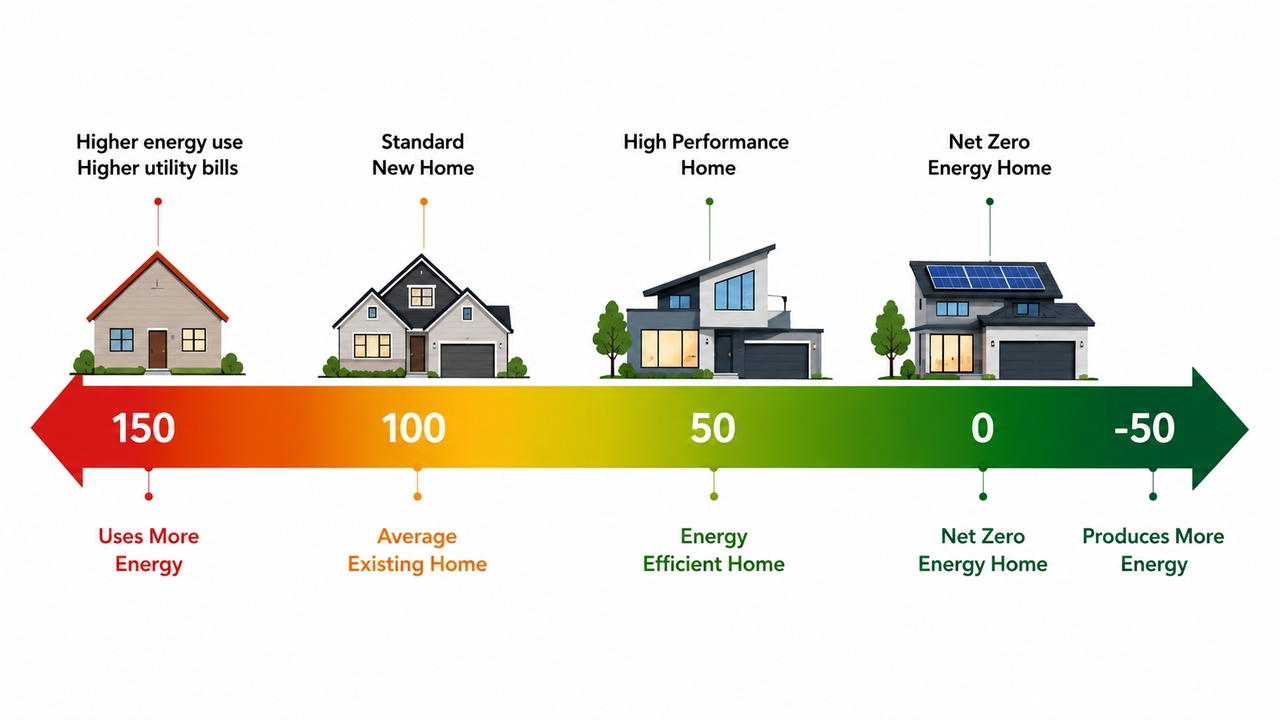
HERS Index Score | Efficiency Benchmark | What It Means |
130 | Average Resale Home | 30% less efficient than a standard 2006 reference home. |
100 | Standard New Code-Built Home | Meets standard 2006 building energy code baseline. |
50 | High-Efficiency Home | 50% more efficient than the reference baseline home. |
0 | Net Zero Energy Home | Produces as much renewable energy as it consumes annually. |
Below 0 | Net Negative Home | Produces more energy than it consumes (achievable via solar + battery). |
A home scoring 70 uses 30% less energy than a standard new build. A home scoring 130 uses 30% more. Older homes with outdated systems can score well above 130. On the other end, homes with strong solar and battery setups can dip into negative territory, meaning they generate a surplus.
Why is a HERS rating important?
A HERS rating provides valuable insight into your home's energy performance, helping homeowners reduce costs, improve comfort, and increase long-term value.
Lower energy bills: High-efficiency structural features drastically reduce monthly utility expenses. Eliminating wasted heating, cooling, and electricity power draw keeps ongoing operational costs predictable and significantly lower throughout every season of the year for homeowners.
Better indoor comfort: A tighter building envelope and efficient systems mean fewer drafts, more even temperatures from room to room, and less strain on your HVAC system, making your home noticeably more comfortable in every season of the year.
Improved resale value: Verified low HERS scores signal lower operating costs to buyers and appraisers. Energy-efficient homes often sell faster and command higher prices because the rating provides third-party evidence of reduced utility expenses and modern performance.
Easier mortgage qualification: Lenders and energy-efficient mortgage programs factor lower projected utility costs into debt-to-income calculations. A strong HERS rating can improve affordability metrics, helping buyers qualify for larger loans or better terms.
How to improve your HERS rating (and Home value)
Improving your HERS index score requires a strategic combination of passive building shell upgrades, high-efficiency mechanical systems, and advanced energy storage technologies.
Seal the building envelope
The building envelope is your home's first line of defense against energy loss. Proper insulation in walls, attics, floors, and foundations, paired with thorough air sealing around windows, doors, and ducts, keeps conditioned air where it belongs. Less leakage means lower heating and cooling loads, which translates directly into a better HERS score and a more comfortable home year-round.
Upgrade HVAC and water heating
Heating, cooling, and water heating account for a large share of a home's energy use, so equipment efficiency matters. High-efficiency HVAC systems, correctly sized units, sealed ducts, and smart thermostats cut waste and reduce modeled energy consumption. On the water heating side, swapping a traditional tank unit for a tankless or heat pump water heater slashes standby energy loss and lowers your home's total kWh use.
Improve windows and doors
Energy-efficient windows and doors with low U-factors and tight seals limit unwanted heat transfer in and out of the house. Better glazing and weatherstripping reduce the burden on your HVAC system, which shows up as a lower HERS rating on your next evaluation.
Adding solar generation
Installing a rooftop solar photovoltaic (PV) system allows your home to generate clean electricity and reduce reliance on the utility grid. By offsetting annual energy consumption, solar panels can significantly lower your HERS Index score. When combined with other efficiency improvements, solar generation can move a home much closer to Net Zero energy performance.
Smart energy management
Once your home is sealed, insulated, and running on efficient equipment, the next lever is how intelligently you manage the energy you generate and use. This is where a home battery like the EcoFlow OCEAN Pro comes in. It stores excess solar energy for later use, reducing reliance on the grid while improving energy resilience. By maximizing self-consumption of renewable energy, it helps lower electricity costs and supports a more energy-efficient home.
Key advantages include TOU optimization that shifts usage to off-peak hours, cutting costs and modeled consumption; Intelligent Mode that automatically handles charging and discharging; and an industry-leading 15-year warranty that signals long-term value to appraisers and buyers.

Conclusion
A low HERS rating pays off in more than one way. It means lower bills, a more comfortable home, and a stronger position whether you're refinancing, selling, or just trying to stop overpaying for energy you don't need to use. Envelope upgrades and efficient equipment get you most of the way there, and solar with smart storage can take you the rest of the way. If you're ready to take the next step, upgrading to the EcoFlow OCEAN Pro is a solid way to future-proof your home and maximize your savings. Schedule a consultation with EcoFlow's experts to find the right home energy storage solution and start building a more efficient, resilient home.
Get Your Free Home Energy Consultation!
Which energy solution are you interested in?
FAQs
What does HERS stand for?
HERS stands for Home Energy Rating System, developed by the Residential Energy Services Network (RESNET).
What is the difference between a HERS rating and a HERS Index?
The HERS rating refers to the overall home energy assessment process, while the HERS Index is the numerical score assigned after the evaluation. The terms are often used interchangeably, but the Index is the actual result.
What is a good HERS rating score?
A HERS Index below 100 is considered better than the standard reference home. New energy-efficient homes often score between 40 and 70, while a score of 0 represents a Net Zero Energy home.
How is a HERS rating calculated?
A certified RESNET rater inspects your home, conducts diagnostic tests like blower door and duct leakage testing, and inputs the data into approved software. The system calculates a score by comparing your usage to a reference baseline home.
How much does a HERS rating cost?
A professional HERS rating generally costs between $1,500 and $3,000, depending on your home's size, age, location, and structural complexity. This cost is often recouped through long-term energy savings and higher resale value.

