
Do Mini Splits Use a Lot of Electricity? (The Real Numbers)
If you are looking to upgrade your home comfort, the first question is usually: do mini splits use a lot of electricity? Compared to traditional central HVAC systems or window units, the answer is a resounding no. Mini splits are among the most energy-efficient heating and cooling solutions available today. Pairing your system with a reliable home backup battery adds even more savings and peace of mind, letting you run your mini split during outages or peak-rate hours without relying fully on the grid.
What is a mini split system, and how does it work?
A ductless mini split system is a highly efficient heating and cooling solution that delivers comfort directly to individual rooms or zones without the need for bulky ductwork. It’s ideal for home additions, older houses without existing ducts, open-concept spaces, or anyone wanting precise temperature control in specific areas.
The system consists of two primary parts: a sleek indoor air-handling unit and a robust outdoor compressor. These are connected by a small conduit housing the power cable, refrigerant tubing, and a condensate drain.
The key to their efficiency is inverter technology. Unlike traditional HVAC systems that cycle on and off at full power, a mini split's inverter-driven compressor continuously adjusts its speed to match the exact heating or cooling demand. This means the system avoids the energy spikes that come with constant on/off cycling.
Compared to central air conditioners, mini splits eliminate the energy losses associated with ductwork, which can account for up to 30% of energy consumption in a forced-air system. That alone makes them a significantly more efficient choice for most homes.
How is mini split electricity usage measured?
To understand your bill, you need to distinguish between the power the unit pulls and the energy it actually consumes.
Watts vs. Kilowatt-Hours (kWh)
Watts (W) and kilowatts (kW) measure the rate at which a device draws power — think of it like the speed of a car. Kilowatt-hours (kWh) measure the actual amount of energy consumed over time, as the distance traveled.
Here's a simple example: A 1,000-watt (1 kW) mini-split running for 1 hour consumes 1 kWh of electricity. That's the unit your utility company uses to calculate your bill. If electricity costs $0.15 per kWh, that one hour costs you 15 cents.
This distinction matters because your bill is based on kWh, not peak watts. Inverter-driven mini splits often run at lower average power once the set temperature is reached, keeping real-world consumption manageable.
What is SEER rating and why does it matter?
SEER stands for Seasonal Energy Efficiency Ratio. It measures how much cooling output a system delivers per unit of electrical energy consumed over a typical cooling season. A higher SEER rating means the unit produces the same amount of cooling or heating while using less electricity.
Modern mini splits typically range from 15 to 30+ SEER, compared to 13–16 SEER for most central air conditioners. A unit rated at 25 SEER uses roughly half the electricity of a 13 SEER system to achieve the same output. Over the lifetime of the unit, that difference translates to hundreds — sometimes thousands — of dollars in energy savings.
How many watts does a mini split use?
Wattage is directly related to BTU capacity — the larger the space a unit is designed to condition, the more power it draws. BTU (British Thermal Unit) measures heating or cooling output, while wattage measures the electrical input required to produce it.
Mini split wattage by size (BTU Chart)
BTU Capacity | Typical Wattage Range | Best For |
|---|---|---|
9,000 BTU | 500–750W | Small rooms, studios |
12,000 BTU | 800–1,200W | Average bedroom/living room |
18,000 BTU | 1,500–2,000W | Large rooms, open floor plans |
24,000 BTU | 2,000–2,500W | Larger zones, multi-room areas |
36,000 BTU | 3,000–3,500W | Whole-home or commercial use |
Note: Actual wattage varies by brand, SEER rating, and operating conditions. These are general estimates — always consult the manufacturer's specifications.
How many amps does a mini split use?
Amps are calculated using a simple formula: Amps = Watts ÷ Volts. Most smaller mini splits operate on 115V circuits, while larger units typically require 230V.
Here are general amp draw estimates by unit size:
9,000 BTU: approximately 4–7 amps (115V) or 3–4 amps (230V)
12,000 BTU: approximately 7–10 amps (230V)
18,000 BTU: approximately 10–15 amps (230V)
24,000 BTU: approximately 15–20 amps (230V)
Amp draw determines the size of the circuit breaker and the electrical panel capacity you need. An undersized circuit can repeatedly trip breakers or pose a fire hazard. Before installation, always verify the unit's minimum circuit ampacity and maximum overcurrent protection rating listed in the manufacturer's documentation — and have a licensed electrician handle the wiring.
How much electricity does a mini split use daily/monthly? (Real-World kWh Estimates)
Mini split energy usage depends on runtime, climate, and system size, but real-world estimates show they are highly efficient. A typical 12,000 BTU unit running 8–12 hours per day, uses about 8–15 kWh daily. Over a full month, that works out to roughly 240–450 kWh — significantly less than the 840+ kWh a comparable central air conditioning system can consume under similar conditions.
To put these numbers in perspective, a medium-sized mini split system often operates at a steady 500–800W. This leads to a monthly consumption of roughly 240–360 kWh. In contrast, a traditional central AC system—which lacks zoning and inverter precision—can easily consume 840+ kWh per month to achieve the same level of comfort.
One important caveat: heating mode, especially in very cold climates, can consume more electricity than cooling mode. When outdoor temperatures drop significantly, the system runs defrost cycles that temporarily increase power draw. However, modern hyper-heat models are engineered to maintain high efficiency even at temperatures well below freezing, which substantially reduces this effect.
Factors that affect the power consumption of a mini split
Not every mini split will perform the same way in every home. Several critical variables determine whether your system runs lean or draws excessive power.
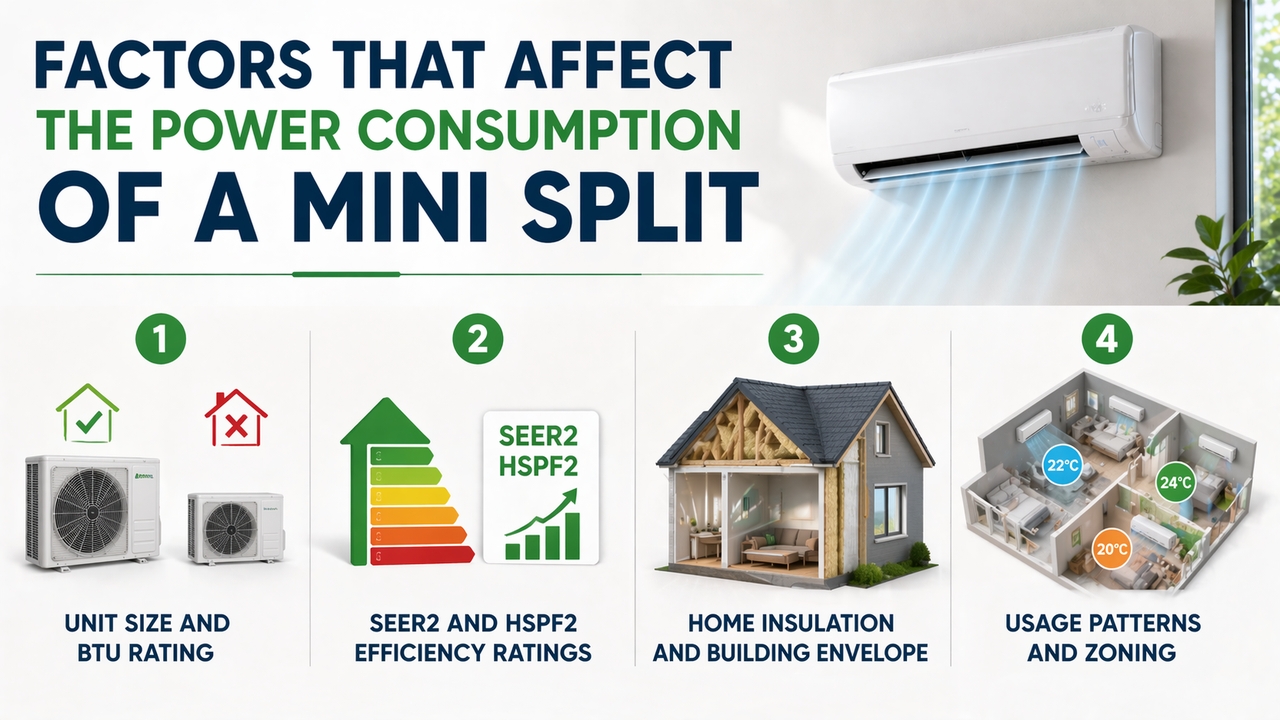
Unit size and BTU rating: Sizing is the most critical factor. An oversized unit will "short-cycle," turning on and off rapidly, wasting energy and wearing out the compressor. Conversely, an undersized unit will run at maximum speed indefinitely, struggling to reach the target temperature and causing your energy use to spike.
SEER2 and HSPF2 efficiency ratings: These ratings tell you exactly how much cooling (SEER2) or heating (HSPF2) you get per watt. A system with a 25 SEER2 rating is significantly more efficient than a 14 SEER2 model, reducing monthly kWh consumption.
Home insulation and building envelope: A well-insulated home with sealed air leaks requires the mini split to work far less to maintain a set temperature. Poor insulation is one of the biggest hidden drivers of elevated electricity costs — the system may be efficient, but it's fighting against constant heat gain or loss.
Usage patterns and zoning: One of the biggest advantages of mini splits is zoning — each indoor unit controls its own space independently. Running only the zones that are occupied, rather than conditioning the entire house, can dramatically cut electricity usage compared to a whole-home central system.
Tips to run your mini split as efficiently as possible
Maximizing your system's efficiency not only lowers your monthly bills but also extends the lifespan of your equipment. Here is how to get the most out of every watt.
Pair your mini split with a reliable backup power source
Even the most efficient mini split is only as reliable as the power behind it. During grid outages or peak-rate periods, a home battery keeps your system running without missing a beat — and without paying premium rates for electricity you could have stored in advance.
The EcoFlow Ocean Pro is purpose-built for exactly this. The powerhouse is designed to slash utility bills through intelligent Time-of-Use (TOU) management. The system automatically prioritizes the use of stored energy during expensive peak hours and recharges when rates are lowest. With 10–80kWh of storage and 24kW output, it handles heavy loads like 5-ton HVACs while "peak shaving"—storing cheap energy to power your home when rates spike. Featuring 40kW solar input and a 15-year warranty, it transforms your home into an independent microgrid that automates long-term ROI.

Choose the right size for your space
Proper sizing has a bigger impact on efficiency than almost any other factor. An oversized unit short-cycles — switching on and off before completing a full conditioning cycle — while an undersized one runs at maximum capacity around the clock. Both scenarios waste electricity and accelerate system wear. A general starting point is approximately 20 BTU per square foot, adjusted upward for poor insulation, high ceilings, or hot climates. When in doubt, a Manual J load calculation from a licensed HVAC professional gives you a precise answer.
Use smart scheduling and sleep mode
Most modern mini splits allow you to program setback temperatures for times when a room is unoccupied. Even a modest setback of 3–4 degrees can meaningfully reduce daily energy consumption. Sleep mode takes this further — it gradually adjusts the temperature over several hours as you rest, cutting power use without the discomfort of waking up in a room that's too warm or too cold.
Keep filters and coils clean
A clogged filter restricts airflow, forcing the compressor to work harder to move the same volume of air — and harder means more watts consumed. During heavy-use seasons, clean or rinse the indoor unit's filter monthly. Schedule a professional maintenance visit once a year to clean the evaporator and condenser coils, check refrigerant levels, and inspect electrical connections. A well-maintained unit runs more efficiently and lasts significantly longer.
Seal your home against air leaks
Gaps around windows, doors, electrical outlets, and plumbing penetrations let conditioned air escape and unconditioned air enter — forcing your mini split to run longer and more frequently to compensate. Weatherstripping, caulk, and expanding spray foam are inexpensive fixes that pay for themselves quickly in reduced energy costs. The tighter your home's building envelope, the less work your mini split has to do to maintain a comfortable temperature.
Conclusion
Mini splits are among the most electricity-efficient ways to heat and cool your home — but getting the most out of one means choosing the right size, keeping it maintained, and managing how and when you run it. Pair that with a smart backup power strategy, and you've built a genuinely resilient home energy system.
The EcoFlow Ocean Pro solar battery takes that a step further, letting you store solar energy, ride out outages, and reduce what you pay to the grid — all while keeping your mini split running exactly when you need it most.
Ready to optimize your home’s energy management? Schedule a free consultation with our experts today and find out how much you could save.
Get Your Free Home Energy Consultation!
Which energy solution are you interested in?

FAQs
1. What are the disadvantages of a mini-split?
Mini splits have higher upfront costs and require professional installation. Indoor units are visible on walls, which some users dislike. They may also need multiple units for whole-home coverage, increasing total cos
2. Is it cheaper to leave a mini-split on all the time?
Yes, keeping a steady temperature is often cheaper. Inverter technology adjusts output efficiently, avoiding energy spikes from frequent on/off cycling. However, use scheduling to reduce runtime when rooms are empty.
3. Does a mini split use a lot more electricity than a central AC?
No, mini splits usually use less electricity. They avoid duct losses and use inverter compressors, making them 30–50% more efficient than many central air conditioning systems.
4. What is the best temperature to keep a mini split on?
For efficiency and comfort, set cooling to 24–26°C (75–78°F) and heating to 20–22°C (68–72°F). Moderate settings reduce energy use while maintaining a comfortable indoor environment.
5. How much does it cost to run a mini split monthly?
A typical 12,000 BTU unit costs roughly $38–$72 per month in the U.S. average electricity rate. Actual costs vary based on your local rate, climate, usage hours, and the unit's SEER rating.

