
How to Calculate Peak Voltage of a Wave (With Formulas & Examples)
Struggling to understand why your appliances or solar inverter specs mention peak voltage? Learning how to calculate peak voltage of a wave helps you choose the right equipment and avoid costly overloads. Whether you're dealing with household AC power, generators, or renewable energy systems, peak values determine safety margins and performance. This guide breaks down simple formulas for peak voltage, peak-to-peak voltage, and RMS conversions with clear examples.
What is peak voltage?
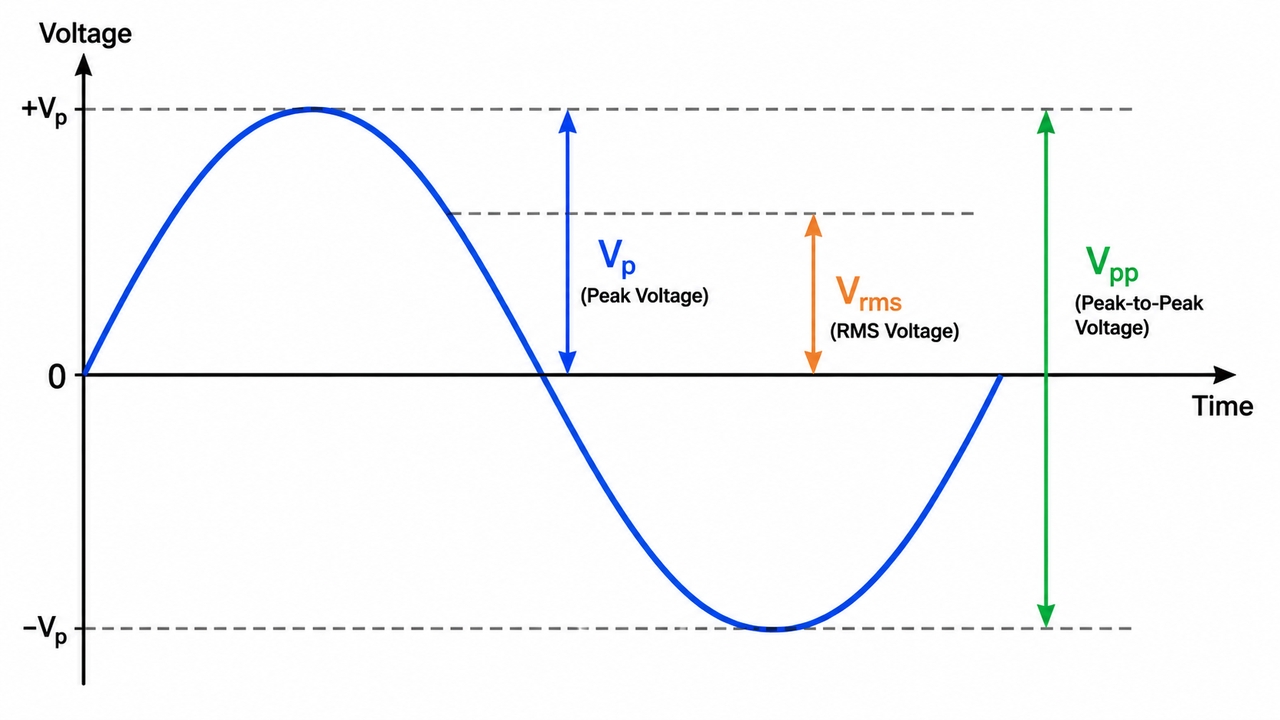
Peak voltage (Vp) is the maximum instantaneous voltage measured from the zero line to the highest point (positive peak) of the waveform. For a clean sine wave, this is the tallest point before the signal swings back down.
Understanding peak voltage is important for both electrical design and system safety because it helps:
Choose the right component ratings: Capacitors, diodes, transistors, and insulation must withstand the waveform's maximum voltage without failing.
Maintain safety limits: Electrical systems are designed with voltage limits to prevent insulation breakdown, electric shock hazards, and equipment damage.
Avoid overloads and failures: Components exposed to voltages above their peak rating may overheat, degrade, or fail unexpectedly.
Design reliable power systems: Engineers use peak voltage when designing inverters, power supplies, generators, and solar energy systems to ensure stable operation under normal and surge conditions.
Peak voltage vs. Peak-to-peak voltage vs. RMS voltage
To accurately measure or manipulate an AC signal, you need to understand the three primary ways voltage is expressed on a standard sine wave:
Peak voltage (Vp): The highest point of the wave, measured from the zero reference line to the top (positive peak) of the waveform.
Peak-to-peak (Vpp): The total voltage swing from the highest positive peak to the lowest negative peak of the waveform.
RMS voltage (Vrms): The "effective" or root mean square value. This is the equivalent DC voltage that would produce the same heating effect on a resistive load. Most household outlets and multimeters display RMS values.
How to calculate peak voltage (Peak voltage formula)
Depending on the electronic data you already have, you can find the peak voltage using one of three primary calculations.
From peak-to-peak voltage:
Formula: Vp = Vpp × 0.5
Because a standard, symmetrical sine wave extends equally above and below the zero line, the peak voltage is simply half of the peak-to-peak value.
Example:
If the measured peak-to-peak voltage is 340V:
Vp = 340 × 0.5 = 170V
From RMS voltage:
Formula: Vp = Vrms × √2 (≈1.414)
Most standard multimeters measure AC voltage in RMS. To find the maximum peak value, the wave will actually hit, multiply the RMS value by the square root of 2.
Example:
If your wall outlet measures a standard continuous 120V RMS, the true peak voltage:
Vp = 120 × 1.414 ≈ 169.7V (commonly rounded to 170V)
From average voltage:
Formula: Vp = Vavg × (π/2) (≈1.571)
For a sinusoidal waveform, peak voltage can also be estimated from the average voltage.
Example:
If the average voltage is 108V:
Vp = 108 × 1.571 ≈ 169.7V (Approx. 170 V)
Peak-to-peak voltage formula
Peak-to-peak voltage (Vpp) is the total voltage difference between the highest positive peak and the lowest negative peak of an AC waveform. It is commonly used when analyzing signals with oscilloscopes and evaluating waveform amplitudes.
How to calculate peak-to-peak voltage from peak voltage
If you already know the peak voltage (Vp), finding the peak-to-peak voltage is simple, you can use the following formula:
Vpp = 2 × Vp
For example, if the peak voltage is 60V, here's how to calculate peak-to-peak voltage
Vpp = 2 × 60 = 120V
How to find peak-to-peak voltage from RMS voltage
If you only have the RMS value, you can jump straight to peak-to-peak without calculating peak voltage first.
Peak-to-peak voltage formula: Vpp = Vrms × 2√2 (≈2.828)
For example, if the RMS voltage is 120V:
Vpp = 120 × 2.828 = 339.4V
Why peak voltage matters for home energy systems
Peak voltage is more than a theoretical electrical concept. It directly affects the performance and reliability of modern home energy systems. Devices such as solar inverters, backup generators, and battery storage systems continuously convert or regulate AC waveforms to deliver stable power to your home. While household electricity is rated using RMS voltage, these systems must also withstand the waveform's peak voltage without damaging internal components.
Understanding the difference between peak voltage and RMS voltage also helps you interpret surge power ratings and continuous output specifications. This is especially important when running appliances with high startup currents, such as air conditioners, refrigerators, and well pumps, ensuring your energy system can safely meet both everyday and short-term power demands.
Managing power demands with smart energy systems
This is where a well-built battery system earns its keep. The EcoFlow Ocean Pro Home Solar Battery is designed for robust, whole-home backup, built to handle exactly the kind of surge demands described above.
Ocean Pro delivers a 24kW continuous output paired with a 205A LRA surge rating, so it can support demanding startup loads from HVAC systems, pool pumps, and EV chargers running at once. During an unexpected grid outage, that surge capacity keeps your home running instead of tripping breakers or losing power to key circuits.
By leveraging Time-of-Use (TOU) billing structures, you can charge your battery array when electricity is cheapest, and seamlessly deploy that stored energy to power your home during expensive peak demand hours. This advanced control loop shields your appliances from peak voltage instabilities while dramatically lowering your monthly electricity bills.

Conclusion
Calculating peak voltage and peak-to-peak voltage gives you valuable insight into how AC power actually behaves in your home systems. By understanding these key measurements, you can make better decisions about equipment compatibility and safety.
When it comes to protecting your home, choosing the right smart energy storage solution is essential. A reliable system like the EcoFlow Ocean Pro Home Solar Battery provides robust whole-home backup and helps you take full advantage of Time-of-Use savings.
Get Your Free Home Energy Consultation!
Which energy solution are you interested in?

Ready to secure reliable power and lower your bills? Schedule a free consultation with an EcoFlow energy consultant today and find the perfect solution for your home.
FAQs
What is the formula for peak voltage?
Peak voltage can be found three ways depending on your starting value: Vp = Vpp × 0.5 from peak-to-peak voltage, Vp = Vrms × 1.414 from RMS voltage, or Vp = Vavg × 1.571 from average voltage, whichever value you already have on hand.
What is the peak voltage of 240V?
If 240V is the RMS value of the waveform, peak voltage equals 240 × 1.414, which works out to approximately 339.4V, well above the RMS reading you started with.
How do you calculate peak voltage from RMS voltage?
Multiply the RMS voltage by the square root of 2, approximately 1.414, to convert it into the peak voltage. For example, 100V RMS becomes roughly 141.4V at the peak.
What is the peak-to-peak value for 120V?
A 120 V RMS sine wave has a peak voltage of about 170 V, giving a peak-to-peak voltage of approximately 340 V. The peak-to-peak value represents the total voltage swing from the positive peak to the negative peak.
Why Do Inverters Need to Handle Peak Power Demands?
Many appliances require extra power for a few seconds during startup. An inverter must handle these peak power demands to prevent shutdowns and ensure motors, compressors, pumps, and other high-load devices start and operate reliably.

