
Is Balcony Solar Worth It? Costs, Laws, and ROI Explained
For decades, the financial and logistical benefits of solar energy have been locked behind a significant barrier to entry: homeownership.
If you didn't own your roof, you simply couldn't install solar panels. However, the rising popularity of accessible, decentralized solar energy is democratizing renewable power for renters, condo owners, and apartment dwellers.
Enter the era of "balcony solar".
This article will break down everything you need to know about balcony solar systems. We will explore exactly what they are, the rapid shift in US policy incentives making them legal, what they cost, and the ideal use cases. Finally, we'll look at the limitations of balcony solar and how it compares to robust, whole-home battery energy management systems.
What is balcony solar system?
Balcony solar, sometimes referred to as plug-in photovoltaics (PIPV) or micro-solar, refers to compact, plug-and-play solar systems designed for easy, tool-free self-installation.
Unlike massive rooftop arrays, these kits typically range from a modest 400W up to a maximum of 1,200W.
How does it work?
Traditional solar installations are hardwired directly into a home's main electrical panel by licensed electricians. A balcony solar system bypasses this entirely.
The system utilizes a microinverter to convert the direct current (DC) power generated by the panels into alternating current (AC) power. You then plug the microinverter directly into a standard 120V wall outlet on your balcony or patio. The electricity generated flows into your home's circuitry, naturally offsetting your baseline power draw.
The safety standard
For a long time, the safety of plugging power into an outlet was questioned. This changed with the introduction of the UL 3700 certification. However, keep in mind that UL 3700 was published in December 2025, and UL Solutions opened its testing and certification program in January 2026.
This rigorous safety standard ensures that plug-in systems will not overload your home's circuits. Crucially, it mandates anti-islanding protection, meaning the plug's prongs go dead in less than a second if disconnected from the wall, preventing electric shock and ensuring the system doesn't dangerously backfeed power to the grid during a blackout.
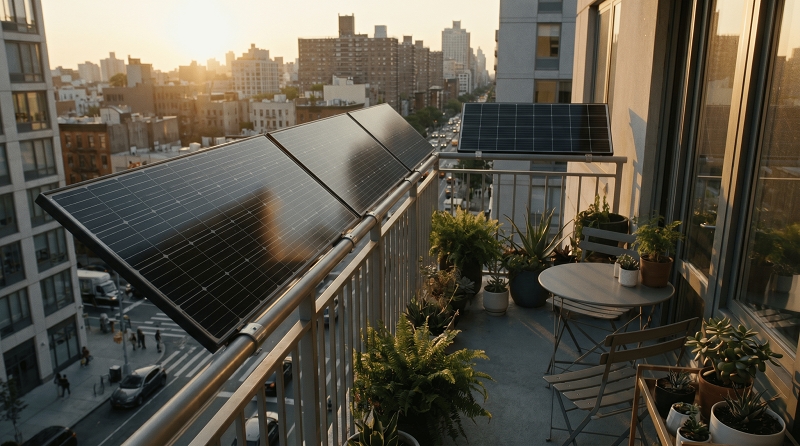
Current US policy incentives & regulations about balcony solar
While millions of these systems are already powering apartments across Europe, the US has historically lagged due to strict electrical codes. However, a massive legislative wave in 2025 and 2026 is changing the landscape overnight.
The legislative wave: State governments are beginning to reclassify these small, plug-in solar systems as "household appliances" rather than power generation facilities. This reclassification cuts through bureaucratic red tape.
Pioneer states: Utah paved the way by passing the first dedicated plug-in solar law in 2025. Since then, over 28 states have introduced similar bills. As of mid-2026, five states — Utah, Maine, Virginia, Maryland, and Colorado — have successfully passed legislation legalizing plug-in solar, with more states actively considering bills.
Key consumer benefits:
Exemption from utility interconnection: In legally protected states, you do not need to sign an expensive, complex interconnection agreement with your utility company.
No waiting periods: You bypass the months-long wait for utility approval and professional installation.
Renter protections: Many of these new laws include provisions that protect renters and condo owners against strict blanket bans from landlords or Homeowner Associations (HOAs).
The costs of installing balcony solar systems
One of the most appealing aspects of plug-and-play solar is its low financial barrier to entry.
Upfront hardware costs
A basic 400W balcony kit typically starts around $300 to $400. For those looking to maximize their apartment's potential, a full 1,200W system (usually three to four small panels) will cost between $1,000 and $1,500.
Installation & other costs
Because balcony solar is completely DIY, your installation cost is $0. Furthermore, in states with progressive PIPV laws, you eliminate expensive permitting fees and utility interconnection charges.
Return on Investment (ROI)
While an 800W system won't zero out your power bill, it will constantly chip away at your baseline usage. Depending on your local utility rates, the estimated payback period for a balcony kit is usually between 3 to 7 years. After that, the energy generated is pure profit.
Ideal use scenarios and operation for balcony solar
Balcony solar is not designed to take a house off the grid; it is a specialized tool for a specific demographic. That's why the target audiences are primarily renters, apartment dwellers, and condo owners without roof access.
Additionally, for renters or apartment dwellers, traditional solar energy systems are not a practical solution. That's why balcony systems make the most sense, since they are fully portable. When your lease is up, you simply unplug the kit, unbolt the panels, and take your investment with you to your next home.
How to use it (the setup process)?
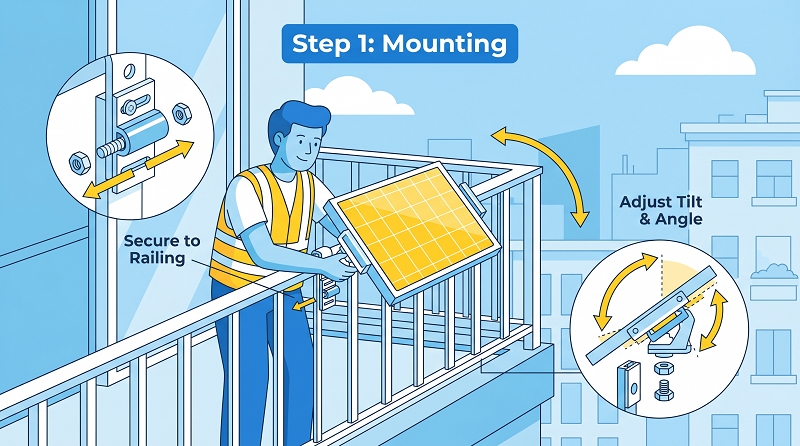
Step 1: Mounting
Safely secure the solar panels to your balcony railing, fence, or patio deck using the provided mounting brackets. Adjust the tilt to optimize your sun angle if the hardware allows.
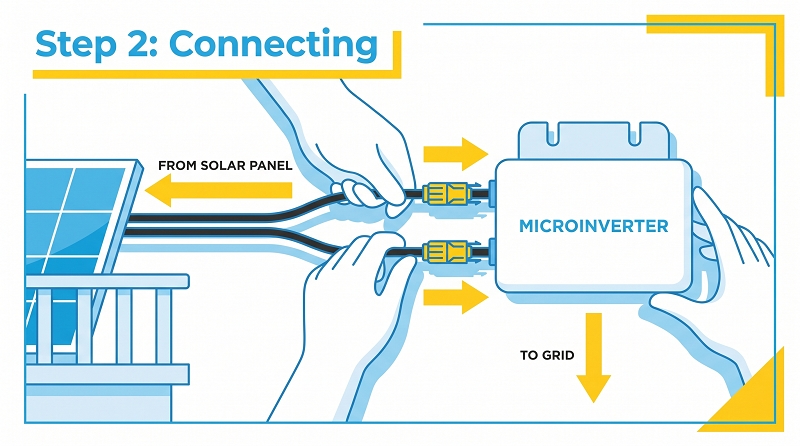
Step 2: Connecting
Connect the cables from the solar panels directly into your microinverter.
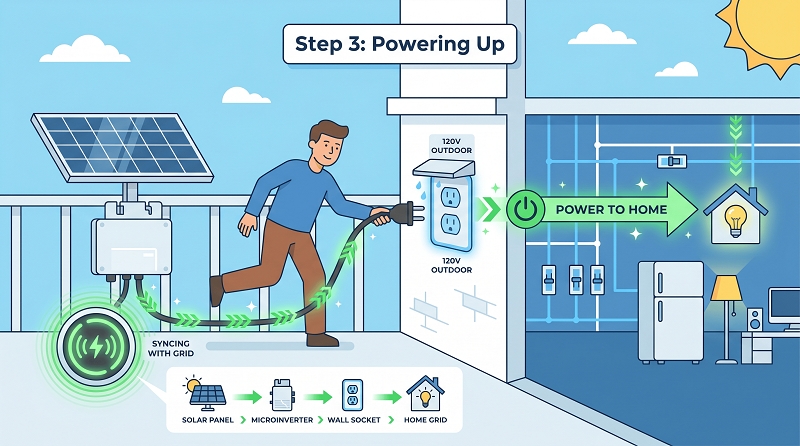
Step 3: Powering up
Plug the microinverter directly into a standard, outdoor-rated 120V wall socket. Once the microinverter syncs with your home/apartment's grid frequency, it will begin feeding power straight into your home's circuitry
Is balcony solar right for you: crucial factors to consider
Before ordering a kit, evaluate your living situation against these four factors:
Sun exposure and orientation: Do you have a South, East, or West-facing balcony that receives direct, unshaded sunlight for most of the day? North-facing or heavily shaded balconies will yield poor results.
HOA and landlord guidelines: Even in states with protective "Right to Solar" laws, you must check for specific aesthetic, structural, or weight restrictions regarding your balcony railing.
Outlet accessibility: Do you have a safe, outdoor-rated 120V electrical outlet accessible on your balcony to plug the microinverter into? Running extension cords through sliding glass doors is not a safe long-term solution.
Your ultimate energy goals: Are you simply looking to shave $20 to $40 off your monthly electric bill? If so, "balcony solar" is perfect. On the other hand, are you seeking blackout protection and grid independence? If so, you need a different solution.
Balcony solar vs. whole-home systems: learning the differences
Balcony solar is perfect for small-scale, steady savings, especially for apartment owners. However, if you are a homeowner seeking robust off-grid capabilities, total home backup, or the ability to run heavy machinery, you will need something more robust. That's where solutions like the EcoFlow Ocean Pro present a massive leap in capability.
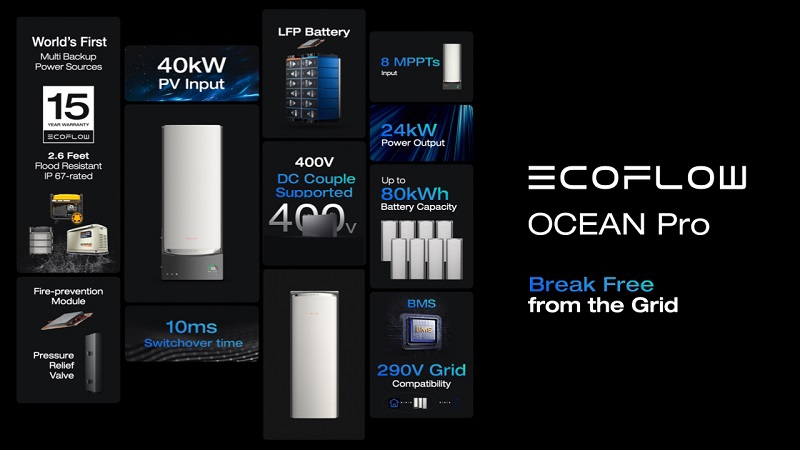
Here is how advanced systems like the Ocean Pro differ from balcony kits:
Powering minor loads vs. heavy appliances: Balcony systems legally top out around 1.2kW, enough for a fridge and a laptop. The Ocean Pro delivers massive nominal output (up to 24.0kW) and features a 205A LRA (Locked Rotor Amps) capable of starting high-demand surge loads like central air conditioners and well pumps.
Space limitations vs maximum solar harvesting: Balcony solar is heavily constrained by your railing space. The Ocean Pro is built for expansive roof or ground-mount setups, supporting a massive maximum STC input of 40kW across 8 distinct MPPTs (supporting 5kW per channel) at an incredible 97.5% efficiency.
Daytime offsetting vs true energy resilience: Basic balcony kits lack heavy battery storage. The Ocean Pro integrates robust 10kWh DC battery units. It is highly scalable, supporting up to 8 batteries (80kWh total capacity) and 2 inverter units to keep large homes running for days during a grid outage.
Standard plug vs seamless grid integration: Balcony solar uses a basic 120V plug. The Ocean Pro (housed in a NEMA 3R enclosure for indoor or outdoor use) wires directly and seamlessly into the home, supporting 120/240V split-phase and 208V 3-phase power. It integrates smartly with the home via the EcoFlow OCEAN Smart Electrical Panel 40 and the EcoFlow Mobile App.
Get Your Free Home Energy Consultation!
Which energy solution are you interested in?

Signing off
Balcony solar represents a vital shift in the renewable energy landscape, serving as the ultimate gateway for renters and apartment owners who have historically been left out of the solar revolution.
With changing state laws and rigorous new safety certifications, plugging a solar panel directly into your wall is no longer a sci-fi concept; it's a practical, everyday reality.
Whether that means starting small with a plug-in kit for your condo, or taking your entire house fully off-grid with an advanced solution like the Ocean Pro, the power to generate your own electricity has never been more accessible.
Frequently Asked Questions (FAQs)
Does balcony solar really work?
Yes. While it is just gaining a foothold in the US, balcony solar is a massive success globally. In Germany alone, an estimated 1 million households use "Balkonkraftwerk" (balcony power plants) to successfully offset their daily baseline electricity consumption.
Do I need my utility's permission to plug in a balcony solar system?
It depends on your state. In states with new plug-in solar legislation (like Utah, Maine, Colorado, and Virginia), utility interconnection agreements and approval fees are no longer required for systems under the legal wattage limit (usually 1,200W). If you live in a state without these protections, your utility may still technically require an agreement.
Can a balcony solar system power my house during a blackout?
No. For safety reasons, grid-tied plug-in solar automatically shuts off during a blackout. This anti-islanding protection prevents your panels from sending live electricity back into the grid, which could injure utility workers repairing the lines. For backup power during outages, you need a hybrid inverter and battery system (like the Ocean Pro) with off-grid capabilities.
How much money can I actually save with balcony solar?
A standard 400W–800W setup usually saves an apartment dweller around $15 to $50 a month by offsetting baseline electricity usage. Depending on your local utility rates, this leads to a full return on your initial investment within 3 to 7 years.
Why hasn't balcony solar taken off in the US?
Historically, balcony solar was stuck in a regulatory gray area in the US. It wasn't until the creation of the UL 3700 safety standard and state-level legislative pushes in 2025 and 2026 that the legal pathways for plug-and-play solar finally opened up in America. However, keep in mind that UL 3700 was published in December 2025, and UL Solutions opened its testing and certification program in January 2026.

