
kVA to Amps Guide: How to Calculate Your Power Requirements Correctly (UK 2026)
Figuring out kVA to amps is key to making sure your electrical system handles the load – no tripped breakers, no fire risks. In the UK, where standard domestic voltage sits at 230V, knowing how to switch between these units helps you pick the right backup power, size your cables properly, and stay on the right side of current safety regs. This guide gives you the exact formulas for single‑phase and three‑phase systems, plus some practical tips on managing your home energy in 2026.
What Is kVA and How Is It Different from kW?
Before we get into the numbers, let’s be clear on what we’re actually measuring. In the UK, you’ll spot kVA (kilovolt‑amperes) and kW (kilowatts) on all sorts of kit – from industrial generators right down to portable power stations.
Definition of kVA
kVA is known as Apparent Power. It represents the total amount of energy being used by a system. Think of it as the “raw” power being fed into your home or business before it gets put to work by your appliances.
Difference Between kVA and kW
While kVA is the total power, kW is the Real Power—the actual electricity that does the work, like boiling your kettle. The gap between the two comes down to electrical efficiency, otherwise known as the power factor.
kVA: Total power supplied.
kW: Power converted into useful output.
Why It Matters
Understanding this distinction prevents you from under-speccing your equipment. If you buy a power source based purely on kW but your appliances have a poor power factor, you might find your system tripping constantly because the kVA demand is higher than expected. This logic applies equally when you are interested in a 10 kilowatt solar system, as you must ensure the inverter and storage can handle your peak kVA requirements.
Understanding Amps and Why They Matter
If kVA is the volume of electricity, Amps (Amperes) are the “flow.” Knowing your Amperage is non-negotiable for anyone living in the UK who values fire safety and functional electronics.
Definition of Amperes
Amps measure the current or the rate at which electricity flows through a circuit. It’s the “speed” of the electrons moving through your wiring.
Relevance to UK Electrical Safety
In Britain, the standard domestic voltage sits at 230V. Every cable, fuse, and circuit breaker in your home comes with a maximum Amp rating – a standard UK plug, for instance, is fused at 13A. If your kVA conversion shows your demand pushes past those ratings, you’re looking at overheating wires and a real risk of electrical fire.

How to Convert kVA to Amps in the UK
Converting these units depends entirely on whether your property uses a standard single-phase setup or a heavy-duty three-phase system.
Single-Phase Conversion (Typical Homes)
Most UK homes run on single-phase electricity at 230V. To find the Amps, use this formula:
I=(kVA×1000)/V
Three-Phase Conversion (Commercial / Industrial)
For larger properties or workshops using 400V three-phase power, the calculation accounts for the increased efficiency of the three lines:
I=(kVA×1000)/(V×√3)
Practical Examples
Let’s look at how these numbers play out in a real-world British household:
| kVA Rating | Phase Type | Voltage | Calculated Amps |
|---|---|---|---|
| 1 kVA | Single Phase | 230V | ~4.35A |
| 3 kVA | Single Phase | 230V | ~13.04A |
| 10 kVA | Three Phase | 400V | ~14.43A |
Once you’ve calculated your total required Amperage (for example, finding that 3kVA at 230V is roughly 13.04A), the next step is ensuring your power supply can handle that load reliably.
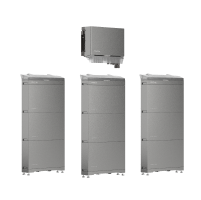
When choosing backup power, the EcoFlow PowerOcean offers a perfect balance. With a continuous output that comfortably covers the calculated needs of most essential household appliances, including refrigerators, lights, and Wi-Fi routers, it ensures smooth and efficient operation even during power outages. More importantly, for motor-driven tools like drills or water pumps that require a massive surge to start, the PowerOcean features a high peak output, effectively preventing blackouts caused by momentary overloads. This ensures that even appliances with high startup demands are smoothly powered on without overloading the system.
Furthermore, as mentioned regarding the difference between single and three-phase power, the PowerOcean is compatible with both 230V and 400V systems. This means that whether your calculations are based on a standard home setup or a complex commercial three-phase system, it provides precise power support that aligns with the latest UK 2026 electrical safety standards.
Why Your "Paper Calculation" Isn't Enough
A formula gives you a theoretical number, but real-world electricity is messy. You must account for Inrush Current (the surge when a fridge kicks in) and environmental factors like ambient temperature, which can affect wire conductivity.
Key Factors Affecting Your Calculation
To get a truly accurate reading, you need to look beyond the basic formula.
Power Factor Variations
An old heater might have a power factor of 1.0 (perfectly efficient), but an industrial motor might sit around 0.8. The power factor represents how effectively the “Apparent Power” (kVA) is converted into “Real Power” (kW).
| Appliance Type | Typical Power Factor (PF) | Notes |
|---|---|---|
| Incandescent Bulbs / Heaters | 1.0 | Purely Resistive Load |
| Computers / Modern LEDs | 0.9 – 0.95 | Equipped with PFC (Power Factor Correction) |
| Aircons / Fridges / Water Pumps | 0.7 – 0.8 | Inductive Load (contains a motor) |
The EcoFlow PowerInsight 2 makes a real difference here. It lets you monitor voltage (230V/400V) and total household current (up to 100A) in real time, tracking up to 50 devices at once. With accuracy down to ±1% and push notifications sent straight to your phone, you can see exactly how your load shifts through the day. That means you can tweak your usage and knock some pounds off your electricity bill.
Voltage Fluctuations and Load Type
The target is 230V, but the UK grid can bounce anywhere between 216V and 253V. If the voltage drops, the amperage goes up for the same kVA load – and that can easily trip your breakers.
Common Mistakes to Avoid
Ignoring the 80% Rule: Never run a circuit at 100% capacity indefinitely. Aim for 80% to keep things cool.
Confusing kW and kVA: Always check the label. If you calculate for 5kW but the device pulls 5kVA with a low power factor, you’re in trouble.
.png)
Step-by-Step Guide to Calculating Total Power Requirements
Doing your own power audit is a brilliant way to understand your home’s “energy appetite.” Here’s how to do it systematically without getting overwhelmed.
Identify Devices and Ratings
List every essential appliance and check the rating plate for its Wattage (W) or kVA. Keep in mind that for many motor-driven appliances, the kVA will be slightly higher due to efficiency losses. Crucially, account for “starting” power—some devices, like a chest freezer, can pull four times their running wattage the moment the compressor kicks in. This data is essential when designing a comprehensive EcoFlow home energy ecosystem tailored to your needs.
Apply Formulas and Safety Margins
Once you have your total kVA, use the UK standard formula:
Amps = (kVA × 1000) / 230 V
Always add a 20% safety buffer to your final figure. This industry-standard margin prevents your breakers from running too hot and accounts for minor voltage drops, ensuring long-term system reliability.
Verify Compliance
Check your total Amperage against your consumer unit (fuse box). Each circuit has its own Miniature Circuit Breaker (MCB) – typically 32A for sockets and 6A for lighting. Whether you’re adding new appliances or a home battery storage unit, make sure the total demand stays within those individual limits and under the main house fuse (usually 60A to 100A in the UK).
When to Consult a Qualified Electrician
While crunching the numbers yourself is a great first step for planning your EcoFlow setup, the actual installation and final verification often require a professional touch.
Legal and Safety Considerations
In the UK, electrical safety is governed by Part P of the Building Regulations. This means that most electrical work in “wet” areas (like kitchens and bathrooms) or the installation of new circuits must, by law, be carried out by a “competent person.” DIY-ing beyond a simple plug-and-play setup can not only be life-threatening but can also make your home impossible to sell later without the correct paperwork.
Complex Systems
If you’re moving beyond a portable power station and looking into whole-home integration, such as tying solar panels and the PowerOcean system into your main distribution board, the complexity rises exponentially. You may also need to evaluate the cost of a 10kw solar system with battery storage in the UK to ensure your project stays within budget while meeting all safety standards. An electrician will manage the “earthing” requirements—which are specific to UK soil—and ensure that if the grid goes down, your backup system doesn’t accidentally “backfeed” electricity into the street.
Certification
Documentation matters. Only an electrician registered with a recognised body – like NICEIC or NAPIT – can issue an Electrical Installation Certificate (EIC) or a Minor Works Certificate. You’ll need these for two main reasons. First, to keep your home insurance valid if a fire ever happens. Second, to show future buyers that your high-tech 2026 energy system was installed to the latest British Standard (BS 7671).
Schedule Your Free Consultation Today!
What kind of product or solution are you interested in?

Conclusion
Getting your kVA to amps calculation right is what separates a system that runs quietly from one that leaves you sitting in the dark. Know the 230V UK standard, factor in power factors, and pick a solid kit like the EcoFlow PowerOcean and PowerInsight 2. That way, your home stays powered, safe, and efficient through 2026 and beyond. And if you’re ever unsure, run your numbers past a qualified sparky.
FAQ
1. How many amps is 1 kVA at 230V?
1 kVA at 230V is approximately 4.35 Amps. This is calculated by dividing 1,000 (1 kVA) by 230.
2. What is the difference between kVA and kW?
kVA measures “apparent” power, while kW measures “real” power used for work. The difference between the two is determined by the power factor of the appliance.
3. Does kVA include power factors?
No. kVA is the Apparent Power—the total capacity flowing through the system. The difference between kVA and kW isn’t about energy “loss” (efficiency), but rather Reactive Power. This is caused by the phase shift between voltage and current in inductive loads like motors or compressors.
4. How many amps is a 10 kVA generator?
On a standard UK single-phase system (230V), a 10 kVA generator provides roughly 43.48 Amps. On a three-phase system (400V), it provides roughly 14.43 Amps per phase.
5. How do I know if I need 3-phase power?
You likely need three-phase power if you run heavy industrial machinery or have exceptionally high total power demands (usually over 18kVA). Most UK homes are perfectly fine on single-phase.

