
Energy Bills Too High? Here Is What the Average UK Household Pays and How to Actually Reduce It
One of the largest expenses in the UK is the cost of energy. Whilst there has also been some alleviation from the highs of 2022 and 2023, millions are still spending more than they need to, without even realising it. Whether your bills feel too high, you suspect an error, or you simply want practical uk energy bills saving tips that make a real difference, this guide covers everything you need to know for 2026.
What Is the Average Energy Bill in the UK Right Now?
Average annual and monthly costs for UK households in 2026
Under the present Ofgem price cap, an average energy bill uk household will pay around £1,568 per annum in 2026, which equates to approximately £131 per month for a typical dual fuel home. The smaller homes are cheaper, and the bigger residences with a lot more space are quite a bit more costly.
Many factors influence the average energy bill uk, including the type of heating system, the number of people living in the home, the level of home insulation, and where you live.
How the Ofgem price cap affects what you pay
The Ofgem price cap does not limit how much you spend on your bill. It limits the amount that your supplier can charge you for each kWh and per unit. Increase your energy usage beyond the average energy costs in the UK, and no matter the cap, your bill will be higher than the average. What you pay this winter could vary from last summer, as the cap is quarterly.
Why your bill may be higher than the national average
One of the most common causes of households paying more than the average energy bill uk, is that they are on a standard variable tariff instead of a competitive fixed tariff. Other unnecessary expenses include poor insulation, older appliances, and devices that are left on standby.
Why So Many UK Households Are Overpaying for Energy
Estimated bills versus actual usage
If you have been receiving estimated bills from your supplier instead of reading from the meter, there is a good possibility that you've been overcharged. Make sure to provide meter readings on a regular basis, or make sure your smart meter is working properly.
Outdated tariffs and missed switching opportunities
Many homes are considered on a “standard” variable rate deal without opting for it after a fixed-rate agreement concludes. These are generally much pricier than their alternatives. Checking the market regularly and switching when a better deal is available is one of the simplest uk energy bills saving tips available.
Poor home insulation and hidden energy waste
Walls, roofs, windows, and floors are responsible for large amounts of energy loss in homes in the UK. Draught-proofing, loft insulation, and cavity wall insulation all help to lessen the energy consumption required to heat your home, whilst not altering your behaviour at all.
Incorrect Energy Bills in the UK: What to Do and How to Claim Compensation
A uk energy bill warning worth heeding is that billing errors are more common than most people realise. If you receive a bill that seems significantly higher than usual, do not ignore it.
The most common billing errors and how to spot them
Common mistakes include overestimated readings, duplicate charges, and wrong tariffs being used. The easiest way to spot these is to line items that match your bill with your contract.
Your rights under Ofgem rules
Ofgem has rules about your supplier billing you correctly and in good time. If they have charged you more than they should have, they must refund you the correct amount as well. If you receive a bill for a catch-up amount that is beyond your ordinary service charge, you can ask for a payment plan.
How to dispute a bill and claim compensation
Incorrect energy bills compensation uk rules give you a clear path to recourse. Make sure to reach out to your supplier with proof of the mistake and document all correspondence. If the problem is not resolved within eight weeks, take it up to the Energy Ombudsman, who can provide compensation in serious cases.
How to use smart meter data to back up your complaint
Your supplier can use half-hourly consumption data if you have a smart meter. Asking this and then checking your bill is one of the best ways to show a clear billing error.
Practical Tips to Reduce Your UK Energy Bills Today
Heating and hot water: the biggest cost in most homes
Heating accounts for around 55% of the average uk energy bill. Turning your thermostat down to just one degree can reduce heating costs by up to 10% annually. The first step to saving money is to program your home heating system so that it only heats when it is necessary.
Appliances and standby power: small changes, real savings
To calculate the approximate cost of devices that are left on standby, multiply the average cost of £16 per month by the number of months in a year. Turning off equipment at the wall equals no cost. The longer you have to wait, the more significant the difference will be when you upgrade older appliances to A-rated models.
Lighting, draught-proofing and insulation quick wins
The replacement of all the lights in your home with LED lights can save you approximately £40 a year. Sealing around the door and window openings around doors and windows costs little and provides instant heat savings. The cost of loft insulation is generally £150 to £300 per year for homes of varying sizes.
Switching tariffs and making the most off-peak rates
For those on a TOU plan, appliances that use a lot of electricity, such as the dishwasher and washing machine, can significantly lower your bills if you run them during off-peak hours. Some tariffs even have cheaper overnight rates of 7p per kWh, and can be as high as 25p or more during peak hours.
Solar panels: generating your own electricity to offset bills
By installing solar panels, you will produce electricity and lessen your dependence on the grid. In the UK, a typical 4kW system will produce approximately 3,400kWh per year. When paired with battery storage, solar can have a significant impact on your reliance on grid power.
Understanding Your Energy Usage: The First Step to Lasting Savings
Most households have a general sense that their bills are high, but very few know which appliances or habits are primarily responsible. Seeing the live cost of running your tumble dryer or electric shower changes behaviour in a way that a monthly bill simply does not.
Once you can see exactly where your energy goes, the natural next step is a system that acts on that information automatically, without requiring daily manual adjustments.
From Awareness to Automation: Managing Your Home Energy Intelligently
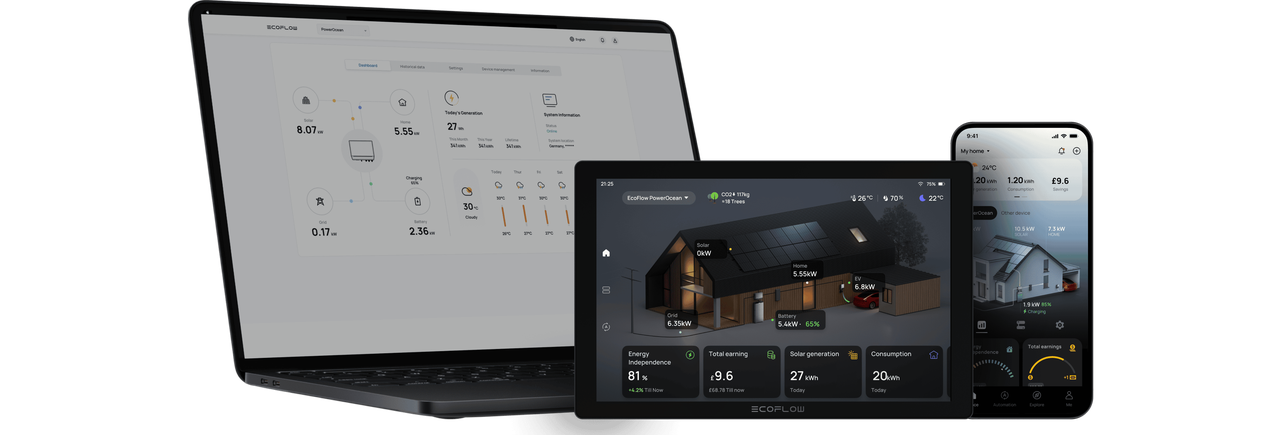
EcoFlow Home Energy Management System can monitor both your solar production and your home consumption, as well as your battery storage and grid rate, at the same time, and intelligently manage your home energy usage for households who wish to go beyond monitoring to optimisation.
How an intelligent energy management system works
The EcoFlow HEMS is compatible with solar panels, home battery, EV charger and other devices via a single platform. Excess power generated from the sun is stored when production is high. When the grid rates are high, it takes electricity from your battery. When cheap overnight rates are available, it charges ready for the next day.
Tariff optimisation and realistic savings
The system connects directly to the main time-of-use tariffs offered in the UK, allowing energy to be used at the most cost-effective times. In some households, combining monitoring, storage, and automated energy management has led to significant reductions in grid electricity use, depending on tariffs, usage patterns, and system configuration.
Adding Battery Storage: Locking In Your Savings Around the Clock
The biggest benefit of smart energy management is when it's coupled with home battery storage. The biggest savings are realized when electricity is stored when it is cheap and used during the expensive peak hours, or when it is generated by solar power.
How home battery storage reduces grid dependence
A home battery lets you store electricity when it's least expensive and use it when prices are highest. This fundamentally changes your relationship with energy price fluctuations.

The EcoFlow OCEAN 2 Plus Single-Phase is a modular home battery storage solution designed to integrate seamlessly with the EcoFlow HEMS, providing expandable home battery storage for single-phase UK homes. They have a 15-year warranty and are available to fit into your existing solar system, and can be increased over time. For the optimal configuration for your home, get a solar battery quote from the EcoFlow team.
Schedule Your Free Consultation Today!
What kind of product or solution are you interested in?


Conclusion
There are more than just one-off tips to help you reduce your energy bills in the UK. It starts with understanding what average energy bills uk households face, knowing your rights when bills are incorrect, and making practical changes to how you use energy day to day. The greatest long term benefits are achieved when solar generation, home battery storage and intelligent energy management are integrated. See the EcoFlow Home Energy Ecosystem and what a total solution might be to your home.
FAQs
What is the average energy bill in the UK in 2026?
The average energy bill uk households pay in 2026 is approximately £1,568 per year, or around £131 per month, for a typical medium-sized home on a dual-fuel tariff. This will differ depending on home and insulation type and usage.
What can I do if my energy bill is incorrect?
Contact your supplier directly with evidence of the error and request a correction. Keep records of all communications. If the problem is not resolved in 8 weeks, escalate to the Energy Ombudsman. Your electricity supplier will reimburse any overcharging under Ofgem regulations.
How much compensation can I claim for an incorrect energy bill in the UK?
Incorrect energy bills compensation uk rules allow the Energy Ombudsman to award significant compensation in serious cases. For most straightforward billing disputes, the outcome is a credit or refund. The important thing is to bring it up early and have accurate accounting all along.
What are the best ways to reduce my energy bills in the UK?
The best uk energy bills saving tips include providing accurate meter readings, switching to a competitive energy tariff, home insulation, using appliances during off-peak times and, of course, installing solar panels with home battery storage units and saving money in the longer term.
Can solar panels and battery storage really lower my energy bills?
Yes. A home battery and PV system will save households a considerable amount of money annually. Combined, with a smart Home Energy Management System, savings are maximised through automatic energy scheduling to match the lowest time of day rates.

