Watt Hours to Amp Hours: Formula, Conversion & Calculator Guide
When you work with batteries, solar systems, or backup power, you will see two main units. These are watt hours (Wh) and amp hours (Ah). Learning to convert watt hours to amp hours is very important. It helps you size your batteries correctly. You can also use it to estimate how long your power will last. It is the best way to compare different energy storage systems and optimize your home energy ecosystem. for maximum efficiency. Many battery labels list capacity in amp hours. However, your appliances usually measure energy in watts or watt hours. This mismatch can be confusing. Using the Wh to Ah formula helps you find the true usable energy in your battery.
What are Watt Hours and Amp Hours?
Understanding these two units is the first step to mastering your power setup. They tell you different things about how much energy your battery holds.
Watt Hours (Wh)
Watt hours measure the total energy stored in a battery. Think of this as the size of your fuel tank. It tells you exactly how much total work the battery can do before it runs out.
Amp Hours (Ah)
Amp hours measure the electrical charge capacity over time. This tells you how much current (Amps) a battery can provide for one hour. While common, this number doesn't tell the whole story on its own.
Why confusion?
Most batteries are labeled in Ah, but this can be misleading. A "100Ah" battery does not always hold the same amount of energy. It depends entirely on voltage.
100Ah at 12V = 1,200Wh of total energy.
100Ah at 48V = 4,800Wh of total energy.
Even though both say "100Ah," the 48V battery holds four times more energy! This is why checking the Wh is the best way to compare batteries fairly.
How to convert Watt Hours to Amp Hours?
The conversion from watt-hours to amp-hours is a straightforward mathematical process.
Basic formula: AmpHours (Ah) = WattHours (Wh) ÷ Voltage (V)
Step 1: Identify total energy capacity
Look at your device or battery label.
Step 2: Identify the system voltage (V)
Ascertain the voltage (V) of the battery or system.
Step 3: Perform the division
Divide the watt hours by the voltage to get your amp hour rating.
Example: If you have a 1200Wh battery and it runs on a 12V system:
1200Wh/12V = 100Ah
This means your battery has a 100Ah capacity. Knowing this helps you choose the right solar controller or charger for your setup.
How to convert Amp Hours to Watt Hours
An amp hour to watt hour conversion reveals your battery's true energy capacity. This helps you understand exactly how much power is available for your appliances.
Reverse formula: WattHours (Wh) = AmpHours (Ah) × Voltage
Step 1: Identify the battery voltage
Look at your battery label or user manual. Most batteries or solar setups in Australia run on 12V, 24V, or 48V.
Step 2: Identify Ah rating
Find the amp hour (Ah) number on your battery. This is usually the most prominent number on the casing.
Step 3: Perform the calculation
Multiply the Ah by the Voltage to see your total Watt hours.
Example: If you have a 100Ah battery for your caravan running at 12V:
100 × 12 = 1200 Wh
Why Do You Need to Know Amp Hour & Watt Hour Calculations?
Sizing your battery
The capacity of a battery is normally measured or rated in terms of Ah (Ampere Hours). However, the Ah rating does not give you an idea of the actual amount of energy stored. To know the actual amount of energy stored in your battery, you need to convert Ah to Wh (Watt Hours). This will enable you to size your battery appropriately.
Comparing battery value
Two batteries labeled 100Ah may not provide the same energy. The voltage of the battery makes a big difference. For example, a 100Ah 12V battery stores much less energy than a 100Ah 24V battery. Converting the capacity to Watt Hours makes comparison easier. It helps you choose the battery with higher usable energy.
Estimating runtime
Most appliances are rated in Watts. Batteries, however, are rated in amp-hours. By converting battery capacity into Watt Hours, you can estimate runtime. This shows how long a device can operate on a battery. It aids in strategizing energy consumption, preventing those unwelcome power outages.
System compatibility
The solar power system comprises solar batteries, charge controllers, and inverters. These parts need to be compatible in terms of voltage. The understanding of "Amp Hours" and "Watt Hours" is important for this purpose. This ensures that the battery's energy is converted in a safe manner, which is also efficient.
Watt Hours to Amp Hours Conversion Table
Use this watt hours to amp hours calculator guide to quickly find the capacity you need for your specific battery voltage and energy goals.
Watt Hours (Wh) | Voltage (V) | Amp Hours (Ah) |
500Wh | 12V | 41.67Ah |
1000Wh | 12V | 83.33Ah |
1000Wh | 24V | 41.67Ah |
2000Wh | 48V | 41.67Ah |
Optimizing Energy Conversion with High-Voltage Systems
Efficiency is everything when you are relying on solar power. In Australia, heat and long cable runs can lead to energy loss. Choosing the right system architecture helps you keep more of the power you generate.
Modern home backup systems are moving away from traditional 12V or 24V setups. They are shifting toward high-voltage designs. Less energy is lost as heat when the voltage is higher during conversion. This maximizes the utility of each watt-hour your battery holds.
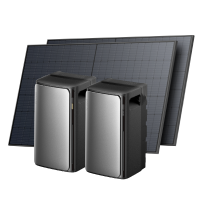
This technology is now widely used in the solar battery industry, with popular brands like EcoFlow leading the way. The EcoFlow PowerOcean Single-phase Battery is a premium storage solution designed for the Australian market. It uses an advanced high-voltage architecture. Each battery pack operates at this high voltage to maximize efficiency. This design helps you squeeze every bit of usable energy from your solar array. It allows for modular expansion, beginning at 5kWh and scaling up to 15kWh in one inverter. You don't have to worry about complex manual Ah calculations when upgrading. You simply add more modules to increase your total Wh capacity.

While formulas are great for planning, the EcoFlow Intelligent Home Energy Management System (HEMS) automates daily work. It manages how those watt-hours are distributed throughout your home. It seamlessly links your solar input, battery storage, and household load. This helps you achieve maximum self-sufficiency and lowers your electricity bills.
Ready to save more on your bills? Get a solar quote today and start using energy more efficiently.
Schedule Your Free Consultation Today!
What kind of product or solution are you interested in?


Conclusion
By grasping the watt hours to amp hours conversion concept, you can get a better idea of the battery capacity. This enables you to compare the capacity of the battery more accurately. Additionally, you can get the most out of your solar products by knowing the conversion of Wh to Ah. With the current technology, you can get the most efficient energy solution. EcoFlow PowerOcean is one such solution. This comes with high-voltage battery technology. This allows you to manage your energy usage more efficiently.
FAQs
1. Does converting amp hours to watt hours account for efficiency loss?
No, the formula gives you theoretical capacity. In real-world use, inverters and heat usually cause a 10–15% loss. To be safe, most Australian experts recommend sizing your battery slightly larger than your math suggests to cover these conversion inefficiencies.
2. How many watt hours in a 100Ah lithium battery?
It depends on the voltage. A standard 12.8V 100Ah lithium battery holds 1,280Wh, while a 24V 100Ah battery holds 2,400Wh. For maximum efficiency, the EcoFlow PowerOcean uses a high-voltage system. This design ensures you get the most usable energy from every battery pack.
3. How do watt hours affect backup runtime?
Watt hours are the total "fuel" available. The more Wh you have, the longer your devices will run. If you have a 1000Wh battery and run a 100W laptop, it will last about 10 hours. Higher Wh ratings mean more peace of mind during long outages or cloudy days.
4. Why does voltage matter in Wh to Ah conversions?
Voltage is like water pressure. Higher voltage allows you to move the same amount of energy (Wh) with fewer Amps. This is why modern systems like the EcoFlow PowerOcean use high voltage; it reduces heat loss and allows for thinner, safer wiring throughout your home.
5. How long does it take to charge a 100Ah battery with a 500W solar panel?
A 100Ah (12V) battery is 1,200Wh. In Australian conditions, a 500W panel usually yields about 400W of actual power. Dividing 1,200Wh by 400W gives you roughly 3 hours of peak sunlight for a full charge. Dust and heat may slightly increase this time.