kW to Amps: How to Convert Kilowatts to Amps in Australia
Converting kW to amps tells you how much current an appliance draws and whether your home’s circuits can handle it. In Australia, the calculation depends on your supply voltage, whether it’s single-phase or three-phase, and the appliance’s power factor. This guide runs through the formulas, gives you practical examples, and covers what to check when planning electrical loads at home.
Key Takeaways
The basics: kW tells you how fast power is being used or generated. Amps tells you how much current is actually flowing through the wires.
Voltage in Australia: Single-phase is nominally 230V, though you’ll often see 240V in practice. Three-phase runs at 400V or 415V.
The rule: Current equals watts divided by voltage times power factor. So a 1 kW resistive load on single-phase pulls about 4.17 to 4.35 amps.
Breakers: Normal power points sit on a 10A, 15A, or 16A/20A circuit. Heavy gear like induction cooktops, heat pumps, and EV chargers usually needs its own dedicated circuit to handle the load.
What Is the Difference Between kW and Amps?
Kilowatts (kW) measure electrical power, while Amps (A) measure the current flowing through a circuit. The two are related, but they describe different electrical properties. Understanding this distinction makes it easier to calculate appliance current and assess electrical loads.
These power and current ratings also matter when coordinating solar, storage and household loads within a home energy ecosystem.
Kilowatts as a Measure of Electrical Power
A kilowatt represents real, usable electrical power delivered at a rate of 1,000 joules per second (1 kW = 1,000 W). Check the appliance’s electrical input rating when calculating current. An air conditioner’s cooling or heating capacity is thermal output and must not be used directly as electrical input in the current formula.
Amps as a Measure of Electrical Current
Amperes—shortened universally to Amps—quantify electrical charge movement through a conductor. Every copper cable behind your plasterboard, every terminal pin on a three-pin plug, and every miniature circuit breaker (MCB) inside your meter box handles a finite volume of current before heating up. Circuit breakers respond to current: thermal protection operates with a delay under overload, while magnetic protection responds rapidly to high fault currents.
The Relationship Between Electrical Power and Current
Electrical power comes down to voltage and current. For DC and purely resistive AC loads, you just multiply one by the other:
Power (W) = Voltage (V) × Current (A)
But Australia’s grid runs on AC, so appliances with motors, like compressors, pool pumps, and fridges, need the power factor thrown into the mix. It accounts for the relationship between real and apparent power, including the phase difference between voltage and current.
How Do You Convert kW to Amps?
To convert kW to amps, you need three things: the appliance’s power rating, your supply voltage, and the power factor. The formula changes depending on whether you’re on single-phase or three-phase. Here’s how to pick the right calculation and work through an example.
Identify the Voltage and Supply Type
Most Australian detached homes run on a single-phase 230V/240V AC supply at 50 Hz. Some properties have a three-phase connection at 400V/415V line-to-line; confirm the supply type rather than inferring it from an appliance’s cooling capacity. To check, look at your main switchboard. A single toggle usually means single-phase, while a wider 3-pole linked switch means three-phase.
Choose the Correct kW to Amps Formula
Depending on whether your property is single-phase or three-phase, use the formula that fits.
Single-phase AC:
Current (A) = Power (kW) × 1,000 ÷ (Voltage (V) × Power Factor)
Three-phase AC (line-to-line voltage):
Current (A) = Power (kW) × 1,000 ÷ (1.732 × Line-to-Line Voltage (V) × Power Factor)
Note: 3 ≈ 1.732.Under standard AS 60038/AS/NZS 3000, Australia’s nominal line-to-line voltage is 400V (historically referenced as 415V). Single-phase nominal voltage is 230V (historically 240V). Power factor typically ranges from 0.80 to 0.90 for motor-driven equipment and 1.0 for purely resistive heating.
Calculate Amps With a Worked Example
Imagine you have installed a split-system air conditioner with a 7.2 kW cooling capacity. Because modern inverter heat pumps have a high Energy Efficiency Ratio (EER/COP of around 3.5), its actual electrical input power is only around 2.1 kW (2,100 W). Running on a single-phase 230V supply with a rated power factor of 0.90:
Convert kW to Watts: 2.1 × 1,000 = 2,100W
Multiply Voltage by Power Factor: 230 × 0.90 = 207V
Divide Watts by the Result: 2,100 ÷ 207 ≈ 10.14A
(Note: Always use electrical input power from the compliance plate, not the cooling/heating thermal output rating).
This example gives approximately 10 Amps under the stated assumptions. A licensed electrician must assess the manufacturer’s installation requirements and select suitable circuit protection, isolation and cable sizing for the actual installation.
If this calculation is part of an upgrade, the cost of installing air con also depends on the electrical work and installation layout.

How Is kW to Amps Conversion Used in Australia?
Knowing how many Amps an appliance draws is useful when installing air conditioners, EV chargers, solar inverters and other high-power equipment. The table below shows estimated current ratings for common Australian applications, followed by examples of how these calculations apply in practice. These are illustrative electrical input ratings, not installation specifications; circuit protection, cable sizes and connection requirements must be confirmed for the equipment and installation.
| Application | Typical Rating | Nominal Voltage | Est. Current (Amps) | Circuit Requirement |
|---|---|---|---|---|
| Kettle / Toaster | 2.2 kW | 240V (1-Phase) | 9.2A (PF=1.0) | Standard 10A GPO |
| Oven / Induction Cooktop | 7.4 kW | 240V (1-Phase) | 30.8A (PF=1.0) | Dedicated 32A/40A breaker |
| Split-System AC | 3.5 kW | 240V (1-Phase) | 16.2A (PF=0.9) | Dedicated 20A isolator |
| Level 2 EV Charger | 7.4 kW | 230V (1-Phase) | 32.0A (PF=1.0) | Dedicated 32A/40A line |
| Workshop Welder | 4.8 kW | 240V (1-Phase) | 20.0A (PF=1.0) | 15A/20A industrial plug |
| Ducted HVAC System | 14.0 kW | 415V (3-Phase) | 22.3A (PF=0.88) | Dedicated 3-pole 25A breaker |
Calculate Current for Household Appliances
Working out how much current your air con, hot water, and washing machine draw helps you understand how they run, and keeps your combined loads within what your circuits can handle. When you want to pin down peak times and see how solar, household demand, and battery storage interact, the EcoFlow PowerInsight 2 can show compatible household, solar and battery energy flows, depending on the connected equipment and installation. Its visual interface shows live power draw and energy flow in real time, so you can refine your habits and schedule the heavy appliances to better align flexible loads with available solar generation.
Calculate Current for Solar and Battery Systems
When you’re planning solar and storage in Australia, converting kW to amps helps you estimate current demand from inverter output, working voltage, and connection type. But beyond the hardware specs, everyday planning means looking at your household consumption curve, peak solar hours, and smart ways to store daytime surplus for the evening peak.
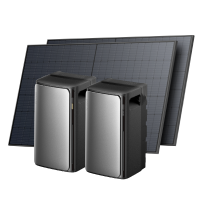
The Ecoflow OCEAN 2 Plus single phase ties solar generation and battery storage into one system. You can scale capacity as your needs grow and tailor a clean energy setup that matches how your household actually uses power.
Calculate Current for EV Chargers
Charging an electric vehicle at home adds substantial continuous load to your switchboard. While portable emergency trickle chargers draw roughly 2.0 kW (around 8.3A to 10A on an everyday domestic plug), dedicated Level 2 wall boxes deliver 7.4 kW on a single-phase line.
Running 7.4 kW on 230V pushes a flat 32 Amps continuously through the feed for hours at a time. If an older suburban house is limited to a 63A main service fuse, running a 32A car charger simultaneously with a 4.5 kW electric hot water booster and an induction cooktop can push total demand dangerously close to the main service limit.
Estimate Current for Commercial and Industrial Equipment
In commercial sheds, workshops, and light industrial facilities, heavy motors operate on a 400V three-phase supply (traditionally 415V). For example, a 22 kW air compressor with a power factor of 0.85 operating at nominal 400V draws approximately:
Current (A) = 22 × 1,000 ÷ (1.732 × 400 × 0.85) ≈ 37.4 A per phase
(If measured at historical 415V, the current is approximately 36.0 A).

What Should You Check When Converting kW to Amps?
For homes with solar battery storage, check inverter output and the current ratings of the circuits it will supply, as well as the battery’s energy capacity.
A kW to Amps calculation gives you an estimate of electrical current, but it doesn’t tell you everything about circuit requirements. Power factor, equipment ratings, circuit protection and starting current can all affect the actual load. These factors are especially important when dealing with high-power appliances or new electrical installations.
Account for Power Factor in AC Systems
Resistive elements like basic electric radiators, kettles, and halogen lamps convert power directly into heat, maintaining a power factor of 1.0. Inductive loads equipped with electromagnetic windings—compressors, pool pumps, and ceiling fans—cause voltage and current to slip out of sync, lowering the power factor to between 0.75 and 0.90. Overlooking power factor leads to undersizing wiring, because the circuit must carry the current associated with apparent power (current is measured in amps; apparent power in kVA), not just the real power component.
Verify Equipment Current Ratings
Never rely purely on rough calculations when the manufacturer’s compliance plate sits riveted directly to the chassis. Cross-check the equipment’s rated input current and the manufacturer’s installation instructions; the exact nameplate terminology varies by product.
A smart meter can help you review historical grid imports and exports, but its interval data does not replace equipment current ratings or a circuit assessment.
Check Circuit Capacity and Protection
Australian wall outlets feature distinct physical and electrical tiers:
10A GPO: Standard three-pin domestic outlet wired using 1.5mm² or 2.5mm² cable.
15A GPO: Outlets with an enlarged earth pin aperture (found on heavy welders, caravan cords, and large plug-in ovens), typically wired on dedicated runs.
Direct Hardwiring: Where equipment requires hardwiring, connection, isolation and protective devices must be selected for the equipment and installation by a licensed electrician.
Allow for Higher Starting Current
Motor-driven machinery demands substantially more current during start-up than during steady operation. Standard squirrel-cage induction motors frequently exhibit an inrush or Locked Rotor Current (LRA) reaching 4 to 7 times their nominal running current for a few fractions of a second. A licensed electrician should select protection using the equipment’s starting characteristics and installation conditions.
Schedule Your Free Consultation Today!
What kind of product or solution are you interested in?
Conclusion
Converting kW to amps bridges the gap between how appliances use power and how your circuits safely carry it. Factor in Australian voltages, line configurations, and equipment power factors, and you can accurately assess load capacity, avoid nuisance trips, and plan upgrades with confidence. Whether you’re adding an EV wallbox, picking a modern reverse-cycle system, or integrating solar and battery storage, current calculations support planning, while a qualified installation assessment is needed to confirm safety and compliance.
FAQs
How do I convert watts to amps in Australia?
Divide the wattage by your circuit voltage (230V or 240V for single-phase) and the power factor. For a simple resistive load like a kettle on 240V, a 1,200W appliance draws 1,200 ÷ 240 = 5 amps.
Can you have amperage with no voltage?
No, not in any practical circuit. Voltage is the driving force that pushes the charge. Without it, no current flows.
How many amps are 3,000 watts at 240V?
A 3,000W load at 240V draws 12.5 amps, assuming a power factor of 1.0. If it’s a motor with a power factor around 0.85, the running current climbs to about 14.7 amps.
How do you convert mA to amps?
Divide by 1,000. A safety switch rated to trip at 30 mA works out to 30 ÷ 1,000 = 0.03 amps.