What Is the Average Electricity Bill in Brisbane? (And How to Reduce It)
Electricity is the largest utility expense for most Brisbane households, and the bill keeps growing. Queensland households pay some of the highest electricity costs in Australia, with the average Brisbane household spending around $1,668 per year on power. That works out to roughly $417 per quarter or $139 per month.
If that number looks familiar, the home is roughly on track. If the bill consistently sits higher, the gap is worth investigating. For households already running a home battery backup system, paying the average electricity bill in Brisbane means the setup is likely underperforming.
This guide breaks down the Brisbane average electricity bill by household size. It explains how charges are structured, how time-of-use tariffs work, and how solar and battery storage can help change the cost equation.
Average Brisbane electricity bill benchmarks (by household size)
Compare household electricity costs against typical Brisbane benchmarks to understand the key factors that drive monthly energy bills.
The single biggest variable is household size. More people means more appliances, more devices charging, more hot showers, and more lighting. Brisbane's hot climate adds another layer. Air conditioning through summer pushes bills up sharply for larger homes, and hot water systems are a significant contributor year-round.
Household Size | Daily Usage (kWh) | Avg Quarterly Bill | Avg Annual Bill |
1 person | 9.35 kWh | ~$417 | ~$1,668* |
2 persons | 14.04 kWh | ~$563 | ~$2,252 |
3 persons | ~18 kWh | ~$680 | ~$2,720 |
4 persons | ~22 kWh | ~$755 | ~$3,020 |
5+ persons | ~26 kWh | ~$850+ | ~$3,400+ |
*Note: This benchmark refers to a typical 1-person Brisbane household.
The average electricity bill for a Brisbane 2-person household sits around $563 per quarter, roughly $187 per month. For a single person, the average Brisbane electricity bill is closer to $417 per quarter.
One important caveat: these figures reflect average usage on standard tariff plans. Households on Time-of-Use tariffs, those with solar, or homes running ducted air conditioning or pool pumps will see different numbers. Brisbane's humid subtropical climate pushes summer bills up significantly. Winter is mild and uses far less heating energy than southern states.
Demystifying Brisbane electricity rates and charges
Learn how Brisbane electricity bills are structured by understanding usage charges, daily supply fees, and how they affect overall costs.
Every Brisbane electricity bill combines two types of charges. Understanding both is the first step toward knowing where money is actually going.
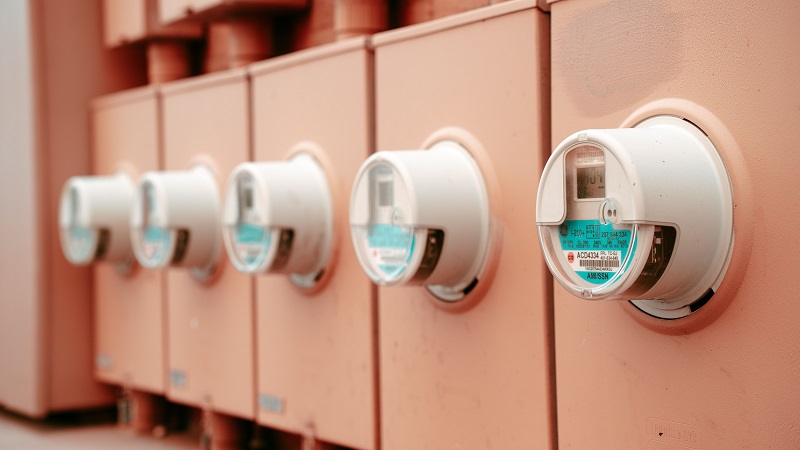
Usage charges (variable)
This is the cost for every unit of electricity consumed, measured in cents per kilowatt-hour (c/kWh). In Brisbane, which sits on the Energex distribution network, usage rates on standard flat-rate plans typically range from 25c/kWh to 33c/kWh. The exact rate depends on the retailer and plan chosen. On Time-of-Use tariffs, the rate changes depending on when electricity is used, which is covered in the next section.
Daily supply charges (fixed)
This is a fixed daily fee simply for remaining connected to the electricity grid. It applies every single day regardless of how much or how little electricity the household uses. In Brisbane, daily supply charges typically range from 80c/day to $1.50/day depending on the retailer. Over a quarter, that alone adds $73 to $137 to the bill before a single kilowatt-hour is used.
The Queensland Government's electricity tariffs page explains how tariff structures work and what rights Brisbane households have when comparing plans and switching retailers.
Off-peak electricity times in Brisbane: timing is money
iscover how Time-of-Use tariffs work and how shifting energy consumption to cheaper periods can help reduce electricity expenses.
Brisbane's Energex network operates on a Time-of-Use (ToU) structure that divides the day into three pricing windows. Knowing which window is which turns everyday routines into a bill management tool.
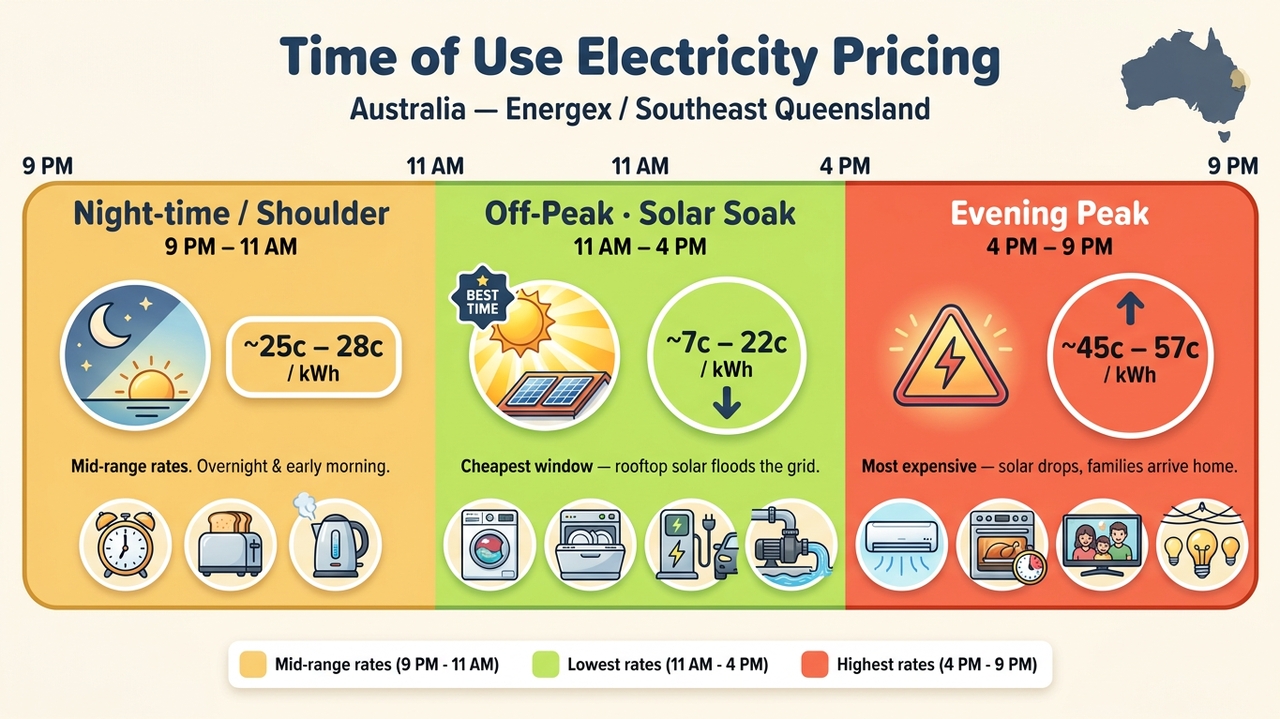
Off-peak / midday: 11 AM to 4 PM
This is the cheapest window of the day. Abundant rooftop solar floods the grid with cheap generation during these hours. Rates can drop to as low as 7c/kWh to 22c/kWh on some ToU plans. Energex itself calls this the "solar soak" window. Any appliance that does not need to run at a specific time belongs in this window.
Evening: 4 PM to 9 PM
This is the most expensive window. Solar generation drops off. Families arrive home. Air conditioners, ovens, and entertainment systems all switch on at once. Grid demand surges. Rates during this window can reach 45c/kWh to 57c/kWh on ToU plans, making it the most expensive electricity of the day.
Night-time: 9 PM to 11 AM
Overnight and early morning rates sit at a mid-range level, typically around 25c/kWh to 28c/kWh. Not the cheapest window, but considerably less than the evening peak.
Practical shifts that cut the average Brisbane electricity bill
Shifting heavy appliances out of the 4 to 9 PM peak window and into the midday solar soak delivers immediate savings without spending a dollar. Specific moves worth making:
Run the dishwasher at midday or after 9 PM rather than straight after dinner
Schedule the washing machine for the 11 AM to 4 PM window on weekdays
Set the pool pump to run from 11 AM to 3 PM
Pre-cool the house between 2 PM and 4 PM before the expensive peak begins
Each shift removes load from the most expensive pricing window. Over a full year, the combined impact on the average Brisbane electricity bill adds up meaningfully. For households considering battery storage, working out what size solar battery is needed based on actual evening usage is a smart first step.
Using solar and battery storage to reduce peak electricity costs
Explore how combining solar generation with intelligent battery storage can reduce reliance on expensive peak-rate electricity and improve energy independence, especially when calculating the average electricity bill in Brisbane.
Shifting the dishwasher to midday helps. But it does not solve the fundamental problem. Brisbane solar panels generate peak power from 10 AM to 3 PM, exactly when most households are out. That surplus goes to the grid at a low feed-in tariff rate, typically 5 to 10 cents per kWh. When the family comes home at 5 PM and the evening peak begins, that same energy costs 45 to 57 cents to buy back.
A battery helps address that mismatch. It captures the solar surplus during the cheap midday window. At 4 PM, when rates spike, it releases its stored energy rather than drawing from the expensive grid.
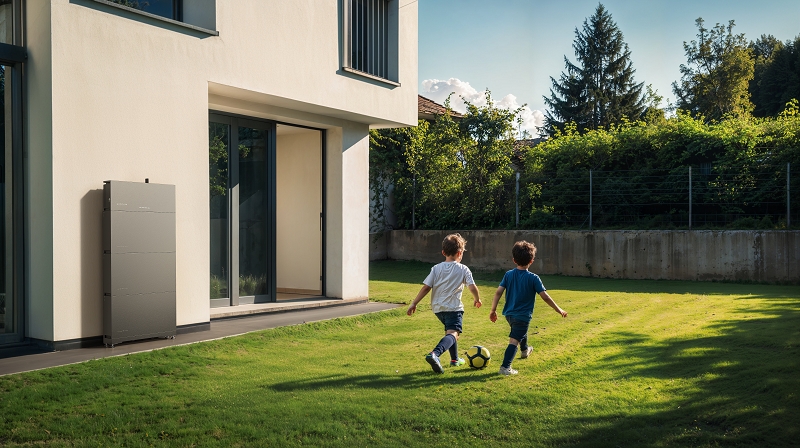
EcoFlow PowerOcean
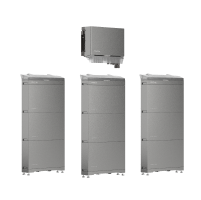
The EcoFlow PowerOcean Three-Phase system is built for this scenario. Brisbane homeowners face a costly energy gap: solar power generated midday is sold cheaply to the grid, while evening peak power comes with steep tariffs. Scalable home battery storage solves this imbalance by storing excess solar for after-hours use.
The EcoFlow PowerOcean uses LFP battery chemistry with aerosol fire protection (activates at 170 degrees Celsius). It carries an IP65 weatherproof rating and a 15-year warranty. Scalability starts at 5 kWh of storage and expands up to 45 kWh for the single-phase, and up to 60 kWh for the three-phase, as the household grows.
During a grid outage, it delivers 10 kW of backup output with a 20 millisecond switchover. Essential appliances keep running through Brisbane summer storms without interruption.
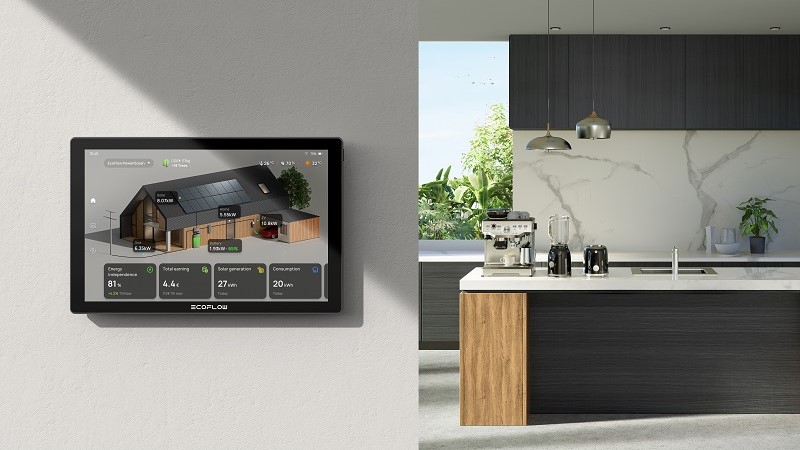
EcoFlow PowerInsight 2
A battery works best when it is managed intelligently. To maximise savings from solar battery storage, households need full visibility of real-time energy generation and consumption data. Smart energy monitoring tools automate charge and discharge cycles aligned with local ToU tariff windows.
The EcoFlow PowerInsight 2 Monitor is a wall-mounted 11-inch touchscreen that acts as a command centre for the whole system. Powered by AI Energy OS, it visualises real-time energy flow and automates charge scheduling. It fills the battery during cheap midday solar hours and discharges during the 4 to 9 PM peak. Matter 1.4 support lets smart plugs and thermostats be managed from the same panel.
The combination of solar generation, a smart battery, and intelligent monitoring turns a Brisbane home from a passive energy consumer into an active energy manager.
For a clear picture of potential savings, contact our professional energy consultants for a personalised assessment based on actual household usage and local tariff structure.
Schedule Your Free Consultation Today!
What kind of product or solution are you interested in?
Signing off
Adjusting daily energy habits, optimising appliance runtime and adding solar battery storage can drastically cut power costs for Brisbane households of all sizes.
Shifting heavy appliances usage to the midday off-peak window delivers immediate savings. Pairing that with solar panels and a battery system drastically cuts costly peak-time grid power expenses from the bill.
Rising rates are unlikely to reverse. Building an energy system that generates, stores, and manages power on the household's own terms is one of the most effective long-term approaches.
Contact our professional energy consultants to get a tailored solar battery recommendation based on the specific household's size, usage patterns, and local Brisbane tariff structure.
FAQs
Why have electricity bills in Brisbane gone up so much recently?
Brisbane electricity costs are rising for several reasons. Ageing network infrastructure upgrades are being passed on to consumers, and wholesale market volatility has also pushed rates higher. Additionally, temporary government rebate programs have now ended. As a result, bills appeared to jump by up to 16% in early 2026 as a result.
What is the difference between a flat-rate tariff and a time-of-use tariff?
A flat-rate tariff charges the same rate per kWh regardless of when electricity is used. A time-of-use tariff charges different rates across three windows. Off-peak (11 AM to 4 PM) is cheapest. Peak (4 PM to 9 PM) is most expensive. Shoulder (9 PM to 11 AM) sits in the middle. Households that can shift usage to off-peak hours benefit most from ToU plans.
Can I install the EcoFlow PowerOcean system myself?
No. The EcoFlow PowerOcean is a high-voltage residential energy storage system. Under Australian law and electrical safety standards including AS/NZS 5139, installation must be carried out by a licensed electrician with solar accreditation. Attempting DIY installation voids the warranty and creates serious safety and insurance risks.