
Understanding the Vanadium Redox Flow Battery for Grid Energy Storage
The energy storage problem is getting harder to ignore. Solar and wind now supply a meaningful share of electricity across the US, but their output rises and falls with the weather. When the sun sets or the wind drops, grids need stored energy to fill the gap. For short-duration backup lasting a few hours, lithium-ion handles the job. For storage measured in days, or for facilities that cannot afford cell degradation over tens of thousands of cycles, a different category of technology steps in.
The Vanadium Redox Flow Battery is built for exactly this challenge. Industrial in scale, chemically unique, and priced for commercial and utility deployment, these systems are engineering achievements in their own right. They are also, for very practical reasons, a long way from what most homeowners need when the grid goes down.
This article breaks down how vanadium flow batteries actually work, what they do well, where they fall short, and how they compare to the compact home battery backup systems that residential properties genuinely rely on.
The Mechanics Behind the Vanadium Flow Battery
Unlike standard solid-state lithium systems, flow batteries physically separate power generation from energy storage. This architectural difference allows for independent scaling of capacity and output for large commercial installations.
Liquid Electrolyte Tanks
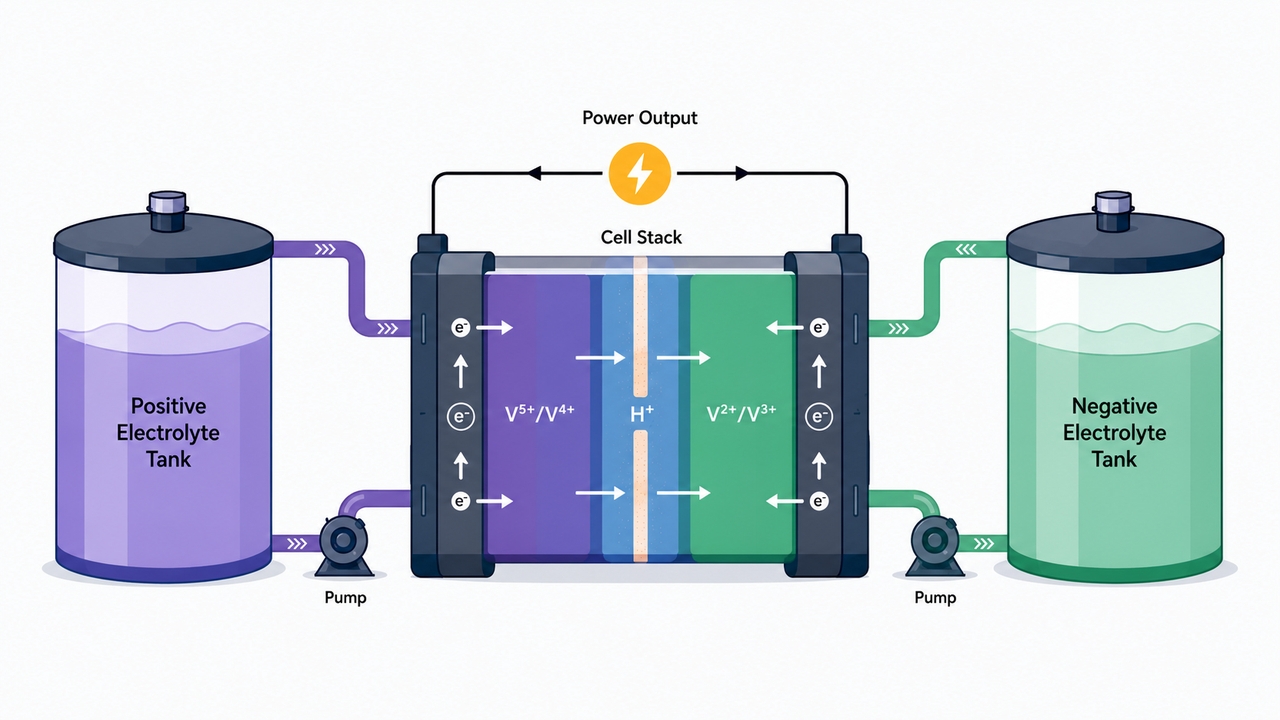
The primary difference between a Vanadium Redox Flow Battery (VRFB) and a conventional battery is where the energy is stored. Instead of using solid electrochemical cells, a vanadium redox battery stores energy in two large external tanks filled with a liquid vanadium electrolyte solution. One tank holds a positive electrolyte, and the other holds a negative one. Energy capacity in vanadium flow batteries scales with electrolyte tank volume, but practical scaling is constrained by engineering limits, cost, and balance-of-plant design. For utility projects with ample space, this provides a straightforward method to build large-scale storage.
The Cell Stack and Pumping System
The tanks themselves do not generate electricity. That process happens in the cell stack. Pumps continuously circulate the liquid electrolytes from both tanks through this central module, where they release or absorb electrons to create an electrical current. This design completely separates power and energy. As researched by the Pacific Northwest National Laboratory on flow battery mechanics, power output is determined by the size and number of cell stacks, while energy capacity depends entirely on tank volume. A project needing more output adds more stacks, and one needing a longer duration enlarges the tanks.
Single-Element Chemistry and the Membrane
Vanadium is uniquely suited to this chemistry because it exists in four distinct oxidation states. Both electrolyte tanks use vanadium, just in different states. A thin membrane inside the cell stack allows protons to pass through while preventing most vanadium ions from crossing over. Using a single element prevents the permanent contamination issues seen in systems that use two different chemical species. If any vanadium does cross the membrane, it can be recovered and rebalanced without damaging the system. Because the liquid electrolyte does not physically degrade like solid cells, VRFBs can sustain tens of thousands of cycles with minimal capacity loss.
Weighing the Pros and Cons of Vanadium Batteries
No storage technology is universally superior. Vanadium flow batteries have genuine strengths that make them the right answer in certain contexts, and real limitations that make them the wrong answer in others.
Pros:
Effectively unlimited cycle life: Over 20,000 cycles with minimal degradation is a practical reality for VRFBs, not a theoretical maximum. For grid-scale operations cycling daily over 20 or more years, the long-term economics of not replacing cells are significant.
100 percent depth of discharge: The full rated capacity is usable without damaging the system. Many solid-state batteries lose their lifespan when regularly drained below 20 percent. Vanadium redox flow batteries can tolerate deep discharge more effectively than many lithium-ion systems, but operational limits still exist depending on system design and efficiency considerations.
Low fire risk: The water-based electrolyte solution cannot support thermal runaway. For large industrial installations where a lithium-ion fire could be catastrophic, this is a meaningful safety advantage.
Electrolyte reusability: The vanadium electrolyte retains its value even after the rest of the system reaches end of life. It can be repurposed or resold, which meaningfully improves the total cost of ownership picture over a multi-decade project.
Cons:
Low energy density: A vanadium battery stores considerably less energy per unit of physical space than lithium-based alternatives. Achieving meaningful capacity requires very large tanks, which is why these systems are measured in megawatt-hours rather than kilowatt-hours for practical deployments.
High upfront cost: In 2025–2026, installed costs for vanadium redox flow battery systems are commonly estimated in the mid-hundreds of dollars per kWh at utility scale, with smaller deployments typically higher depending on project scale and system design. That is competitive on a lifetime cost basis, but the upfront capital commitment is substantial.
Active mechanical complexity: Pumps, piping, tanks, and control systems require ongoing maintenance. This is not a set-and-forget technology. Scheduled mechanical inspections, pump servicing, and electrolyte monitoring are part of the operational reality.
Commercial Use vs. Residential Energy Storage
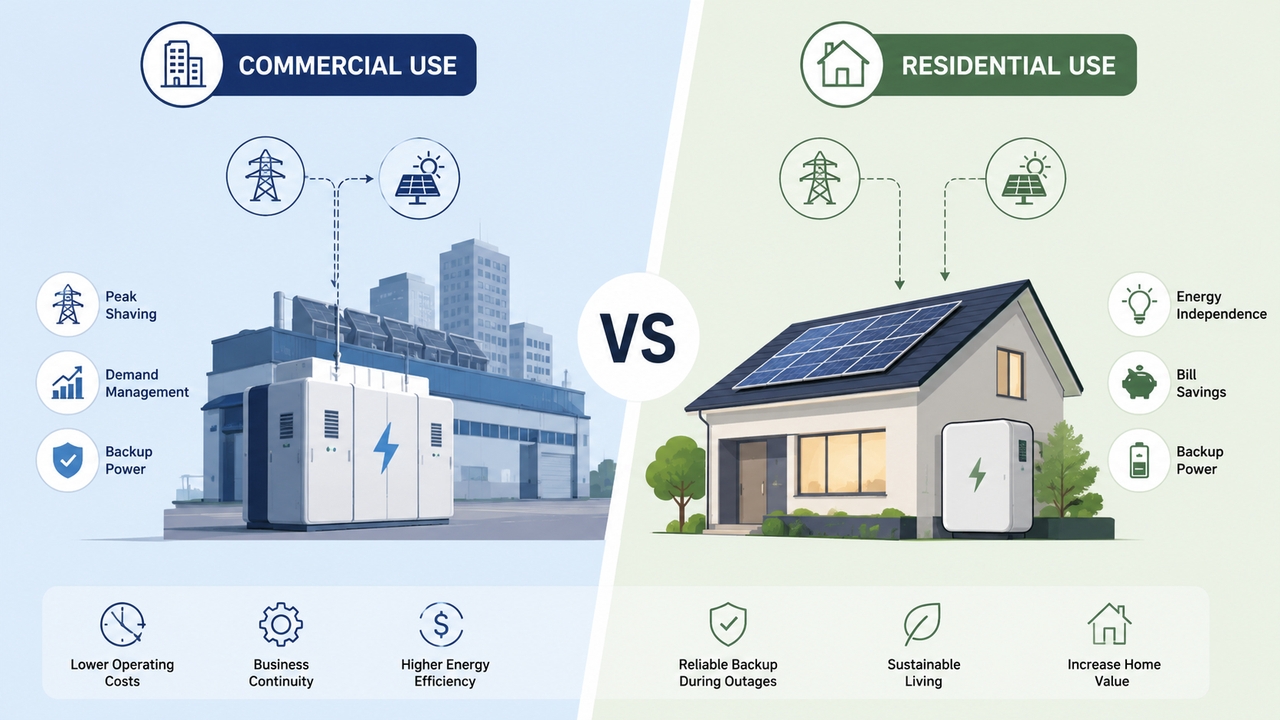
The physical and operational requirements of energy storage determine where different chemistries are deployed. While flow batteries excel in large industrial environments, solid-state systems remain the practical standard for residential applications.
Grid-Scale Operations
Vanadium redox flow batteries (VRFBs) are designed for industrial applications. They are ideal for utility grids pairing renewable energy with long-duration storage, commercial facilities managing peak demand, and remote microgrids. For instance, a large Australian wind farm might use a 20 MWh VRFB to smooth output overnight. In these settings, the massive physical footprint covering thousands of square feet with tanks and pumps is not a limitation. Land is available, maintenance teams are on-site, and the scale justifies the investment.
Spatial Footprint and Structural Constraints
However, the massive footprint required for a VRFB makes it impractical for suburban homes. Vanadium tanks require concrete foundations, large floor areas, and separation from living spaces. A system capable of backing up a standard home for one day would occupy more space than most garages. Residential storage must fit against a wall or in a utility room. Vanadium chemistry cannot compete with high-density solid-state systems when physical space is a primary constraint.
Operational Complexity and Mechanical Maintenance
Industrial facilities have maintenance teams. Utility grids have engineering staff and service contracts. A VRFB installation needs all of that. Pumps wear and require servicing. Membranes have operational lifespans. Electrolyte levels need monitoring. Plumbing connections need inspection.
A modern solid-state home battery requires none of this. No liquid plumbing, no external pumps, no scheduled mechanical maintenance. The system charges, discharges, and manages itself. For a homeowner, that operational simplicity is not a luxury; it is the baseline expectation.
Why LFP Is the Standard for Whole-Home Backup
Lithium Iron Phosphate (LFP) batteries have become the practical answer to residential energy storage precisely because they pack serious capability into a form factor that actually fits in a home. Compact, chemically stable, rated for 3,000 to 6,000 or more cycles under daily household use, and backed by mature installer networks, LFP systems match the real needs of residential properties in ways that industrial flow batteries simply cannot.
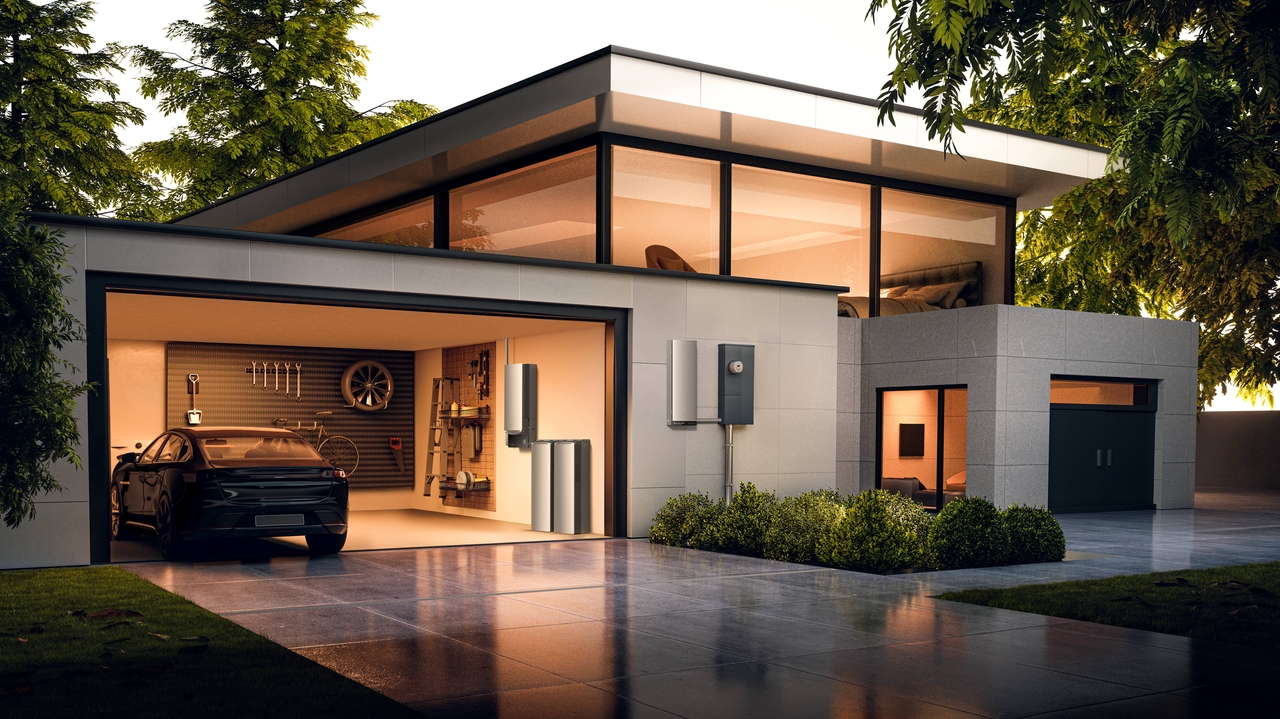
For instance, the EcoFlow OCEAN Pro Solar Battery System is a clear illustration of what purpose-built whole-home LFP backup looks like. Starting at 10kWh and scaling to 80kWh of storage, it handles the kind of loads that a typical home actually runs. Continuous output of 24kW with a 205A LRA means it can start two 5-ton HVAC units simultaneously, handle an electric water heater, and keep the rest of the home running without conflict. No vanadium tank array could do that in the physical space available on a residential property.
The built-in Intelligent Mode automatically shifts energy consumption to off-peak rate hours, reducing utility costs day-to-day rather than waiting purely for an outage to justify the investment. Paired with up to 40kW of solar input across 8 MPPT channels, the system functions as a complete home energy hub, not just an emergency backup.
Get Your Free Home Energy Consultation!
Which energy solution are you interested in?
The Future of Deep Energy Storage Technologies
The future of deep energy storage is moving beyond simply building larger tanks; it is focused on fundamentally optimizing internal chemistries and networking different storage technologies to build a more resilient grid.
Advancements in Electrolyte Efficiency
The biggest engineering push in VRFB development right now targets energy density. Research underway in 2026, including breakthroughs by the Pacific Northwest National Laboratory in mixed-acid electrolytes, is exploring modified acid concentrations and new electrolyte formulations that could meaningfully shrink tank sizes while maintaining capacity. If those improvements reach commercial production, vanadium systems become more competitive in space-constrained settings and more affordable at smaller project scales. Some research and industry projections suggest long-term cost reductions for flow batteries could approach the hundreds of dollars per kWh under favorable scaling conditions, but exact targets vary widely and remain uncertain.
Hybrid Grid Deployments
One of the more interesting trends in grid-scale storage is the pairing of different battery technologies to cover different timescales. Lithium-ion systems respond quickly, dispatching power within milliseconds to handle sudden demand spikes or frequency regulation events. Vanadium flow batteries hold charge for extended periods without degradation, covering multi-hour and multi-day storage needs economically.
Utility operators are increasingly deploying these technologies side by side rather than choosing between them. Fast-responding lithium handles the short bursts; the VRFB covers the long tail. The combination produces a more resilient and flexible grid than either technology could deliver alone, and it reflects a broader recognition that different storage chemistries are complementary rather than competitive at the grid level.
Conclusion
Vanadium redox flow batteries are impressive for grid and commercial storage due to their independent scalability and 20,000-cycle lifespan. However, they are not so well-suited for residential use. Their low energy density, requirement for concrete foundations, and ongoing mechanical maintenance keep them strictly in the industrial sector.
For homeowners facing rising utility rates and the real possibility of extended outages, compact LFP systems deliver what matters most: serious output capability, meaningful capacity, and operational simplicity that requires nothing beyond the initial installation. Those two categories of technology serve different purposes, and understanding that distinction makes it straightforward to identify the right fit for any given application.
FAQs
How long do vanadium flow batteries last?
Vanadium redox flow batteries are widely reported to achieve tens of thousands of cycles, often exceeding 10,000–20,000 cycles depending on system design and operating conditions, with very low degradation compared to lithium-ion batteries. The vanadium electrolyte is highly stable and can be rebalanced, but system components such as membranes, pumps, and electrodes still experience wear over time.
How much does a vanadium flow battery cost per kWh?
In 2025 and 2026, installed costs for commercial and utility-scale VRFB systems typically fall between $350 and $600 per kWh, with smaller projects sitting toward the higher end of that range. Costs have been declining steadily as manufacturing scales up.
Why are vanadium batteries not used in electric cars?
Low energy density is the core barrier. Vanadium systems require large liquid tanks to store meaningful energy, making them far too heavy and bulky for vehicle applications. Electric vehicles need compact, lightweight batteries, which is why lithium-ion and LFP dominate that market entirely.
Is vanadium better than lithium?
It depends entirely on the application. For long-duration grid and commercial storage requiring 20,000-plus cycles with no degradation, vanadium flow batteries hold real advantages. For residential use, compact installation, and daily home backup, LFP lithium systems are better suited in nearly every practical dimension.
What are vanadium redox batteries used for?
VRFBs are deployed primarily at utility and commercial scale: grid-connected renewable energy storage, industrial peak shaving, remote microgrids, and wind and solar farm integration. Applications where physical space is available, operational teams are on-site, and storage durations of 4 to 12 hours or more are needed are where vanadium systems consistently perform at their best.

