
Understanding PPW Meaning: Your Guide to Solar Costs & Calculations
Navigating solar quotes can often feel like learning a brand-new language. When you are reviewing proposals from different installation companies, the total project costs will vary wildly based on the size of the system, the brands of equipment used, and the complexity of your roof. How do you cut through the noise to figure out which quote actually offers the best value?
The answer lies in a single, crucial industry-standard metric: PPW, or Price Per Watt. Understanding PPW is the key to unlocking transparent comparison in the solar marketplace. This guide will break down exactly what PPW means, how to calculate it, what a "good" rate looks like, and how modern whole-home battery energy systems redefine the value of every watt you purchase.
What does PPW mean in the solar industry?
In the solar industry, PPW stands for Price Per Watt. It represents the capital cost of your solar energy system for every single watt of power capacity it is rated to produce under ideal laboratory conditions.
Think of PPW as the solar industry's equivalent of "price per square foot" in real estate. If you are comparing a 3,000 sq ft home to a 2,000 sq ft home, looking strictly at the total purchase price does not tell you which home is priced more competitively; you need to evaluate the price per square foot to level the playing field. Similarly, PPW allows you to compare a 6 kW system quote from Installer A with an 8.5 kW system quote from Installer B objectively.
The focus on "Gross PPW"
When industry professionals analyze solar economics, they focus strictly on the Gross PPW. Gross PPW is calculated using the total system contract cost before applying any local state rebates, utility incentives, or regional solar renewable energy certificates (SRECs).

How to calculate Price Per Watt (with examples)?
Calculating your "Gross PPW" is incredibly straightforward. It requires only two numbers from your solar proposal:
The Total Gross System Cost ($): The total cash price of solar panels, inverter, racking, labor, and engineering (excluding optional add-ons like standalone batteries or extensive main electrical panel upgrades).
The Total System Wattage (W): The combined power output of your panels.
Note that installers usually write system sizes in kilowatts (kW). To convert kilowatts to watts, simply multiply by 1,000. [System Wattage (W) = System Size (kW) x 1,000]
The formula: PPW = Total Gross System Cost ($) / Total System Wattage (W)
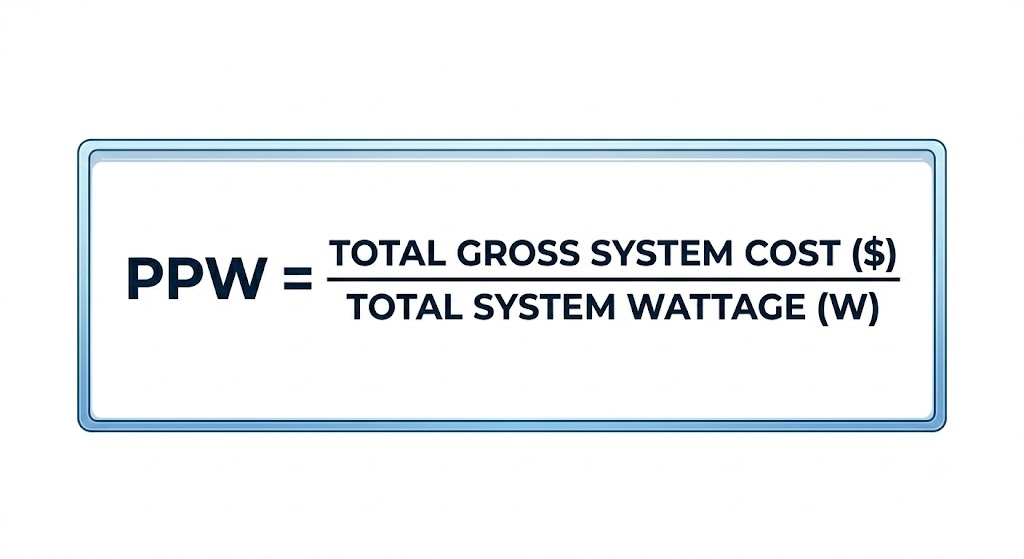
Step-by-step example:
Let's say you received a quote from a local installer for a solar panel system:
Quoted System Size: 8.5 kW
Gross System Cost: $23,800
Step 1: Convert kW to Watts
8.5 kW x 1,000 = 8,500 Watts
Step 2: Apply the Formula
PPW = $23,800 / 8,500 W = $2.80 per Watt
In this scenario, your "Gross PPW" is $2.80. You can now use this rate to compare this quote directly against any other bids you receive, regardless of their size.
What is considered a "good" PPW?
Solar pricing fluctuates based on your geographic location, local labor markets, permitting fees, and current supply chain dynamics. However, based on data from trusted industry trackers like the National Renewable Energy Laboratory (NREL), the national average for a residential solar system falls between $2.50 and $3.50 per watt before incentives, with the median sitting around $2.75–$3.10 per watt based on 2026 market data.
As a general rule of thumb:
Excellent value: $2.50 to $2.80 PPW
Average market range: $2.80 to $3.30 PPW
Premium/high complexity: $3.40 PPW and above
The "Race to the Bottom" warning
While finding a low PPW is financially appealing, the absolute cheapest option is not always the best long-term investment. If an installer offers a PPW significantly below the market average (e.g., $2.20 PPW or less on a standard residential roof), they may be cutting corners by:
Using low-efficiency, tier-2 solar panels.
Utilizing cheap, string inverters with high failure rates instead of robust microinverters or high-grade hybrid power systems.
Providing subpar labor warranties or lacking the customer service infrastructure to support you if a component fails down the road.
Subcontracting installation crews who may lack proper certifications.
Your goal should be to find a highly competitive PPW paired with high-quality, reliable equipment and an established installer.

Key factors that affect your solar PPW
Two seemingly identical homes in the same neighborhood can receive different PPW quotes. This is because several distinct variables dictate installation and hardware costs:
System size (economies of scale)
Larger solar arrays require the same basic overhead costs (permitting, truck rolls, and engineering plans) as smaller arrays. Because these fixed costs are spread over more watts, larger systems almost always feature a lower PPW than smaller systems.
Equipment quality
Opting for premium, high-efficiency panels (which perform better in low light and degrade slower over time) and advanced smart hybrid inverters will naturally command a higher PPW than standard, entry-level hardware.
Roof type and complexity
A simple, single-plane south-facing roof is fast and easy to install. A steep, multi-tiered roof with clay tiles, multiple valleys, or dormers requires specialized mounting hardware, extra safety equipment, and significantly more labor, driving up the PPW.
Local Labor and Permitting
Local municipal permit fees, grid interconnection requirements, and regional labor rates vary widely by city and state, influencing the base cost of your installation.
Add-ons and upgrades
Special hardware upgrades, main panel upgrades (MPU), EV chargers, and most importantly, home battery backup systems will affect your total out-of-pocket costs.
Beyond PPW: how energy storage changes the value equation
Historically, homeowners evaluated solar purely through the lens of power generation: "How cheaply can I generate a watt of power?" However, in today's energy landscape, a low PPW is no longer enough.
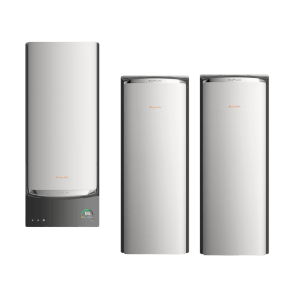
Generating cheap solar power during the middle of the day is highly inefficient if your local utility charges exorbitant peak rates in the evening, or if they do not offer favorable net metering policies. To maximize the value of the watts you paid for, you must be able to capture, store, and intelligently deploy that energy. This is where advanced home energy systems like the EcoFlow Ocean Pro change the equation.

Maximizing your PPW investment with the EcoFlow Ocean Pro
Capture every single watt: The Ocean Pro features an industry-leading maximum STC solar input of 40 kW with a wide MPPT voltage range (60-480V DC). This capability allows you to build a larger panel system to maximize the economies of scale.
Minimize system losses: Buying cheap panels does not help if your system wastes power during conversion. The Ocean Pro boasts a 97.5% efficiency rating for Solar to Home/Grid pathways, and an outstanding 89% efficiency for Solar to Battery to Home/Grid pathways.
Uncompromising power output: The Ocean Pro offers a formidable nominal AC output power of either 11.5 kW or 24.0 kW, with a massive 205A Locked Rotor Amps (LRA) load start capability.
By pairing a competitive panel PPW with the Ocean Pro, you transition from simply generating power to achieving complete, high-efficiency energy independence.
Get Your Free Home Energy Consultation!
Which energy solution are you interested in?
Why you should always use PPW to compare quotes
Using PPW as your primary shopping metric protects you from common sales tactics and ensures a fair, transparent evaluation of your proposals.
It creates an "Apples-to-Apples" comparison
If Installer A quotes you $25,000 for a 7.2 kW system ($3.47 PPW) and Installer B quotes you $27,000 for an 8.8 kW system ($3.06 PPW), Installer B's quote actually offers much better value per unit of power generation, even though the total sticker price is higher.
It identifies hidden fees
When you request the cash-only, battery-excluded Gross PPW, you force the installer to strip away financing dealer fees, interest markups, and secondary equipment costs. This reveals the true base cost of their workmanship and hardware.
Signing off
Understanding PPW's meaning in gross terms is the single best way to protect yourself when shopping for solar.
However, as the era of simple grid-tied generation evolves, a low PPW is only half of the puzzle. To truly maximize your solar investment in a post-federal-tax-credit market, you must transition to a smart, resilient home energy ecosystem.
By pairing a competitive panel PPW with a highly efficient, high-capacity, and scalable storage solution like the EcoFlow Ocean Pro, you ensure that every single watt of clean, affordable power you generate is captured, stored, and utilized exactly when your home needs it most.
Frequently Asked Questions (FAQs)
Does PPW include the cost of a solar battery?
No. Installers calculate standard PPW based strictly on the solar panel system. Including home batteries, a significant separate hardware cost, artificially bloats the metric. Always ask for the cash-only PPW of the panels alone.
Does my quoted PPW include financing fees?
It shouldn't. Solar loans bundle upfront dealer fees that artificially inflate your total project cost and PPW. Always ask for the "Cash PPW" to ensure an accurate, baseline comparison between multiple installers.
Why did my quoted PPW go down when I asked for a larger system?
This happens due to economies of scale. Fixed overhead costs like permitting, truck rolls, and engineering remain identical. With larger systems, these costs distribute across more total watts, lowering your individual price per watt.
What does PPW mean in "net" terms?
Since the Federal Tax Credit ended, net PPW refers strictly to the system cost remaining after applying state-level tax credits or local utility rebates, divided by total wattage. Always compare Gross PPW instead.
What is the 33% rule in solar panels?
The "33% rule" refers to a DC/AC ratio guideline in solar system design. It suggests sizing your DC solar panel array approximately 20%–33% larger than your inverter's rated AC output capacity (a DC/AC ratio of 1.2–1.33). Because panels rarely operate at peak output under real-world conditions, this modest oversizing ensures the inverter runs closer to its optimal range for more hours each day, improving total energy harvest.

