Navigating Solar Inverter Repairs in Australia: 2026 Expert Advice
A working solar system in 2026 is not a luxury. Grid electricity rates sit above 30 cents per kWh across most of Australia. Panels on the roof are saving households real money every single day. So when the inverter screen goes blank, flashes red, or throws up an error code, the financial impact is immediate. Every hour offline means buying power from the grid instead of generating it for free.
The good news is that not every fault means a full replacement. Some problems are straightforward. Others are a signal to upgrade rather than patch. This guide walks through the most common faults behind solar inverter repairs. It covers when fixing makes sense, and when a modern upgrade is the smarter move. It also covers what Australian regulations say about who is allowed to open that box in the first place.
Can a solar inverter be repaired or should it be replaced?
This is the first question every homeowner asks. The honest answer depends on the type of fault, the age of the unit, and what a repair would cost relative to a new system.
String inverters are the most common type in Australian homes. They typically last 10 to 15 years. An inverter on a ten-year-old system is likely near the end of its functional life regardless of the specific fault.
A useful rule of thumb: if repair cost exceeds 40% of a comparable new unit's price, replacement is almost always the better investment.
When a repair makes sense
Some faults are minor and worth fixing, particularly on units under five years old and still within their warranty period.
Tripped breakers or blown isolators are a common call-out. AC and DC isolator switches are a known weak point in Australian systems, especially older units installed before tighter standards came in. A faulty isolator is a fire risk and should be replaced promptly. But the replacement itself is a straightforward job for a licensed electrician and is usually covered under warranty on newer systems.
Software or firmware faults can cause an inverter to shut down or report errors without any physical damage. A manufacturer-issued firmware update sometimes resolves the issue entirely without touching a single component.
Loose external wiring caused by wind, pest damage, or settlement can trigger safety shutdowns. Where the fault is in external connections rather than internal components, a solar technician can often resolve it in a single visit.
When replacement is the smarter choice
Some situations make repair the wrong financial call, even when the fault seems fixable.
Motherboard or internal hardware failure in an older unit is rarely worth repairing. Replacement parts for discontinued models are expensive and hard to source. Labour costs to install them often rival the cost of a new, more efficient inverter.
Out-of-warranty units over eight years old sit in difficult territory. Repair costs typically range from $400 to $700 for minor issues and considerably more for internal component work. A new string inverter starts from around $1,500. When the gap narrows, upgrading makes more sense.
Repeated failures in a short timeframe signal a unit nearing the end of its life. Fixing the same inverter twice in 18 months rarely pays off.
Common reasons you need a repair solar inverter service
Australian conditions are harder on inverters than most homeowners realise. Heat, humidity, storms, and an increasingly unstable grid all accelerate wear.
Grid faults and voltage spikes
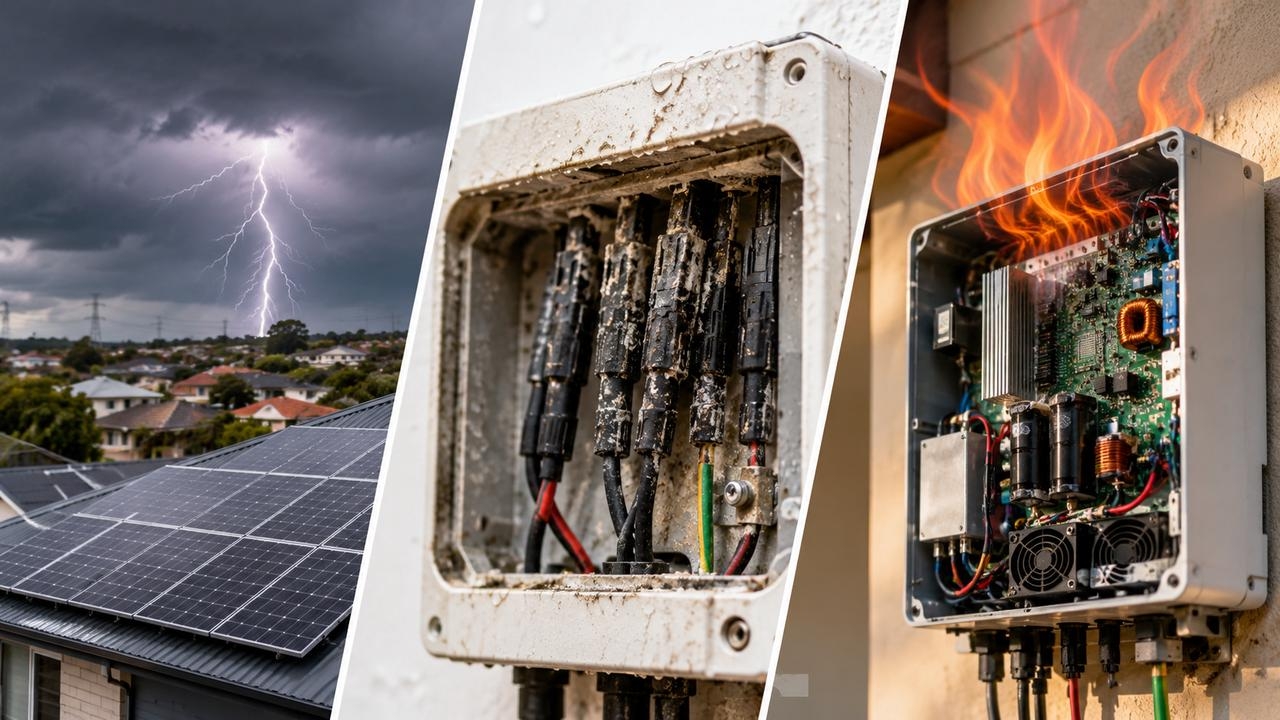
Australia's grid is under growing pressure. As solar penetration rises across suburban networks, local voltage fluctuations are becoming more common. This is most noticeable where many households feed back into the same grid section. Lightning strikes during summer storm season cause sudden voltage spikes that can damage internal surge protectors or trip the inverter's safety disconnect.
Perth has one of the highest rooftop solar penetration rates in the world. Grid voltage issues are a frequent trigger for solar inverter repairs across the metro area. The same pattern shows up in south-east Queensland during storm season.
Isolation faults and moisture ingress
Australia's coastal regions combine high humidity with heavy seasonal rain. Over time, moisture works its way into wiring insulation and connection points. When the insulation degrades, the inverter's built-in isolation monitoring detects a fault and shuts the system down as a safety measure.
This type of fault is common in units installed more than seven years ago, particularly in Queensland, New South Wales coastal areas, and Darwin. The inverter itself may be fine. The fault often sits in degraded DC wiring between the panels and the inverter.
Overheating and thermal degradation
Australian summers are the most aggressive climate threat to inverter longevity. The Arrhenius Principle in physics states that for every 10°C rise in temperature, the lifespan of electronic components is roughly halved. Inside an inverter, electrolytic capacitors contain a liquid that evaporates when exposed to sustained heat. Once enough liquid is gone, the capacitor fails and the inverter stops working.
Units on north-facing walls or in poorly ventilated garages are particularly vulnerable. This applies across hot cities like Adelaide, Broken Hill, and Perth. Relocating the inverter to a shaded, south-facing wall at the time of repair is often recommended by technicians to prevent the same problem recurring.
Why high-voltage systems are never a DIY project
This section is not a suggestion. It is a legal and safety reality.
Solar panels generate high DC voltage even when the grid is switched off and the system appears to be shut down. An inverter sitting behind a tripped breaker can still carry dangerous levels of DC electricity from the panels above. Opening the unit without the correct training, equipment, and licensing puts lives at serious risk.
Under Australian law, as confirmed by energy.gov.au, all solar system work must be carried out by a licensed electrician. Any repair must meet Australian Standards including AS/NZS 4777. Solar Accreditation Australia (SAA) manages the accreditation scheme for solar installers and technicians nationally.
There are four reasons to never attempt DIY solar inverter repairs.
Electrocution hazard. DC voltage from a solar array does not behave like household AC power. It cannot be easily interrupted and does not drop at the zero crossing point. A DC arc is far more dangerous and harder to break than an equivalent AC fault.
Voided warranty. Unauthorised access to an inverter immediately voids the manufacturer warranty. A unit covered by a 10-year warranty becomes an out-of-pocket expense the moment an unlicensed person opens it.
Fire risk. Improperly reconnected wiring, undertightened terminals, or incorrectly rated components can cause arcing inside the inverter casing. Inverter fires have caused significant property damage in Australian homes.
Insurance implications. Household insurers may reject fire or damage claims where unlicensed electrical work is found to have contributed to the incident. The financial exposure goes well beyond the cost of a new inverter.
Solar inverter repairs Perth to Sydney: What are the costs?
Repair costs vary across Australian states and depend heavily on the type of fault, the age of the unit, and the travel involved.
Call-out and diagnostic fees
A licensed electrician or solar technician charges a call-out fee simply to attend the property and run diagnostics. In metropolitan areas such as Sydney, Melbourne, and Brisbane, call-out fees typically range from $150 to $300. The time of day and the company both affect the final figure. This fee applies before any parts or repair work is included.
Component replacement costs
Minor component replacements such as DC isolator switches or cooling fans typically cost between $350 and $600 including labour. Internal component repairs such as capacitor replacement or communication board work run from $400 to $700. Major internal failures on units older than eight years often push costs above $800 to $1,000, at which point most technicians recommend replacement over repair.
Labour rates across Australian states
Labour rates reflect the cost of operating in each market. Perth and Darwin tend to run higher than the eastern states due to market structure and the cost of operating in those regions. Remote and regional areas add travel costs on top of standard rates. A technician travelling two hours to a rural NSW property will charge significantly more than the same job in suburban Sydney or Melbourne.
Unsure whether to pay for a costly repair or invest in a new system? Contact our professional energy consultants to weigh the options and get a recommendation based on the specific system, its age, and current energy costs.
Upgrading your setup: Smart monitoring and storage
A failed inverter is a prompt to ask a bigger question. Is the current system still the right one? A home that installed 6 kW of solar five years ago without battery storage is leaving money on the table every evening. The upgrade decision is often more financially sound than many homeowners expect.
The shift to hybrid inverter technology
A standard string inverter does one job: convert solar DC power to AC for the home. A hybrid inverter does that and more. It manages the solar panels, the home's energy storage, and the grid connection all from one unit. That simplifies future battery retrofits and cuts extra installation costs because no separate battery inverter is needed.
Replacing a dead or aging string inverter with a hybrid model is increasingly common in 2026. The cost premium over a basic replacement is often modest, and the long-term flexibility it unlocks is significant.
Transitioning to integrated home battery storage
Many households use an inverter replacement as the trigger to add battery storage at the same time. Many Australian households take inverter replacement as an ideal chance to add home energy storage at the same time. Hybrid setups combine solar conversion and battery capacity in one unified system, scaling capacity to match varying evening power demands without extra separate inverters. Modular systems such as the EcoFlow PowerOcean Single-Phase Battery integrate a high-performance inverter with scalable, reliable storage. Usable capacity starts from 5 kWh and expands up to 15 kWh per unit. That means the system can be sized to actual nighttime needs rather than over-specifying from the start.

Learn more about EcoFlow PowerOcean
Future-proofing against Australian grid outages
Upgrading to a modern inverter-battery setup does more than replace broken parts. It changes what the home can do when the grid fails.
Australian heatwaves are becoming more frequent and more intense. Summer storms across Queensland, northern NSW, and WA regularly knock out grid supply for hours at a time. A modern inverter with seamless backup switching keeps the fridge cold, Wi-Fi running, and medical equipment powered through those events. No manual switching is needed. The grid coming back online happens automatically.
Taking control of a home energy monitor
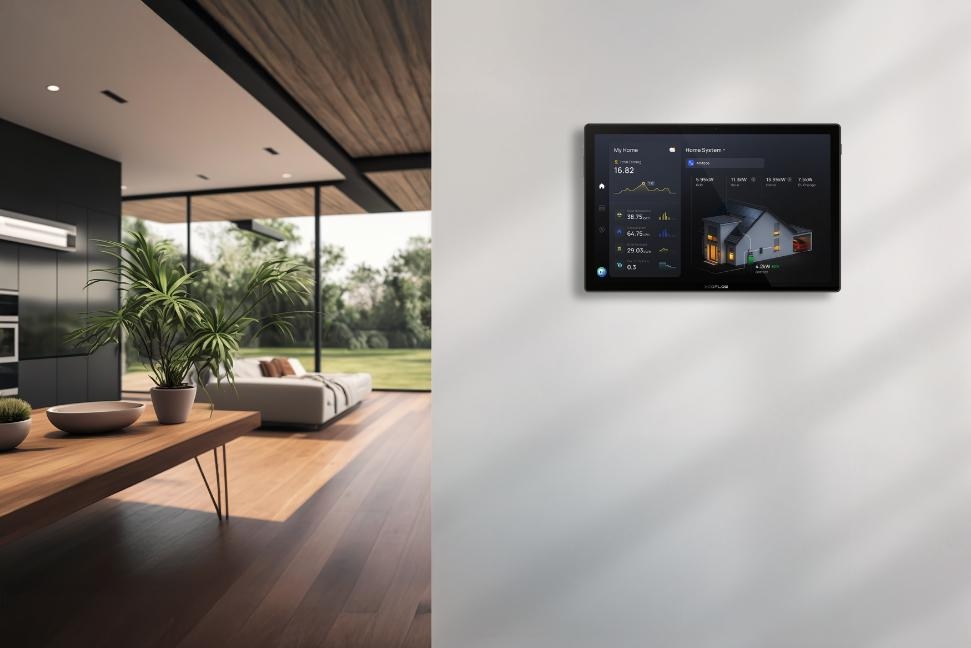
Early detection of inverter faults before they become full failures saves significantly on repair costs. Pairing a solar system with a home energy monitor gives real-time visibility into generation, consumption, and performance trends. Systems such as the EcoFlow PowerInsight 2 Monitor act as a Home Energy Management System. They track solar generation, identify drops in output, and flag performance issues before they escalate. Catching a degrading capacitor or a cooling fault early is far cheaper than a full repair call-out after the unit shuts down.
Conclusion
Minor solar inverter repairs are possible and sometimes the right call, particularly on newer units with simple faults still covered by warranty. But for aging units, repeated failures, or major internal faults, the numbers increasingly favour a full upgrade over patching ageing hardware.
One thing does not change regardless of the fault. All work on high-voltage solar systems in Australia must be carried out by a licensed electrician. The risks of DIY are too serious, and the legal and warranty consequences too significant, to treat this as optional.
Upgrading to a modern home battery storage setup means better warranties and built-in monitoring. It handles tomorrow's energy demands as well as today's. It also means the next grid outage becomes an inconvenience for the neighbours rather than a problem for the household.
FAQs
How long do solar inverters usually last in Australia?
String inverters typically last 10 to 15 years in Australian conditions. Heat exposure shortens that lifespan, particularly for units installed in direct sun without proper ventilation. Microinverters generally last longer, often 20 to 25 years, matching panel warranties.
Is it worth repairing an out-of-warranty solar inverter?
It depends on the age and fault type. If repair costs exceed 40% of a new unit's price, replacement usually makes more financial sense. For units over eight years old with internal component failures, a new hybrid inverter is often the better long-term investment.
Why is my solar inverter showing a red light?
A red light typically signals a fault condition. Common causes include grid voltage issues, isolation faults, overheating, or a communication error. The inverter screen or monitoring app usually shows a specific error code. A licensed solar technician can diagnose the cause safely.
Will my solar panels work if the inverter is broken?
No. The inverter converts DC power from the panels into usable AC power for the home. Without a functioning inverter, the panels generate power but the home cannot use it. Generation stops entirely until the inverter is repaired or replaced.
Who do I call to fix my solar inverter?
Contact a licensed electrician with solar accreditation, or the original installer if they are still in business. Solar Accreditation Australia (SAA) manages the national accreditation scheme. The inverter manufacturer's Australian support line is also a good first call for units still under warranty.